 Add to Chrome
 Add to Firefox
 Add to Edge
Multi-label Classification with Panoptic Context Aggregation Networks
Dec 29, 2025
Context modeling is crucial for visual recognition, enabling highly discriminative image representations by integrating both intrinsic and extrinsic relationships between objects and labels in images. A limitation in current approaches is their focus on basic geometric relationships or localized features, often neglecting cross-scale contextual interactions between objects. This paper introduces the Deep Panoptic Context Aggregation Network (PanCAN), a novel approach that hierarchically integrates multi-order geometric contexts through cross-scale feature aggregation in a high-dimensional Hilbert space. Specifically, PanCAN learns multi-order neighborhood relationships at each scale by combining random walks with an attention mechanism. Modules from different scales are cascaded, where salient anchors at a finer scale are selected and their neighborhood features are dynamically fused via attention. This enables effective cross-scale modeling that significantly enhances complex scene understanding by combining multi-order and cross-scale context-aware features. Extensive multi-label classification experiments on NUS-WIDE, PASCAL VOC2007, and MS-COCO benchmarks demonstrate that PanCAN consistently achieves competitive results, outperforming state-of-the-art techniques in both quantitative and qualitative evaluations, thereby substantially improving multi-label classification performance.

Analyzing Head Orientation of Neurotypical and Autistic Individuals in Triadic Conversations
Nov 01, 2023

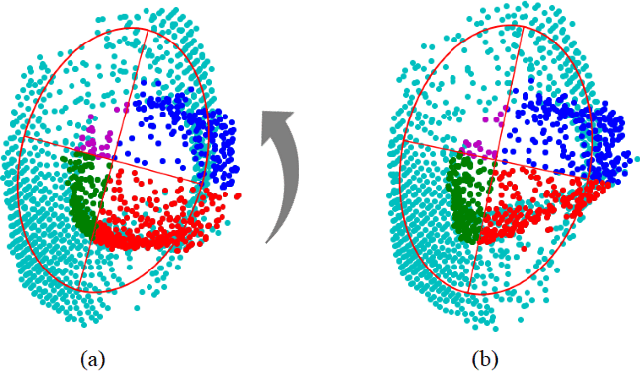
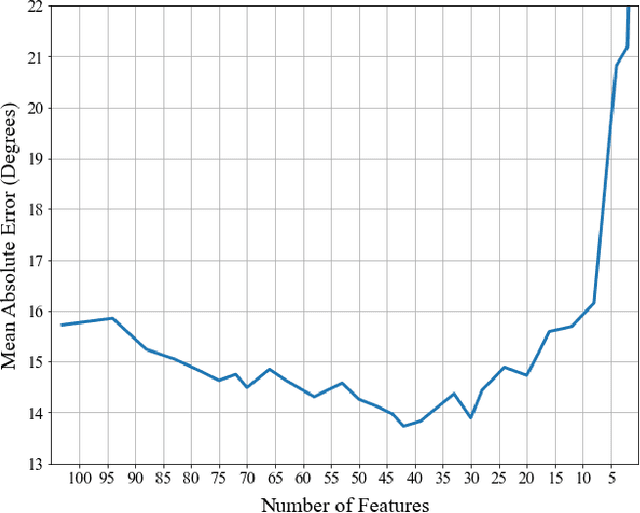
We propose a system that estimates people's body and head orientations using low-resolution point cloud data from two LiDAR sensors. Our models make accurate estimations in real-world conversation settings where the subject moves naturally with varying head and body poses. The body orientation estimation model uses ellipse fitting while the head orientation estimation model is a pipeline of geometric feature extraction and an ensemble of neural network regressors. Compared with other body and head orientation estimation systems using RGB cameras, our proposed system uses LiDAR sensors to preserve user privacy, while achieving comparable accuracy. Unlike other body/head orientation estimation systems, our sensors do not require a specified placement in front of the subject. Our models achieve a mean absolute estimation error of 5.2 degrees for body orientation and 13.7 degrees for head orientation. We use our models to quantify behavioral differences between neurotypical and autistic individuals in triadic conversations. Tests of significance show that people with autism spectrum disorder display significantly different behavior compared to neurotypical individuals in terms of distributing attention between participants in a conversation, suggesting that the approach could be a component of a behavioral analysis or coaching system.