 Add to Chrome
 Add to Firefox
 Add to Edge
Distribution-informed Efficient Conformal Prediction for Full Ranking
Jan 30, 2026
Quantifying uncertainty is critical for the safe deployment of ranking models in real-world applications. Recent work offers a rigorous solution using conformal prediction in a full ranking scenario, which aims to construct prediction sets for the absolute ranks of test items based on the relative ranks of calibration items. However, relying on upper bounds of non-conformity scores renders the method overly conservative, resulting in substantially large prediction sets. To address this, we propose Distribution-informed Conformal Ranking (DCR), which produces efficient prediction sets by deriving the exact distribution of non-conformity scores. In particular, we find that the absolute ranks of calibration items follow Negative Hypergeometric distributions, conditional on their relative ranks. DCR thus uses the rank distribution to derive non-conformity score distribution and determine conformal thresholds. We provide theoretical guarantees that DCR achieves improved efficiency over the baseline while ensuring valid coverage under mild assumptions. Extensive experiments demonstrate the superiority of DCR, reducing average prediction set size by up to 36%, while maintaining valid coverage.

Multi-Condition Conformal Selection
Oct 09, 2025
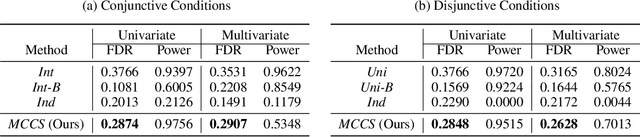

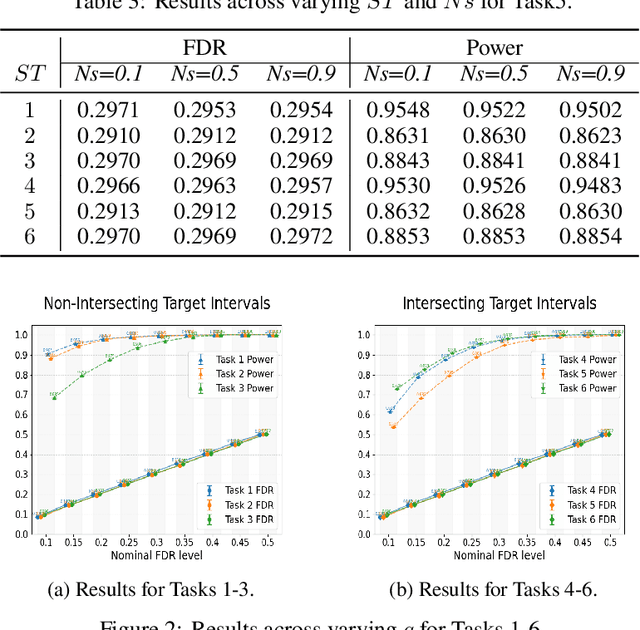
Selecting high-quality candidates from large-scale datasets is critically important in resource-constrained applications such as drug discovery, precision medicine, and the alignment of large language models. While conformal selection methods offer a rigorous solution with False Discovery Rate (FDR) control, their applicability is confined to single-threshold scenarios (i.e., y > c) and overlooks practical needs for multi-condition selection, such as conjunctive or disjunctive conditions. In this work, we propose the Multi-Condition Conformal Selection (MCCS) algorithm, which extends conformal selection to scenarios with multiple conditions. In particular, we introduce a novel nonconformity score with regional monotonicity for conjunctive conditions and a global Benjamini-Hochberg (BH) procedure for disjunctive conditions, thereby establishing finite-sample FDR control with theoretical guarantees. The integration of these components enables the proposed method to achieve rigorous FDR-controlled selection in various multi-condition environments. Extensive experiments validate the superiority of MCCS over baselines, its generalizability across diverse condition combinations, different real-world modalities, and multi-task scalability.