 Add to Chrome
 Add to Firefox
 Add to Edge
Credit the Right Box: Marginal Contribution Assignment for Structured Visual Perception
Aug 02, 2026
Multimodal Large Language Models (MLLMs) are increasingly expected to solve structured perception tasks that require visual recognition, language-to-object binding, object cardinality preservation, and precisely localized grounding and segmentation outputs. However, existing group-relative reinforcement learning methods provide only response-level supervision, creating a granularity mismatch for structured multi-object prediction: a single advantage is broadcast to all tokens in a response, without distinguishing individual box contributions. To address this mismatch, we propose MCR-GRPO, a marginal contribution assignment framework that derives box-level credit directly from each sampled response. Specifically, Marginal Contribution Reward (MCR) estimates each predicted box's contribution through a leave-one-out comparison, measuring how the matched set value changes when the box is removed from the response. After within-response normalization, records that improve the set value receive positive credit, while redundant or harmful ones are suppressed. To make marginal attribution stable and informative, we further introduce a Continuous Matched Set Value Evaluator that integrates permutation-invariant matching, count-aware normalization, and graded localization. MCR-GRPO maps normalized box-level marginal advantages to the token spans that generated each box, preserving GRPO's response-level comparison while enabling box-aware optimization of structured multi-object grounding. Experiments across REC, DOD, segmentation, and counting benchmarks show state-of-the-art performance over prior GRPO-based baselines.

TS4Net: Two-Stage Sample Selective Strategy for Rotating Object Detection
Aug 06, 2021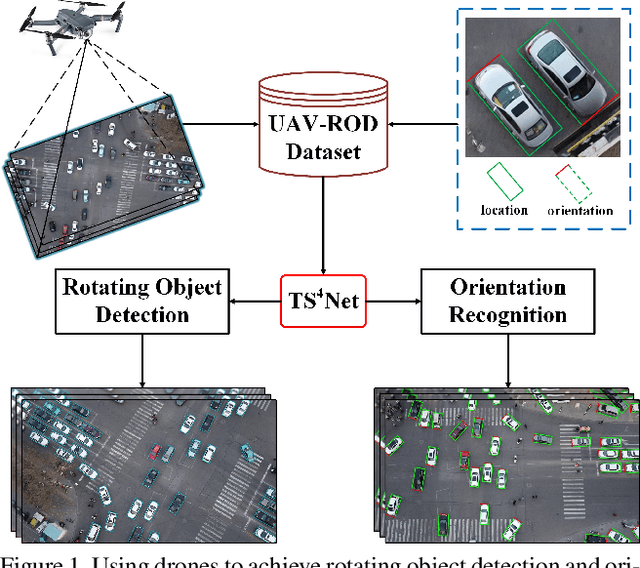
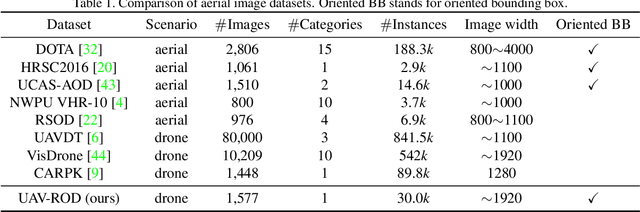
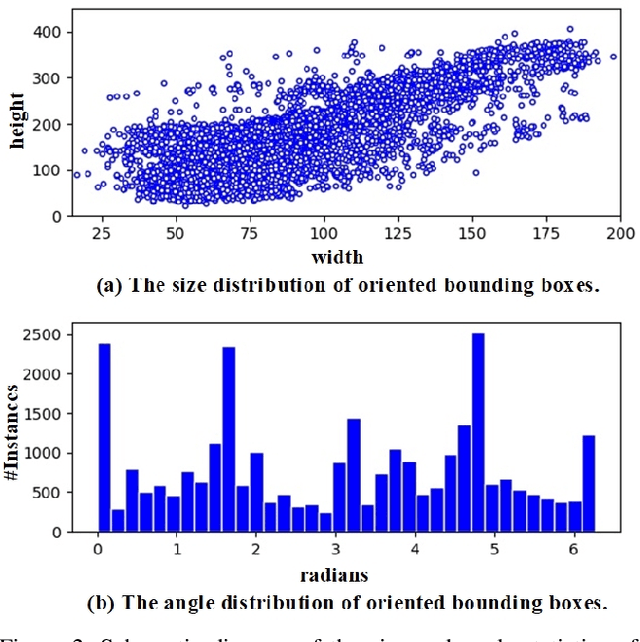
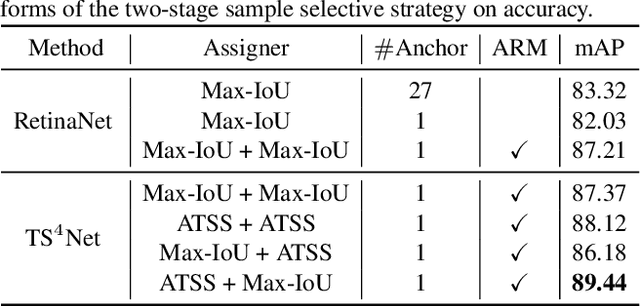
Rotating object detection has wide applications in aerial photographs, remote sensing images, UAVs, etc. At present, most of the rotating object detection datasets focus on the field of remote sensing, and these images are usually shot in high-altitude scenes. However, image datasets captured at low-altitude areas also should be concerned, such as drone-based datasets. So we present a low-altitude dronebased dataset, named UAV-ROD, aiming to promote the research and development in rotating object detection and UAV applications. The UAV-ROD consists of 1577 images and 30,090 instances of car category annotated by oriented bounding boxes. In particular, The UAV-ROD can be utilized for the rotating object detection, vehicle orientation recognition and object counting tasks. Compared with horizontal object detection, the regression stage of the rotation detection is a tricky problem. In this paper, we propose a rotating object detector TS4Net, which contains anchor refinement module (ARM) and two-stage sample selective strategy (TS4). The ARM can convert preseted horizontal anchors into high-quality rotated anchors through twostage anchor refinement. The TS4 module utilizes different constrained sample selective strategies to allocate positive and negative samples, which is adaptive to the regression task in different stages. Benefiting from the ARM and TS4, the TS4Net can achieve superior performance for rotating object detection solely with one preseted horizontal anchor. Extensive experimental results on UAV-ROD dataset and three remote sensing datasets DOTA, HRSC2016 and UCAS-AOD demonstrate that our method achieves competitive performance against most state-of-the-art methods.