 Add to Chrome
 Add to Firefox
 Add to Edge
BatteryMFormer: Multi-level Learning for Battery Degradation Trajectory Forecasting
May 26, 2026
Early battery degradation trajectory forecasting (BDTF), which predicts the full-life state-of-health trajectory from early operational data, is critical for battery optimization, manufacturing, and deployment. Battery degradation data exhibit two key characteristics. First, degradation data present a multi-level structure, including regularities shared within aging conditions and trajectory patterns shared across batteries. Second, degradation-related variations in voltage-current profiles are often localized to specific state-of-charge (SOC) intervals. Existing approaches often fail to explicitly model these characteristics. To bridge this gap, we propose BatteryMFormer, a multi-level Transformer for early BDTF. BatteryMFormer integrates (1) an aging-condition-aware decoder that injects aging-condition priors via aging-condition-informed queries and aging-condition-aware attention, (2) a meta degradation pattern memory that learns and retrieves trajectory prototypes to guide long-horizon forecasting, and (3) a dual-view encoder that jointly captures temporal dynamics and SOC-localized variations from voltage and current time series. Extensive experiments on four battery domains show that BatteryMFormer consistently outperforms state-of-the-art baselines, marking a significant step toward reliable BDTF. Our code is available at https://github.com/Ruifeng-Tan/BatteryMFormer.

Insertion Network for Image Sequence Correspondence
Feb 13, 2026We propose a novel method for establishing correspondence between two sequences of 2D images. One particular application of this technique is slice-level content navigation, where the goal is to localize specific 2D slices within a 3D volume or determine the anatomical coverage of a 3D scan based on its 2D slices. This serves as an important preprocessing step for various diagnostic tasks, as well as for automatic registration and segmentation pipelines. Our approach builds sequence correspondence by training a network to learn how to insert a slice from one sequence into the appropriate position in another. This is achieved by encoding contextual representations of each slice and modeling the insertion process using a slice-to-slice attention mechanism. We apply this method to localize manually labeled key slices in body CT scans and compare its performance to the current state-of-the-art alternative known as body part regression, which predicts anatomical position scores for individual slices. Unlike body part regression, which treats each slice independently, our method leverages contextual information from the entire sequence. Experimental results show that the insertion network reduces slice localization errors in supervised settings from 8.4 mm to 5.4 mm, demonstrating a substantial improvement in accuracy.
Pretrained Battery Transformer (PBT): A battery life prediction foundation model
Dec 23, 2025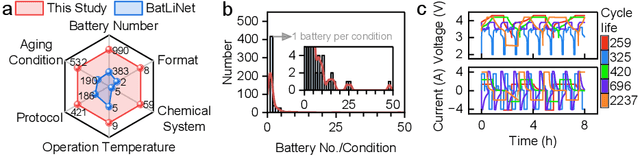
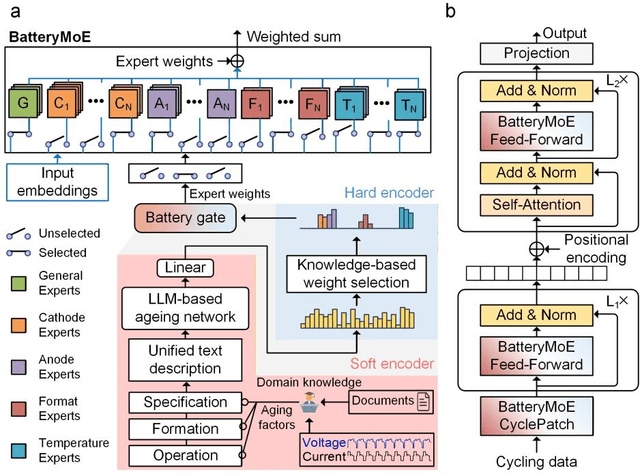
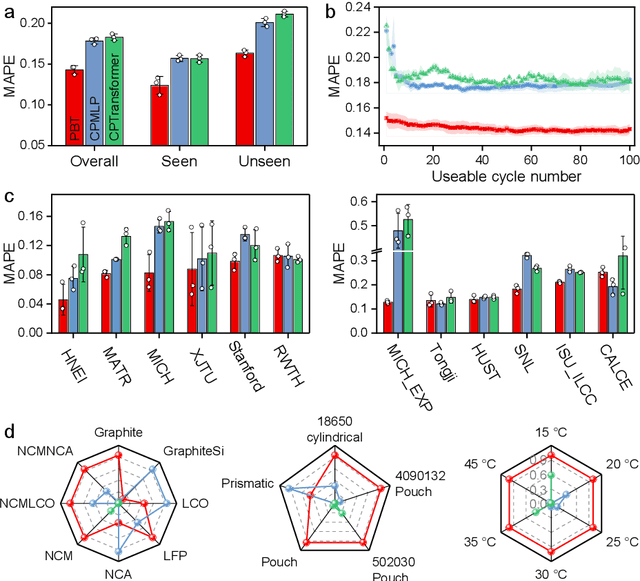
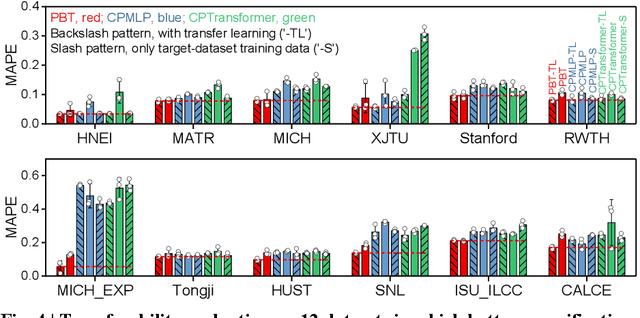
Early prediction of battery cycle life is essential for accelerating battery research, manufacturing, and deployment. Although machine learning methods have shown encouraging results, progress is hindered by data scarcity and heterogeneity arising from diverse aging conditions. In other fields, foundation models (FMs) trained on diverse datasets have achieved broad generalization through transfer learning, but no FMs have been reported for battery cycle life prediction yet. Here we present the Pretrained Battery Transformer (PBT), the first FM for battery life prediction, developed through domain-knowledge-encoded mixture-of-expert layers. Validated on the largest public battery life database, PBT learns transferable representations from 13 lithium-ion battery datasets, outperforming existing models by an average of 19.8%. With transfer learning, PBT achieves state-of-the-art performance across 15 diverse datasets encompassing various operating conditions, formation protocols, and chemistries. This work establishes a foundation model pathway for battery lifetime prediction, paving the way toward universal battery lifetime prediction systems.
BatteryLife: A Comprehensive Dataset and Benchmark for Battery Life Prediction
Feb 26, 2025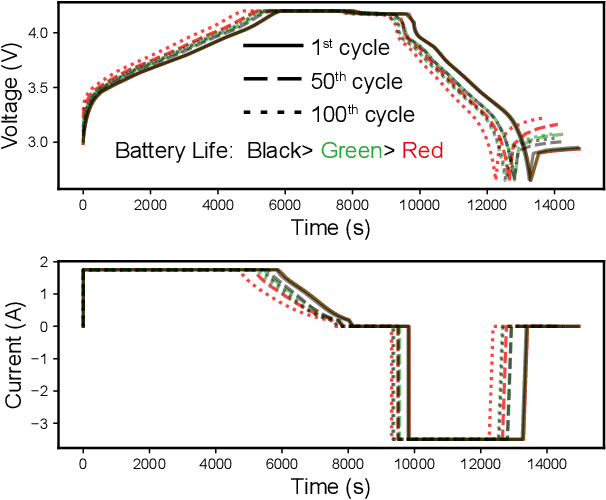
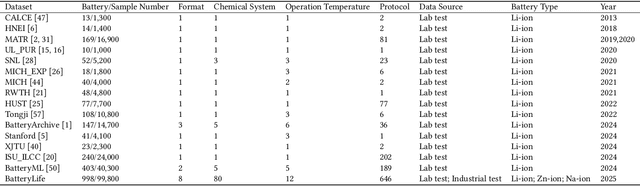
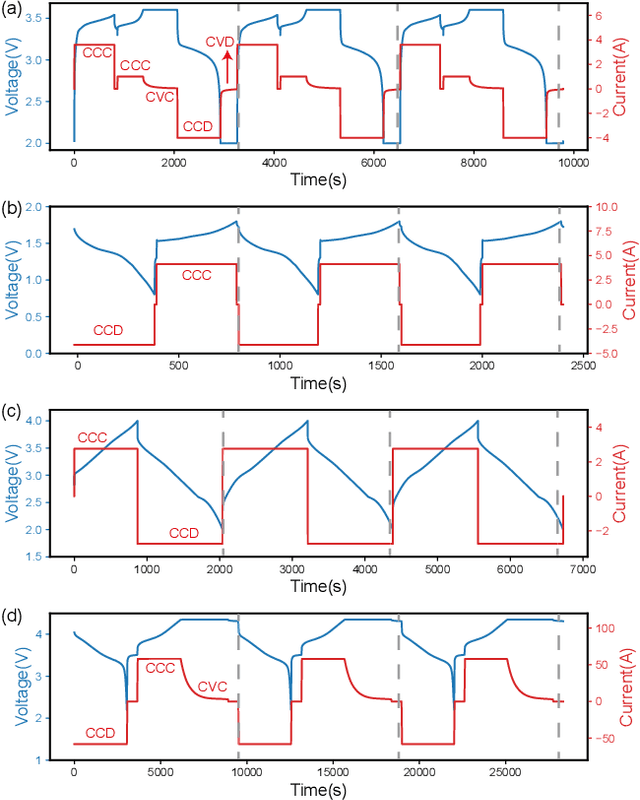
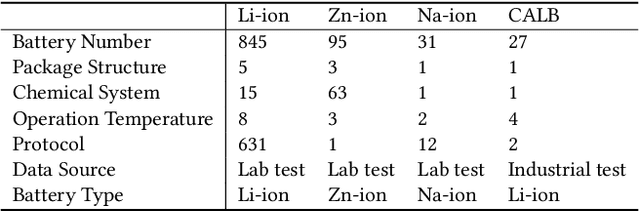
Battery Life Prediction (BLP), which relies on time series data produced by battery degradation tests, is crucial for battery utilization, optimization, and production. Despite impressive advancements, this research area faces three key challenges. Firstly, the limited size of existing datasets impedes insights into modern battery life data. Secondly, most datasets are restricted to small-capacity lithium-ion batteries tested under a narrow range of diversity in labs, raising concerns about the generalizability of findings. Thirdly, inconsistent and limited benchmarks across studies obscure the effectiveness of baselines and leave it unclear if models popular in other time series fields are effective for BLP. To address these challenges, we propose BatteryLife, a comprehensive dataset and benchmark for BLP. BatteryLife integrates 16 datasets, offering a 2.4 times sample size compared to the previous largest dataset, and provides the most diverse battery life resource with batteries from 8 formats, 80 chemical systems, 12 operating temperatures, and 646 charge/discharge protocols, including both laboratory and industrial tests. Notably, BatteryLife is the first to release battery life datasets of zinc-ion batteries, sodium-ion batteries, and industry-tested large-capacity lithium-ion batteries. With the comprehensive dataset, we revisit the effectiveness of baselines popular in this and other time series fields. Furthermore, we propose CyclePatch, a plug-in technique that can be employed in a series of neural networks. Extensive benchmarking of 18 methods reveals that models popular in other time series fields can be unsuitable for BLP, and CyclePatch consistently improves model performance establishing state-of-the-art benchmarks. Moreover, BatteryLife evaluates model performance across aging conditions and domains. BatteryLife is available at https://github.com/Ruifeng-Tan/BatteryLife.
Deep Reinforcement Learning with Label Embedding Reward for Supervised Image Hashing
Aug 10, 2020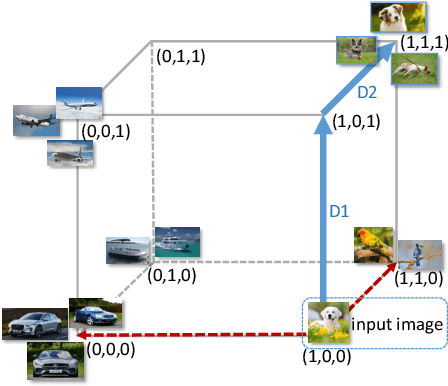
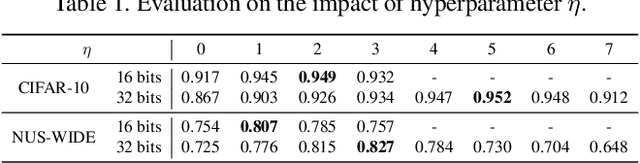
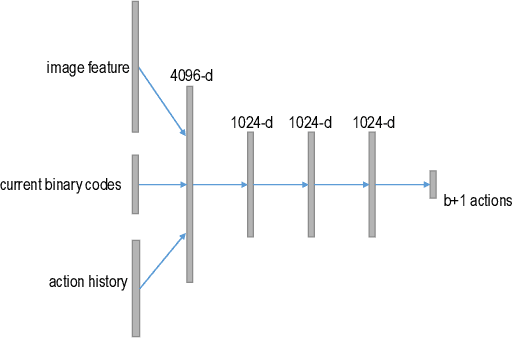
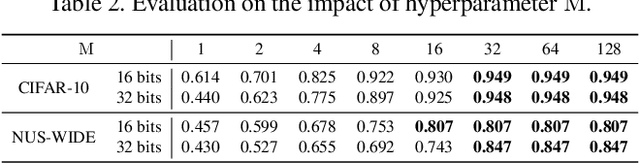
Deep hashing has shown promising results in image retrieval and recognition. Despite its success, most existing deep hashing approaches are rather similar: either multi-layer perceptron or CNN is applied to extract image feature, followed by different binarization activation functions such as sigmoid, tanh or autoencoder to generate binary code. In this work, we introduce a novel decision-making approach for deep supervised hashing. We formulate the hashing problem as travelling across the vertices in the binary code space, and learn a deep Q-network with a novel label embedding reward defined by Bose-Chaudhuri-Hocquenghem (BCH) codes to explore the best path. Extensive experiments and analysis on the CIFAR-10 and NUS-WIDE dataset show that our approach outperforms state-of-the-art supervised hashing methods under various code lengths.