 Add to Chrome
 Add to Firefox
 Add to Edge
Quasi-Constant Modulus Design for Nonlinearity-Tolerant Geometric Shaped Four Dimensional Modulation Format
Apr 20, 2026
In this paper, the quasi-constant modulus (QCM) property is analyzed and leveraged in the design of nonlinearity-tolerant four-dimensional (4D) modulation formats. Accordingly, we propose a family of QCM-based quadrature amplitude modulation (QCM-QAM) constellations with high spectral efficiencies (SEs) of 9, 11, and 13 bit/4D-sym, respectively. The quasi-constant modulus design theoretically enhances tolerance to fiber nonlinearities. Meanwhile, QCM-QAM is evaluated in an unrepeatered wavelength-division multiplexing (WDM) system over both standard single-mode fiber (SSMF) and non-zero dispersion-shifted fiber (NZDSF). Across all SEs, QCM-QAM demonstrates robust nonlinear tolerance in both SSMF and NZDSF. This is evidenced by a consistent shift of the optimal launch power toward higher values and a significant improvement in effective signal-to-noise ratio (SNR). QCM-QAM also delivers generalized mutual information (GMI) gains of 0.22, 0.09, and 0.21 bit/4D-sym in SSMF, and 0.24, 0.10, and 0.22 bit/4D-sym, in NZDSF at the optimal transmission power, corresponding to the SEs of 9, 11, and 13 bit/4D-sym. Furthermore, QCM-QAM achieves transmission reach extensions of 1.6%, 0.9%, and 1.7% in SSMF, and 1.7%, 1.5%, and 1.8% in NZDSF, respectively, for the three SE levels.

CBA: Communication-Bound-Aware Cross-Domain Resource Assignment for Pipeline-Parallel Distributed LLM Training in Dynamic Multi-DC Optical Networks
Dec 23, 2025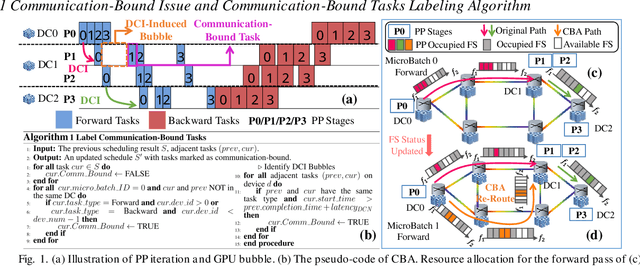
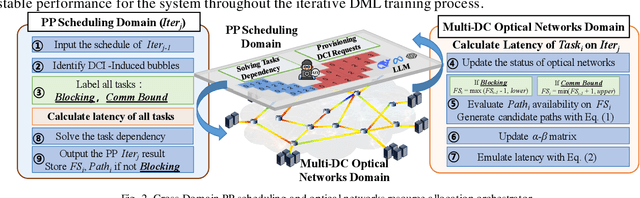
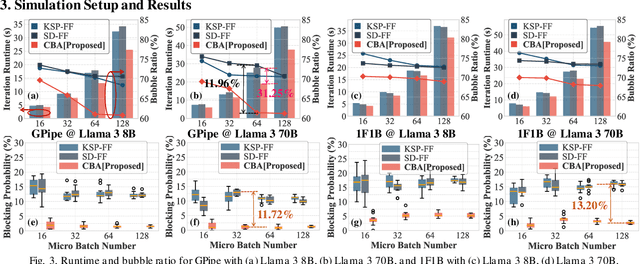
We propose a communication-bound-aware cross-domain resource assignment framework for pipeline-parallel distributed training over multi-datacenter optical networks, which lowers iteration time by 31.25% and reduces 13.20% blocking requests compared to baselines.
Deep Learning Waveform Modeling for Wideband Optical Fiber Channel Transmission: Challenges and Potential Solutions
Jan 14, 2025
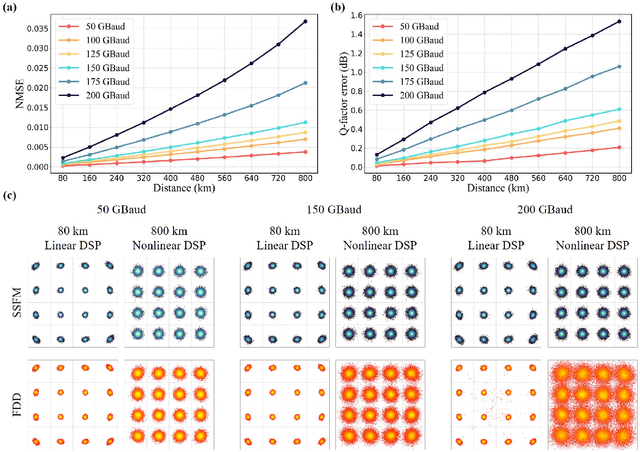
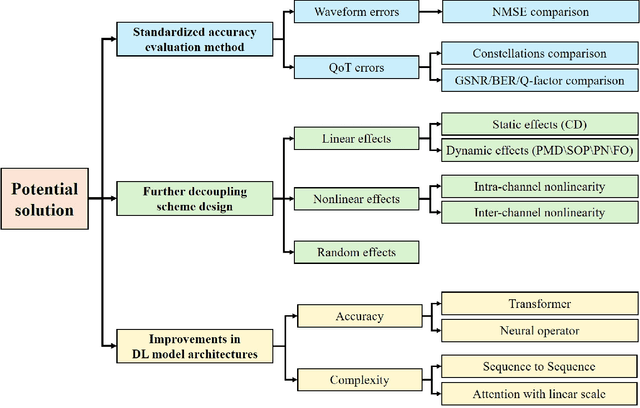
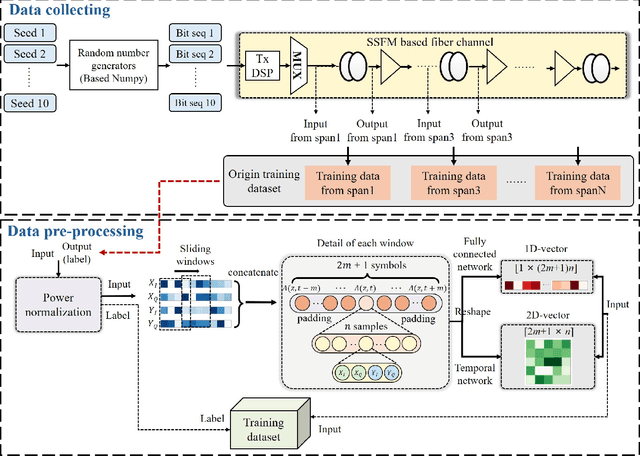
Fast and accurate optical fiber communication simulation system are crucial for optimizing optical networks, developing digital signal processing algorithms, and performing end-to-end (E2E) optimization. Deep learning (DL) has emerged as a valuable tool to reduce the complexity of traditional waveform simulation methods, such as split-step Fourier method (SSFM). DL-based schemes have achieved high accuracy and low complexity fiber channel waveform modeling as its strong nonlinear fitting ability and high efficiency in parallel computation. However, DL-based schemes are mainly utilized in single-channel and few-channel wavelength division multiplexing (WDM) systems. The applicability of DL-based schemes in wideband WDM systems remains uncertain due to the lack of comparison under consistent standards and scenarios. In this paper, we propose a DSP-assisted accuracy evaluation method to evaluate the performance for DL-based schemes, from the aspects of waveform and quality of transmission (QoT) errors. We compare the performance of five various DL-based schemes and valid the effectiveness of DSP-assisted method in WDM systems. Results suggest that feature decoupled distributed (FDD) achieves the better accuracy, especially in large-channel and high-rate scenarios. Furthermore, we find that the accuracy of FDD still exhibit significant degradation with the number of WDM channels and transmission rates exceeds 15 and 100 GBaud, indicating challenges for wideband applications. We further analyze the reasons of performance degradation from the perspective of increased linearity and nonlinearity and discuss potential solutions including further decoupling scheme designs and improvement in DL models. Despite DL-based schemes remain challenges in wideband WDM systems, they have strong potential for high-accuracy and low-complexity optical fiber channel waveform modeling.
Improve the Fitting Accuracy of Deep Learning for the Nonlinear Schrödinger Equation Using Linear Feature Decoupling Method
Nov 07, 2024We utilize the Feature Decoupling Distributed (FDD) method to enhance the capability of deep learning to fit the Nonlinear Schrodinger Equation (NLSE), significantly reducing the NLSE loss compared to non decoupling model.
Low Complexity Joint Chromatic Dispersion and Time/Frequency Offset Estimation Based on Fractional Fourier Transform
Nov 07, 2024
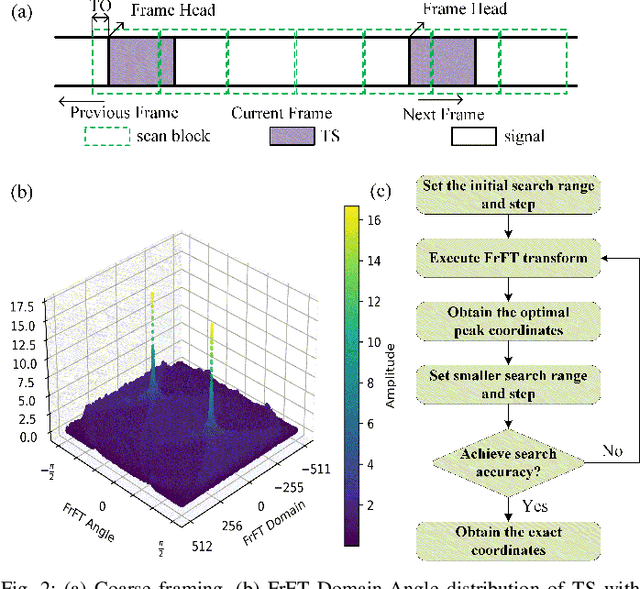


We propose and experimentally validate a joint estimation method for chromatic dispersion and time-frequency offset based on the fractional Fourier transform, which reduces computational complexity by more than 50% while keeping estimation accuracy.
Preamble Design for Joint Frame Synchronization, Frequency Offset Estimation, and Channel Estimation in Upstream Burst-mode Detection of Coherent PONs
Sep 22, 2024Coherent optics has demonstrated significant potential as a viable solution for achieving 100 Gb/s and higher speeds in single-wavelength passive optical networks (PON). However, upstream burst-mode coherent detection is a major challenge when adopting coherent optics in access networks. To accelerate digital signal processing (DSP) convergence with a minimal preamble length, we propose a novel burst-mode preamble design based on a constant amplitude zero auto-correlation sequence. This design facilitates comprehensive estimation of linear channel effects in the frequency domain, including polarization state rotation, differential group delay, chromatic dispersion, and polarization-dependent loss, providing overall system response information for channel equalization pre-convergence. Additionally, this preamble utilizes the same training unit to jointly achieve three key DSP functions: frame synchronization, frequency offset estimation, and channel estimation. This integration contributes to a significant reduction in the preamble length. The feasibility of the proposed preamble with a length of 272 symbols and corresponding DSP was experimentally verified in a 15 Gbaud coherent system using dual-polarization 16 quadrature amplitude modulation. The experimental results based on this scheme showed a superior performance of the convergence acceleration.
Building a digital twin of EDFA: a grey-box modeling approach
Jul 13, 2023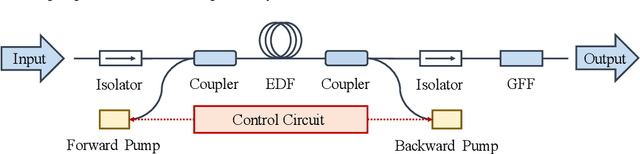
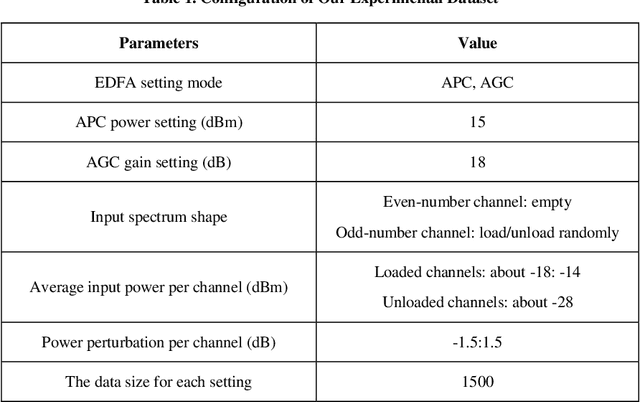
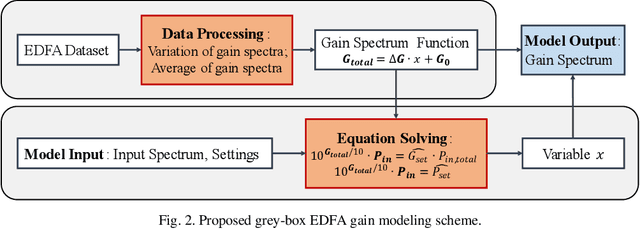
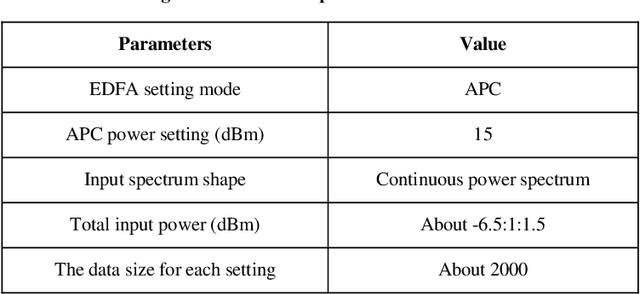
To enable intelligent and self-driving optical networks, high-accuracy physical layer models are required. The dynamic wavelength-dependent gain effects of non-constant-pump erbium-doped fiber amplifiers (EDFAs) remain a crucial problem in terms of modeling, as it determines optical-to-signal noise ratio as well as the magnitude of fiber nonlinearities. Black-box data-driven models have been widely studied, but it requires a large size of data for training and suffers from poor generalizability. In this paper, we derive the gain spectra of EDFAs as a simple univariable linear function, and then based on it we propose a grey-box EDFA gain modeling scheme. Experimental results show that for both automatic gain control (AGC) and automatic power control (APC) EDFAs, our model built with 8 data samples can achieve better performance than the neural network (NN) based model built with 900 data samples, which means the required data size for modeling can be reduced by at least two orders of magnitude. Moreover, in the experiment the proposed model demonstrates superior generalizability to unseen scenarios since it is based on the underlying physics of EDFAs. The results indicate that building a customized digital twin of each EDFA in optical networks become feasible, which is essential especially for next generation multi-band network operations.
Multicarrier Modulation-Based Digital Radio-over-Fibre System Achieving Unequal Bit Protection with Over 10 dB SNR Gain
Jul 04, 2023


We propose a multicarrier modulation-based digital radio-over-fibre system achieving unequal bit protection by bit and power allocation for subcarriers. A theoretical SNR gain of 16.1 dB is obtained in the AWGN channel and the simulation results show a 13.5 dB gain in the bandwidth-limited case.
A Grey-box Launch-profile Aware Model for C+L Band Raman Amplification
Jun 24, 2022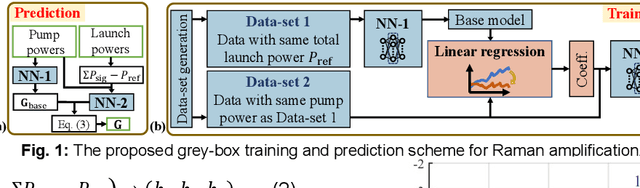
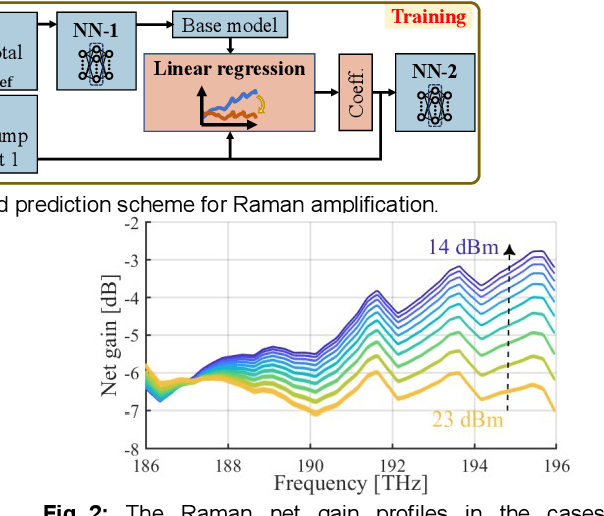
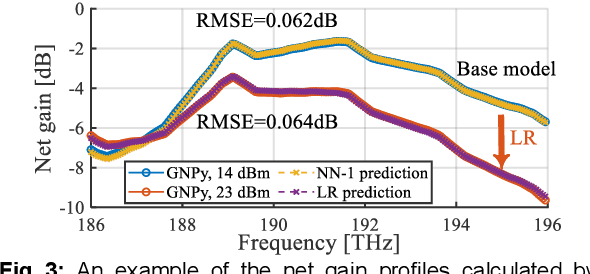
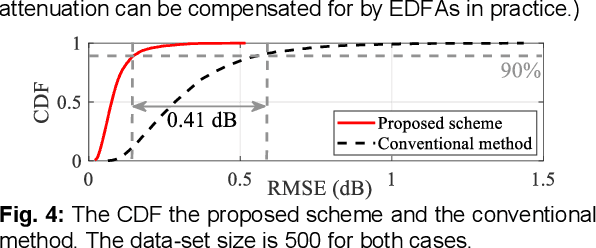
Based on the physical features of Raman amplification, we propose a three-step modelling scheme based on neural networks (NN) and linear regression. Higher accuracy, less data requirements and lower computational complexity are demonstrated through simulations compared with the pure NN-based method.
Physics-informed EDFA Gain Model Based on Active Learning
Jun 13, 2022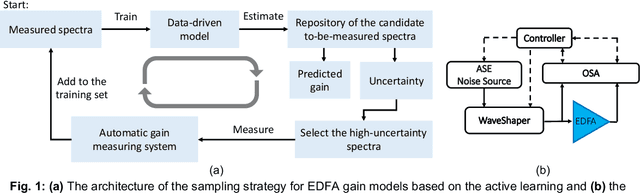
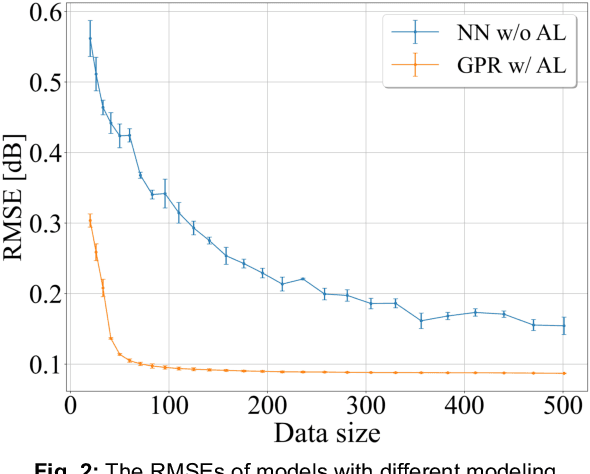
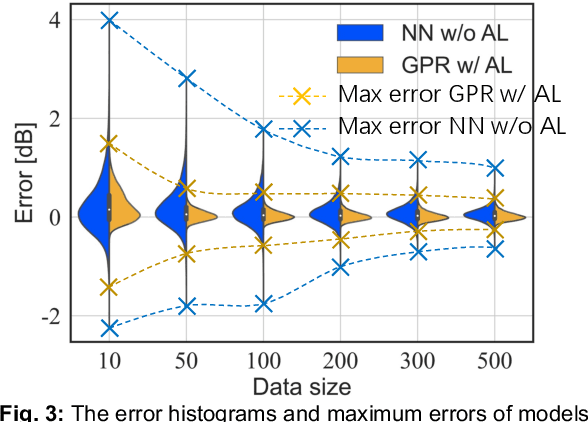
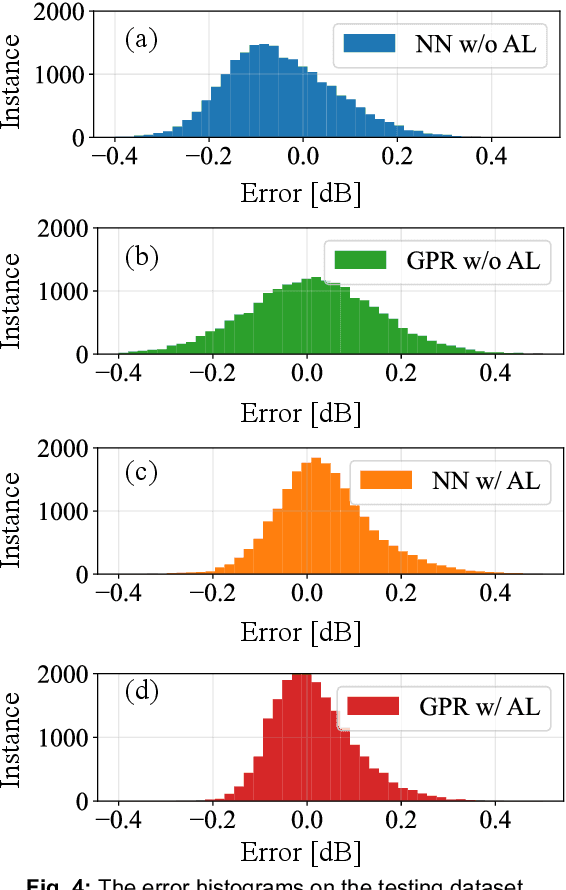
We propose a physics-informed EDFA gain model based on the active learning method. Experimental results show that the proposed modelling method can reach a higher optimal accuracy and reduce ~90% training data to achieve the same performance compared with the conventional method.