 Add to Chrome
 Add to Firefox
 Add to Edge
Quasi-Constant Modulus Design for Nonlinearity-Tolerant Geometric Shaped Four Dimensional Modulation Format
Apr 20, 2026
In this paper, the quasi-constant modulus (QCM) property is analyzed and leveraged in the design of nonlinearity-tolerant four-dimensional (4D) modulation formats. Accordingly, we propose a family of QCM-based quadrature amplitude modulation (QCM-QAM) constellations with high spectral efficiencies (SEs) of 9, 11, and 13 bit/4D-sym, respectively. The quasi-constant modulus design theoretically enhances tolerance to fiber nonlinearities. Meanwhile, QCM-QAM is evaluated in an unrepeatered wavelength-division multiplexing (WDM) system over both standard single-mode fiber (SSMF) and non-zero dispersion-shifted fiber (NZDSF). Across all SEs, QCM-QAM demonstrates robust nonlinear tolerance in both SSMF and NZDSF. This is evidenced by a consistent shift of the optimal launch power toward higher values and a significant improvement in effective signal-to-noise ratio (SNR). QCM-QAM also delivers generalized mutual information (GMI) gains of 0.22, 0.09, and 0.21 bit/4D-sym in SSMF, and 0.24, 0.10, and 0.22 bit/4D-sym, in NZDSF at the optimal transmission power, corresponding to the SEs of 9, 11, and 13 bit/4D-sym. Furthermore, QCM-QAM achieves transmission reach extensions of 1.6%, 0.9%, and 1.7% in SSMF, and 1.7%, 1.5%, and 1.8% in NZDSF, respectively, for the three SE levels.

Deep Learning Waveform Modeling for Wideband Optical Fiber Channel Transmission: Challenges and Potential Solutions
Jan 14, 2025
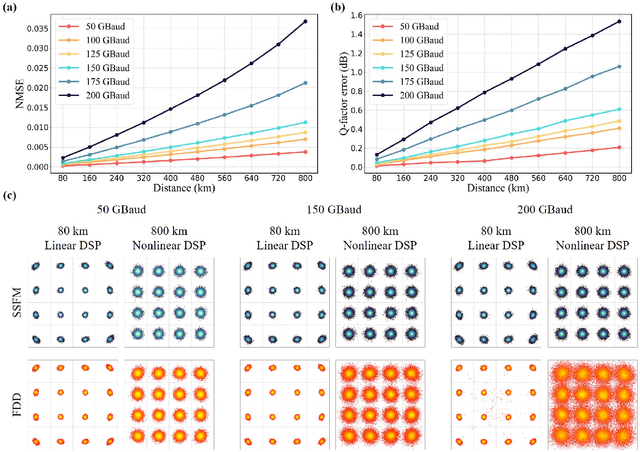
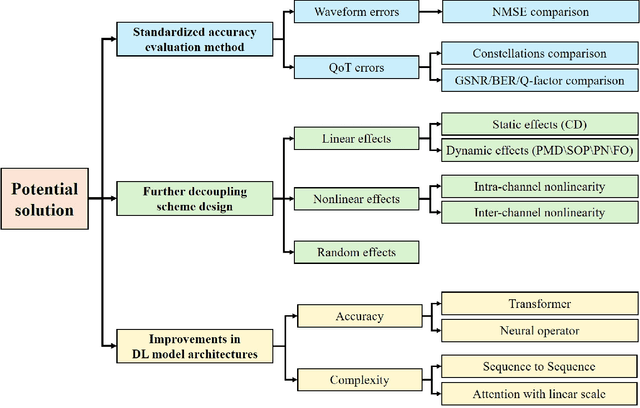
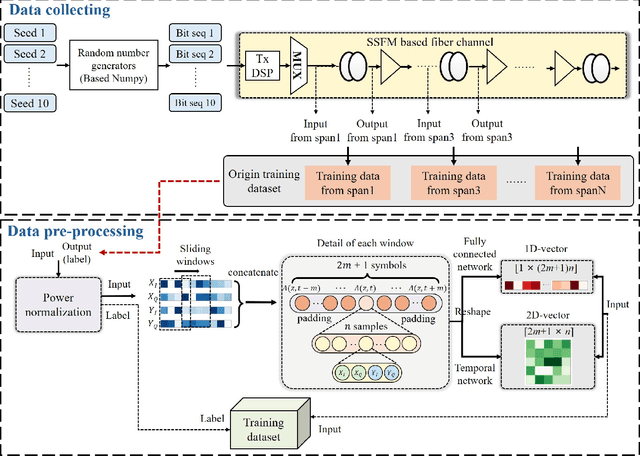
Fast and accurate optical fiber communication simulation system are crucial for optimizing optical networks, developing digital signal processing algorithms, and performing end-to-end (E2E) optimization. Deep learning (DL) has emerged as a valuable tool to reduce the complexity of traditional waveform simulation methods, such as split-step Fourier method (SSFM). DL-based schemes have achieved high accuracy and low complexity fiber channel waveform modeling as its strong nonlinear fitting ability and high efficiency in parallel computation. However, DL-based schemes are mainly utilized in single-channel and few-channel wavelength division multiplexing (WDM) systems. The applicability of DL-based schemes in wideband WDM systems remains uncertain due to the lack of comparison under consistent standards and scenarios. In this paper, we propose a DSP-assisted accuracy evaluation method to evaluate the performance for DL-based schemes, from the aspects of waveform and quality of transmission (QoT) errors. We compare the performance of five various DL-based schemes and valid the effectiveness of DSP-assisted method in WDM systems. Results suggest that feature decoupled distributed (FDD) achieves the better accuracy, especially in large-channel and high-rate scenarios. Furthermore, we find that the accuracy of FDD still exhibit significant degradation with the number of WDM channels and transmission rates exceeds 15 and 100 GBaud, indicating challenges for wideband applications. We further analyze the reasons of performance degradation from the perspective of increased linearity and nonlinearity and discuss potential solutions including further decoupling scheme designs and improvement in DL models. Despite DL-based schemes remain challenges in wideband WDM systems, they have strong potential for high-accuracy and low-complexity optical fiber channel waveform modeling.
Improve the Fitting Accuracy of Deep Learning for the Nonlinear Schrödinger Equation Using Linear Feature Decoupling Method
Nov 07, 2024We utilize the Feature Decoupling Distributed (FDD) method to enhance the capability of deep learning to fit the Nonlinear Schrodinger Equation (NLSE), significantly reducing the NLSE loss compared to non decoupling model.
Solving dynamic multi-objective optimization problems via support vector machine
Oct 19, 2019
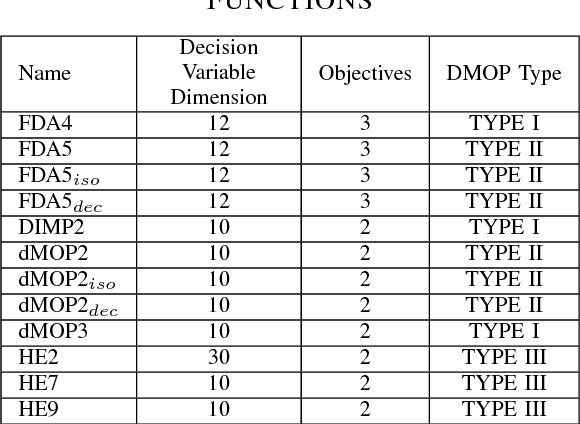
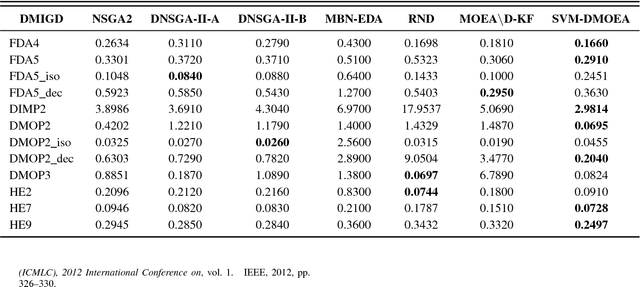
Dynamic Multi-objective Optimization Problems (DMOPs) refer to optimization problems that objective functions will change with time. Solving DMOPs implies that the Pareto Optimal Set (POS) at different moments can be accurately found, and this is a very difficult job due to the dynamics of the optimization problems. The POS that have been obtained in the past can help us to find the POS of the next time more quickly and accurately. Therefore, in this paper we present a Support Vector Machine (SVM) based Dynamic Multi-Objective Evolutionary optimization Algorithm, called SVM-DMOEA. The algorithm uses the POS that has been obtained to train a SVM and then take the trained SVM to classify the solutions of the dynamic optimization problem at the next moment, and thus it is able to generate an initial population which consists of different individuals recognized by the trained SVM. The initial populuation can be fed into any population based optimization algorithm, e.g., the Nondominated Sorting Genetic Algorithm II (NSGA-II), to get the POS at that moment. The experimental results show the validity of our proposed approach.