 Add to Chrome
 Add to Firefox
 Add to Edge
RuntimeSlicer: Towards Generalizable Unified Runtime State Representation for Failure Management
Mar 23, 2026
Modern software systems operate at unprecedented scale and complexity, where effective failure management is critical yet increasingly challenging. Metrics, traces, and logs provide complementary views of system runtime behavior, but existing failure management approaches typically rely on task-oriented pipelines that tightly couple modality-specific preprocessing, representation learning, and downstream models, resulting in limited generalization across tasks and systems. To fill this gap, we propose RuntimeSlicer, a unified runtime state representation model towards generalizable failure management. RuntimeSlicer pre-trains a task-agnostic representation model that directly encodes metrics, traces, and logs into a single, aligned system-state embedding capturing the holistic runtime condition of the system. To train RuntimeSlicer, we introduce Unified Runtime Contrastive Learning, which integrates heterogeneous training data sources and optimizes complementary objectives for cross-modality alignment and temporal consistency. Building upon the learned system-state embeddings, we further propose State-Aware Task-Oriented Tuning, which performs unsupervised partitioning of runtime states and enables state-conditioned adaptation for downstream tasks. This design allows lightweight task-oriented models to be trained on top of the unified embedding without redesigning modality-specific encoders or preprocessing pipelines. Preliminary experiments on the AIOps 2022 dataset demonstrate the feasibility and effectiveness of RuntimeSlicer for system state modeling and failure management tasks.

Efficient Failure Management for Multi-Agent Systems with Reasoning Trace Representation
Mar 23, 2026Large Language Models (LLM)-based Multi-Agent Systems (MASs) have emerged as a new paradigm in software system design, increasingly demonstrating strong reasoning and collaboration capabilities. As these systems become more complex and autonomous, effective failure management is essential to ensure reliability and availability. However, existing approaches often rely on per-trace reasoning, which leads to low efficiency, and neglect historical failure patterns, limiting diagnostic accuracy. In this paper, we conduct a preliminary empirical study to demonstrate the necessity, potential, and challenges of leveraging historical failure patterns to enhance failure management in MASs. Building on this insight, we propose \textbf{EAGER}, an efficient failure management framework for multi-agent systems based on reasoning trace representation. EAGER employs unsupervised reasoning-scoped contrastive learning to encode both intra-agent reasoning and inter-agent coordination, enabling real-time step-wise failure detection, diagnosis, and reflexive mitigation guided by historical failure knowledge. Preliminary evaluations on three open-source MASs demonstrate the effectiveness of EAGER and highlight promising directions for future research in reliable multi-agent system operations.
CoDrone: Autonomous Drone Navigation Assisted by Edge and Cloud Foundation Models
Dec 24, 2025Autonomous navigation for Unmanned Aerial Vehicles faces key challenges from limited onboard computational resources, which restrict deployed deep neural networks to shallow architectures incapable of handling complex environments. Offloading tasks to remote edge servers introduces high latency, creating an inherent trade-off in system design. To address these limitations, we propose CoDrone - the first cloud-edge-end collaborative computing framework integrating foundation models into autonomous UAV cruising scenarios - effectively leveraging foundation models to enhance performance of resource-constrained unmanned aerial vehicle platforms. To reduce onboard computation and data transmission overhead, CoDrone employs grayscale imagery for the navigation model. When enhanced environmental perception is required, CoDrone leverages the edge-assisted foundation model Depth Anything V2 for depth estimation and introduces a novel one-dimensional occupancy grid-based navigation method - enabling fine-grained scene understanding while advancing efficiency and representational simplicity of autonomous navigation. A key component of CoDrone is a Deep Reinforcement Learning-based neural scheduler that seamlessly integrates depth estimation with autonomous navigation decisions, enabling real-time adaptation to dynamic environments. Furthermore, the framework introduces a UAV-specific vision language interaction module incorporating domain-tailored low-level flight primitives to enable effective interaction between the cloud foundation model and the UAV. The introduction of VLM enhances open-set reasoning capabilities in complex unseen scenarios. Experimental results show CoDrone outperforms baseline methods under varying flight speeds and network conditions, achieving a 40% increase in average flight distance and a 5% improvement in average Quality of Navigation.
Venus: An Efficient Edge Memory-and-Retrieval System for VLM-based Online Video Understanding
Dec 08, 2025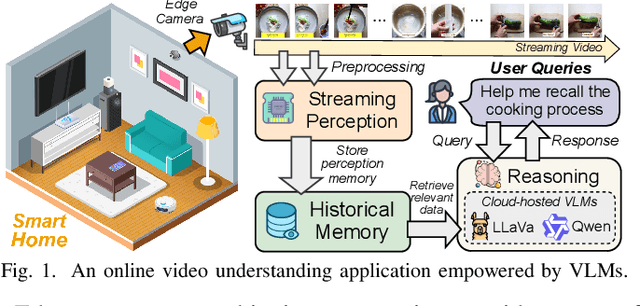
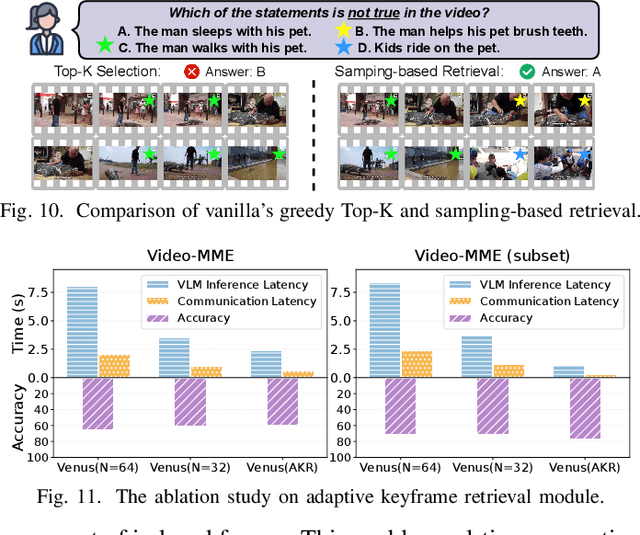
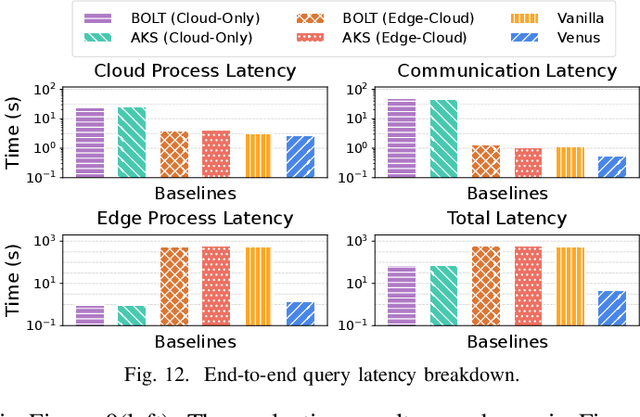
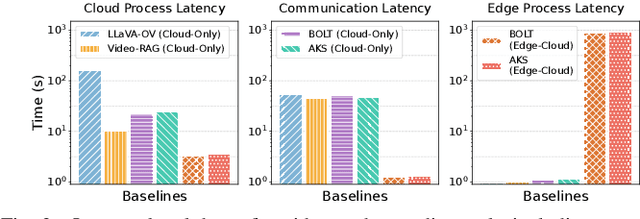
Vision-language models (VLMs) have demonstrated impressive multimodal comprehension capabilities and are being deployed in an increasing number of online video understanding applications. While recent efforts extensively explore advancing VLMs' reasoning power in these cases, deployment constraints are overlooked, leading to overwhelming system overhead in real-world deployments. To address that, we propose Venus, an on-device memory-and-retrieval system for efficient online video understanding. Venus proposes an edge-cloud disaggregated architecture that sinks memory construction and keyframe retrieval from cloud to edge, operating in two stages. In the ingestion stage, Venus continuously processes streaming edge videos via scene segmentation and clustering, where the selected keyframes are embedded with a multimodal embedding model to build a hierarchical memory for efficient storage and retrieval. In the querying stage, Venus indexes incoming queries from memory, and employs a threshold-based progressive sampling algorithm for keyframe selection that enhances diversity and adaptively balances system cost and reasoning accuracy. Our extensive evaluation shows that Venus achieves a 15x-131x speedup in total response latency compared to state-of-the-art methods, enabling real-time responses within seconds while maintaining comparable or even superior reasoning accuracy.