 Add to Chrome
 Add to Firefox
 Add to Edge
Allocation Before Ranking: Decoupled Token Compression for OmniLLMs
Aug 03, 2026
Token compression in OmniLLMs is typically posed as a single saliency-ranking problem: score each multimodal token, keep the top-K. We argue this abstraction is mis-specified. The same attention score simultaneously decides two things: how much retained capacity each modality receives, and which tokens within a modality are kept. A shared top-K rule therefore inherits this audio-favoring allocation prior, spending retained capacity on audio before video tokens have a chance to compete. We propose Macer, a training-free compressor that first assigns explicit audio and video budgets, then performs allocation-normalized ranking within each modality at modality-specific shallow layers. Macer significantly reduces token cost while preserving accuracy across audio-grounded, audio--video joint, visual-dominant, and video-centric benchmarks. At 25 % retention, Macer preserves 98.7 % of full-token performance on Qwen2.5-Omni-7B and 97.3 % on Qwen2.5-Omni-3B. On Qwen2.5-Omni-7B, this 25 % setting reaches OmniZip-level performance at 45 % retention while using lower FLOPs. On OmniVinci-9B, the same allocation-before-ranking principle improves over shared top-K ranking by up to 12.9 points.

CausalGraphX: A Counterfactual Graph Neural Network Framework for Explainable Systemic Risk Assessment
Jul 15, 2026The interconnected nature of global financial systems makes them vulnerable to systemic risks, where the failure of a few institutions can trigger catastrophic cascading defaults. Traditional risk models often fail to capture the complex, non-linear dynamics of these networks. While Graph Neural Networks (GNNs) have shown promise in modeling relational data, they primarily learn correlative patterns and function as black boxes, offering little insight into the causal mechanisms of shock propagation. This limitation is critical for regulators who require explainable models to perform stress tests and devise effective interventions. We introduce CausalGraphX, a novel framework that integrates GNNs with counterfactual reasoning to provide explainable assessments of systemic risk. CausalGraphX employs a Graph Attention mechanism to learn representations of institutional vulnerability and uses an adversarial regularization technique to ensure these representations capture causal drivers rather than spurious correlations. Furthermore, we propose an optimization-based approach to generate counterfactual explanations, answering questions such as, "What minimum capital injection would have prevented Bank A's default under a specific stress scenario?" We validate CausalGraphX on large-scale synthetic financial networks. Our results demonstrate that CausalGraphX significantly outperforms traditional and deep learning baselines in predicting cascading defaults while providing sparse, plausible, and actionable counterfactual explanations.
HPCAgentTester: A Multi-Agent LLM Approach for Enhanced HPC Unit Test Generation
Nov 13, 2025Unit testing in High-Performance Computing (HPC) is critical but challenged by parallelism, complex algorithms, and diverse hardware. Traditional methods often fail to address non-deterministic behavior and synchronization issues in HPC applications. This paper introduces HPCAgentTester, a novel multi-agent Large Language Model (LLM) framework designed to automate and enhance unit test generation for HPC software utilizing OpenMP and MPI. HPCAgentTester employs a unique collaborative workflow where specialized LLM agents (Recipe Agent and Test Agent) iteratively generate and refine test cases through a critique loop. This architecture enables the generation of context-aware unit tests that specifically target parallel execution constructs, complex communication patterns, and hierarchical parallelism. We demonstrate HPCAgentTester's ability to produce compilable and functionally correct tests for OpenMP and MPI primitives, effectively identifying subtle bugs that are often missed by conventional techniques. Our evaluation shows that HPCAgentTester significantly improves test compilation rates and correctness compared to standalone LLMs, offering a more robust and scalable solution for ensuring the reliability of parallel software systems.
Governance Challenges in Reinforcement Learning from Human Feedback: Evaluator Rationality and Reinforcement Stability
Apr 17, 2025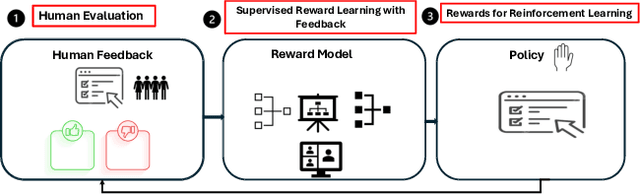

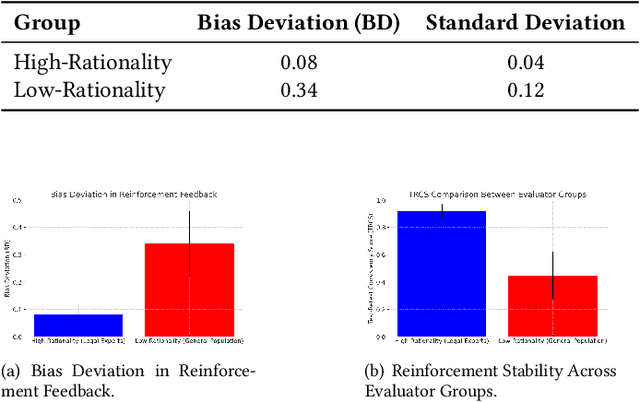
Reinforcement Learning from Human Feedback (RLHF) is central in aligning large language models (LLMs) with human values and expectations. However, the process remains susceptible to governance challenges, including evaluator bias, inconsistency, and the unreliability of feedback. This study examines how the cognitive capacity of evaluators, specifically their level of rationality, affects the stability of reinforcement signals. A controlled experiment comparing high-rationality and low-rationality participants reveals that evaluators with higher rationality scores produce significantly more consistent and expert-aligned feedback. In contrast, lower-rationality participants demonstrate considerable variability in their reinforcement decisions ($p < 0.01$). To address these challenges and improve RLHF governance, we recommend implementing evaluator pre-screening, systematic auditing of feedback consistency, and reliability-weighted reinforcement aggregation. These measures enhance the fairness, transparency, and robustness of AI alignment pipelines.
Synthesizing Public Opinions with LLMs: Role Creation, Impacts, and the Future to eDemorcacy
Mar 31, 2025This paper investigates the use of Large Language Models (LLMs) to synthesize public opinion data, addressing challenges in traditional survey methods like declining response rates and non-response bias. We introduce a novel technique: role creation based on knowledge injection, a form of in-context learning that leverages RAG and specified personality profiles from the HEXACO model and demographic information, and uses that for dynamically generated prompts. This method allows LLMs to simulate diverse opinions more accurately than existing prompt engineering approaches. We compare our results with pre-trained models with standard few-shot prompts. Experiments using questions from the Cooperative Election Study (CES) demonstrate that our role-creation approach significantly improves the alignment of LLM-generated opinions with real-world human survey responses, increasing answer adherence. In addition, we discuss challenges, limitations and future research directions.
Collaboration is all you need: LLM Assisted Safe Code Translation
Mar 14, 2025This paper introduces UniTranslator, a visionary framework that re-imagines code translation as a collaborative endeavor among multiple, compact LLMs. By orchestrating the interaction of specialized agents, each focused on different aspects of the translation process and grounded in a deep understanding of programming concepts, UniTranslator achieves a level of accuracy and efficiency that rivals larger, monolithic models. Our preliminary evaluation demonstrates the potential of UniTranslator to overcome the limitations of existing approaches and unlock the power of smaller LLMs for complex code translation tasks. We explore the effectiveness of this dynamic multi-agent paradigm in handling diverse language pairs, including low-resource languages, and in mitigating common issues such as code artifacts and hallucinations through the use of Natural Language Inference (NLI) grounding and iterative feedback mechanisms
A Multi-Agent Framework for Automated Vulnerability Detection and Repair in Solidity and Move Smart Contracts
Feb 22, 2025The rapid growth of the blockchain ecosystem and the increasing value locked in smart contracts necessitate robust security measures. While languages like Solidity and Move aim to improve smart contract security, vulnerabilities persist. This paper presents Smartify, a novel multi-agent framework leveraging Large Language Models (LLMs) to automatically detect and repair vulnerabilities in Solidity and Move smart contracts. Unlike traditional methods that rely solely on vast pre-training datasets, Smartify employs a team of specialized agents working on different specially fine-tuned LLMs to analyze code based on underlying programming concepts and language-specific security principles. We evaluated Smartify on a dataset for Solidity and a curated dataset for Move, demonstrating its effectiveness in fixing a wide range of vulnerabilities. Our results show that Smartify (Gemma2+codegemma) achieves state-of-the-art performance, surpassing existing LLMs and enhancing general-purpose models' capabilities, such as Llama 3.1. Notably, Smartify can incorporate language-specific knowledge, such as the nuances of Move, without requiring massive language-specific pre-training datasets. This work offers a detailed analysis of various LLMs' performance on smart contract repair, highlighting the strengths of our multi-agent approach and providing a blueprint for developing more secure and reliable decentralized applications in the growing blockchain landscape. We also provide a detailed recipe for extending this to other similar use cases.
LogBabylon: A Unified Framework for Cross-Log File Integration and Analysis
Dec 16, 2024Logs are critical resources that record events, activities, or messages produced by software applications, operating systems, servers, and network devices. However, consolidating the heterogeneous logs and cross-referencing them is challenging and complicated. Manually analyzing the log data is time-consuming and prone to errors. LogBabylon is a centralized log data consolidating solution that leverages Large Language Models (LLMs) integrated with Retrieval-Augmented Generation (RAG) technology. LogBabylon interprets the log data in a human-readable way and adds insight analysis of the system performance and anomaly alerts. It provides a paramount view of the system landscape, enabling proactive management and rapid incident response. LogBabylon consolidates diverse log sources and enhances the extracted information's accuracy and relevancy. This facilitates a deeper understanding of log data, supporting more effective decision-making and operational efficiency. Furthermore, LogBabylon streamlines the log analysis process, significantly reducing the time and effort required to interpret complex datasets. Its capabilities extend to generating context-aware insights, offering an invaluable tool for continuous monitoring, performance optimization, and security assurance in dynamic computing environments.
Harnessing the Power of LLMs: Automating Unit Test Generation for High-Performance Computing
Jul 06, 2024


Unit testing is crucial in software engineering for ensuring quality. However, it's not widely used in parallel and high-performance computing software, particularly scientific applications, due to their smaller, diverse user base and complex logic. These factors make unit testing challenging and expensive, as it requires specialized knowledge and existing automated tools are often ineffective. To address this, we propose an automated method for generating unit tests for such software, considering their unique features like complex logic and parallel processing. Recently, large language models (LLMs) have shown promise in coding and testing. We explored the capabilities of Davinci (text-davinci-002) and ChatGPT (gpt-3.5-turbo) in creating unit tests for C++ parallel programs. Our results show that LLMs can generate mostly correct and comprehensive unit tests, although they have some limitations, such as repetitive assertions and blank test cases.
LookALike: Human Mimicry based collaborative decision making
Mar 16, 2024Artificial General Intelligence falls short when communicating role specific nuances to other systems. This is more pronounced when building autonomous LLM agents capable and designed to communicate with each other for real world problem solving. Humans can communicate context and domain specific nuances along with knowledge, and that has led to refinement of skills. In this work we propose and evaluate a novel method that leads to knowledge distillation among LLM agents leading to realtime human role play preserving unique contexts without relying on any stored data or pretraining. We also evaluate how our system performs better in simulated real world tasks compared to state of the art.