 Add to Chrome
 Add to Firefox
 Add to Edge
MUSE: An Interactive Meta-Agent for Understanding and Steering LLM-powered Data Science Systems
Aug 17, 2026
Recent advances in large language models have enabled a new class of agentic data science systems that allow users to complete complex data science workflows through natural language. Although these systems can significantly reduce manual effort, it remains difficult to diagnose their behavior and steer the reasoning process when failures or unexpected outputs occur. We present MUSE, an interactive meta-agent that enhances user understanding and control of agentic data science systems by (1) dynamically restructuring low-level execution traces into multiple semantic levels that support navigation from high-level overviews to low-level implementation details; (2) enabling users to reference specific workflow steps in context to ask grounded questions, provide feedback, and revise problematic steps without manually locating relevant execution history; and (3) supporting mixed-initiative steering by surfacing suspicious steps for inspection, scaffolding the repair process, and translating user repair intent into contextualized instructions for the underlying agent. In a between-subjects study (n = 15), MUSE improved task efficiency and increased users' confidence in understanding and steering agentic data science workflows.

Effective and Low-cost Lane-based Map Localization for Vehicle-Centric Route Generation
Jun 15, 2026Driver-centric route representation plays a vital role in intuitive driving guidance systems. This paper presents OLRA, a low-cost, map-localization-based framework that derives driver-view-aligned routes by matching map-based navigation routes with camera-detected lane markings. This alignment process mutually enhances vehicle localization accuracy and visual route consistency. To bridge the evaluation gap across different paradigms, we introduce practical route evaluation metrics and benchmark OLRA against OpenPilot, a representative direct-generation approach. Experimental results on the nuScenes dataset demonstrate that OLRA outperforms OpenPilot in complex road segments and in route estimation at distance beyond 20 meters, achieving lower overall Euclidean error. This study is expected to promote future research in low-cost, maplocalization-based route generation methods.
Conditional Activation for Diverse Neurons in Heterogeneous Networks
Mar 13, 2018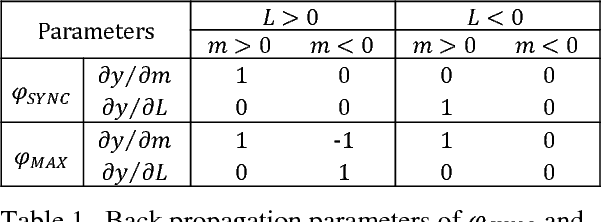
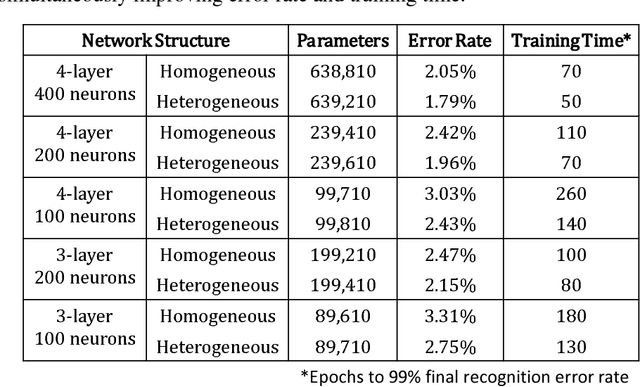
In this paper, we propose a new scheme for modelling the diverse behavior of neurons. We introduce the conditional activation, in which a neurons activation function is dynamically modified by a control signal. We apply this method to recreate behavior of special neurons existing in the human auditory and visual system. A heterogeneous multilayered perceptron (MLP) incorporating the developed models demonstrates simultaneous improvement in learning speed and performance across a various number of hidden units and layers, compared to a homogeneous network composed of the conventional neuron model. For similar performance, the proposed model lowers the memory for storing network parameters significantly.