 Add to Chrome
 Add to Firefox
 Add to Edge
A 3D Formulation of the Extended Phaseless Rytov Approximation
Jun 05, 2026
The extended Phaseless Rytov Approximation (xPRA) is a recently proposed device-free RF imaging technique that provides high-resolution reconstructions of the imaging region using only phaseless measurements, such as received signal strength (RSS). Because of its phaseless formulation, it can be implemented straightforwardly using existing wireless commu?nication infrastructure. It also outperforms well-known device?free phaseless RF imaging methods such as Radio Tomographic Imaging (RTI). The linear phaseless formulation used in xPRA(and RTI) makes these methods potentially useful for integrated sensing and communication (ISAC) systems in next generation wireless networks since they do not require wide bandwidths. However, so far, both xPRA and RTI have primarily been formulated in two dimensions (2D). This paper introduces a 3D extension of xPRA, which we call the extended three-dimensional phaseless Rytov approximation (x3DPRA). The novelty of our approach is that it preserves the straightforward implementation advantages of RTI and xPRA while enabling volumetric (3D) imaging. Simulation results show that x3DPRA provides good estimates of location and shape and can also reconstruct object material attenuation. We present the 3D formulation, validate it with a 2D model comparison, and report simulation results demonstrating its performance.

(Why) Is My Prompt Getting Worse? Rethinking Regression Testing for Evolving LLM APIs
Nov 18, 2023Large Language Models (LLMs) are increasingly integrated into software applications. Downstream application developers often access LLMs through APIs provided as a service. However, LLM APIs are often updated silently and scheduled to be deprecated, forcing users to continuously adapt to evolving models. This can cause performance regression and affect prompt design choices, as evidenced by our case study on toxicity detection. Based on our case study, we emphasize the need for and re-examine the concept of regression testing for evolving LLM APIs. We argue that regression testing LLMs requires fundamental changes to traditional testing approaches, due to different correctness notions, prompting brittleness, and non-determinism in LLM APIs.
Semi-Supervised Domain Generalization for Cardiac Magnetic Resonance Image Segmentation with High Quality Pseudo Labels
Sep 30, 2022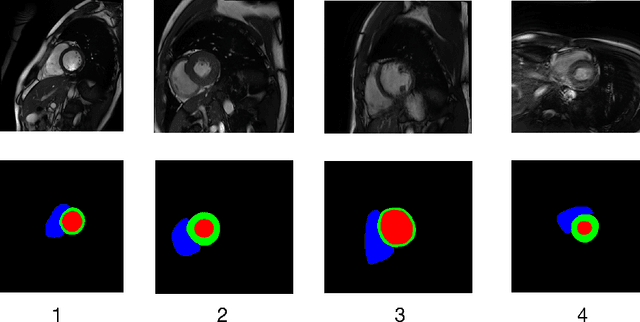

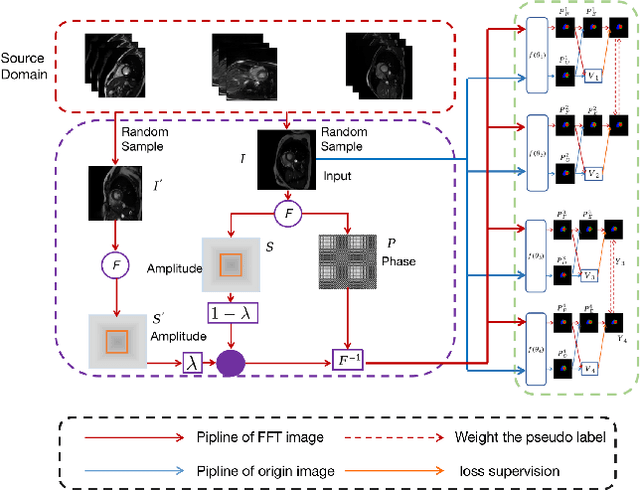
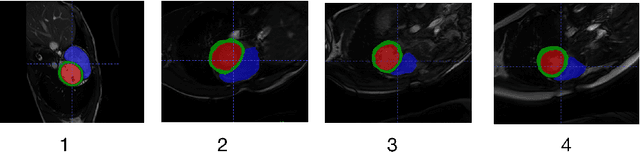
Developing a deep learning method for medical segmentation tasks heavily relies on a large amount of labeled data. However, the annotations require professional knowledge and are limited in number. Recently, semi-supervised learning has demonstrated great potential in medical segmentation tasks. Most existing methods related to cardiac magnetic resonance images only focus on regular images with similar domains and high image quality. A semi-supervised domain generalization method was developed in [2], which enhances the quality of pseudo labels on varied datasets. In this paper, we follow the strategy in [2] and present a domain generalization method for semi-supervised medical segmentation. Our main goal is to improve the quality of pseudo labels under extreme MRI Analysis with various domains. We perform Fourier transformation on input images to learn low-level statistics and cross-domain information. Then we feed the augmented images as input to the double cross pseudo supervision networks to calculate the variance among pseudo labels. We evaluate our method on the CMRxMotion dataset [1]. With only partially labeled data and without domain labels, our approach consistently generates accurate segmentation results of cardiac magnetic resonance images with different respiratory motions. Code will be available after the conference.