 Add to Chrome
 Add to Firefox
 Add to Edge
M$^\star$: Every Task Deserves Its Own Memory Harness
Apr 10, 2026
Large language model agents rely on specialized memory systems to accumulate and reuse knowledge during extended interactions. Recent architectures typically adopt a fixed memory design tailored to specific domains, such as semantic retrieval for conversations or skills reused for coding. However, a memory system optimized for one purpose frequently fails to transfer to others. To address this limitation, we introduce M$^\star$, a method that automatically discovers task-optimized memory harnesses through executable program evolution. Specifically, M$^\star$ models an agent memory system as a memory program written in Python. This program encapsulates the data Schema, the storage Logic, and the agent workflow Instructions. We optimize these components jointly using a reflective code evolution method; this approach employs a population-based search strategy and analyzes evaluation failures to iteratively refine the candidate programs. We evaluate M$^\star$ on four distinct benchmarks spanning conversation, embodied planning, and expert reasoning. Our results demonstrate that M$^\star$ improves performance over existing fixed-memory baselines robustly across all evaluated tasks. Furthermore, the evolved memory programs exhibit structurally distinct processing mechanisms for each domain. This finding indicates that specializing the memory mechanism for a given task explores a broad design space and provides a superior solution compared to general-purpose memory paradigms.

ULA Fitting for Sparse Array Design
Feb 05, 2021
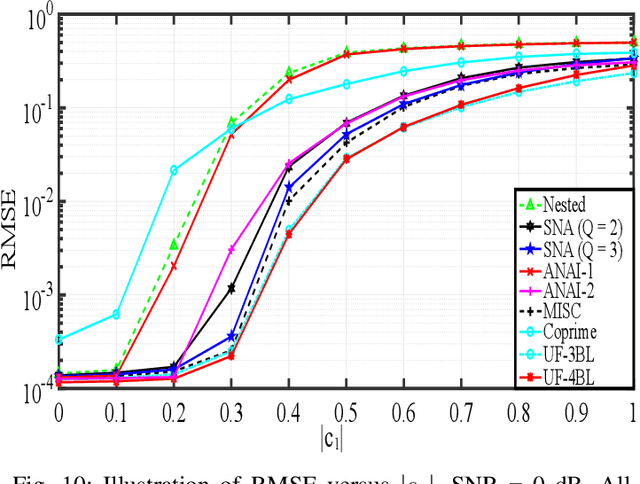
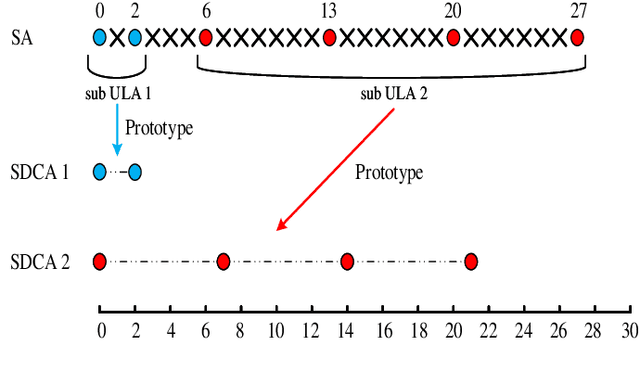
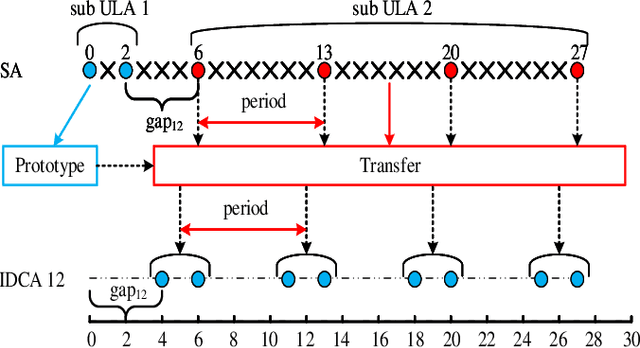
Sparse array (SA) geometries, such as coprime and nested arrays, can be regarded as a concatenation of two uniform linear arrays (ULAs). Such arrays lead to a significant increase of the number of degrees of freedom (DOF) when the second-order information is utilized, i.e., they provide long virtual difference coarray (DCA). Thus, the idea of this paper is based on the observation that SAs can be fitted through concatenation of sub-ULAs. A corresponding SA design principle, called ULA fitting, is then proposed. It aims to design SAs from sub-ULAs. Towards this goal, a polynomial model for arrays is used, and based on it, a DCA structure is analyzed if SA is composed of multiple sub-ULAs. SA design with low mutual coupling is considered. ULA fitting enables to transfer the SA design requirements, such as hole free, low mutual coupling and other requirements, into pseudo polynomial equation, and hence, find particular solutions. We mainly focus on designing SAs with low mutual coupling and large uniform DOF. Two examples of SAs with closed-form expressions are then developed based on ULA fitting. Numerical experiments verify the superiority of the proposed SAs in the presence of heavy mutual coupling.