 Add to Chrome
 Add to Firefox
 Add to Edge
FM-Bench: A Benchmark for Long-Horizon Management with Competing Agents
Aug 19, 2026
Language model agents now execute bounded tasks reliably. Whether they can sustain effective decision-making over long horizons, where actions have cumulative consequences and the environment responds to their choices, remains largely unmeasured. FM-Bench (Football Management Benchmark) measures this. An LLM agent runs a football club for 20 in-game years through 26 tools and roughly 340 to 400 decision stops. It drafts a squad on the same budget as every rival, trades players, negotiates contracts, invests in facilities and youth, sets lineups, and answers to a board that can fire it, while a deterministic engine accumulates every year into one final score with no LLM judge or human rater. The solo track plays each of 15 frontier models against a frozen scripted world, and the Arena places the same models plus a scripted anchor in one shared 20-year world; to our knowledge, the first head-to-head evaluation at this scale. We measure six behavioral capabilities behind the score. Across three seeds, all 15 models complete every horizon while the blind scripted baselines die out in most of theirs, and claude-fable-5 tops the solo board on mean score and the Arena, where the title nonetheless rotates among ten models. Neither scale, price, nor vendor predicts the order; the order settles only late in the horizon, and the best first-play human lands only at the bottom of the model board. What separates the models is managerial behavior rather than computation. Higher-scoring models reduce slow-payoff investment near the end, keep cash invested rather than idle, and open renewals well before the deadline, while token spend predicts nothing. No model learns the market's hidden prices from hundreds of rejected bids, and self-managed memory fails in two opposite modes: an archive that only grows or a plan rewritten every season. Code is available at https://github.com/Analogy-AI/fm-bench.

Hybrid Primal Sketch: Combining Analogy, Qualitative Representations, and Computer Vision for Scene Understanding
Jul 05, 2024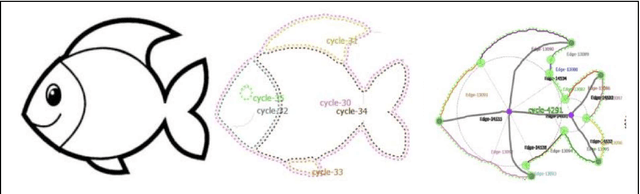
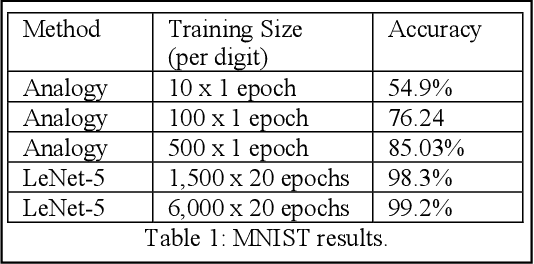
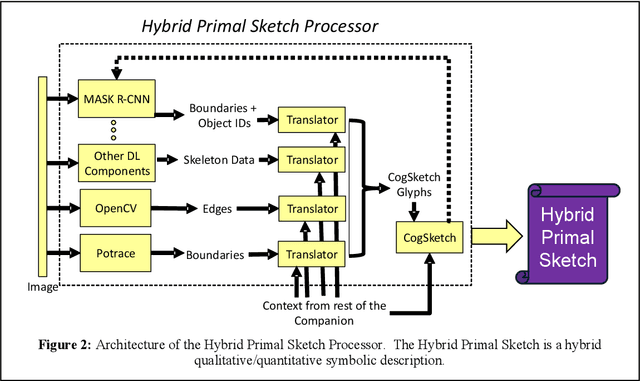
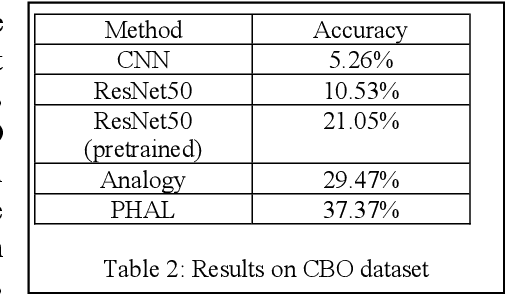
One of the purposes of perception is to bridge between sensors and conceptual understanding. Marr's Primal Sketch combined initial edge-finding with multiple downstream processes to capture aspects of visual perception such as grouping and stereopsis. Given the progress made in multiple areas of AI since then, we have developed a new framework inspired by Marr's work, the Hybrid Primal Sketch, which combines computer vision components into an ensemble to produce sketch-like entities which are then further processed by CogSketch, our model of high-level human vision, to produce both more detailed shape representations and scene representations which can be used for data-efficient learning via analogical generalization. This paper describes our theoretical framework, summarizes several previous experiments, and outlines a new experiment in progress on diagram understanding.
Symmetry as a Representation of Intuitive Geometry?
Jun 04, 2022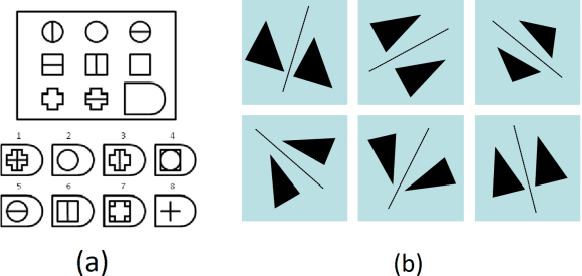
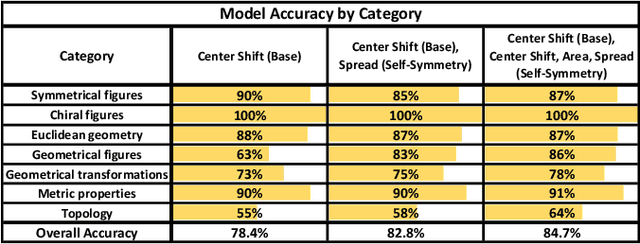
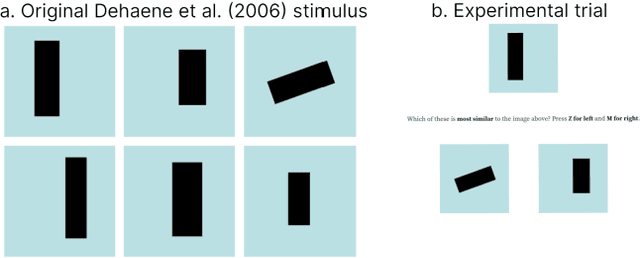
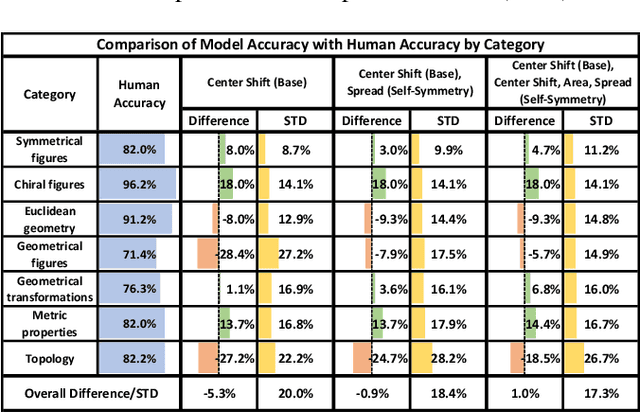
Recognition of geometrical patterns seems to be an important aspect of human intelligence. Geometric pattern recognition is used in many intelligence tests, including Dehaene's odd-one-out test of Core Geometry (CG)) based on intuitive geometrical concepts (Dehaene et al., 2006). Earlier work has developed a symmetry-based cognitive model of Dehaene's test and demonstrated performance comparable to that of humans. In this work, we further investigate the role of symmetry in geometrical intuition and build a cognitive model for the 2-Alternative Forced Choice (2-AFC) variation of the CG test (Marupudi & Varma 2021). In contrast to Dehaene's test, 2-AFC leaves almost no space for cognitive models based on generalization over multiple examples. Our symmetry-based model achieves an accuracy comparable to the human average on the 2-AFC test and appears to capture an essential part of intuitive geometry.