 Add to Chrome
 Add to Firefox
 Add to Edge
Towards Long-Horizon Vessel Trajectory and Destination Forecasting with Reasoning Large Language Models
Jun 07, 2026
Long-horizon maritime trajectory prediction is important for shipping management, logistics planning, and maritime risk analysis, yet month-level forecasting remains insufficiently studied. Existing deep learning methods mainly focus on short- and mid-term coordinate extrapolation and often struggle to preserve route feasibility and destination correctness over extended horizons. This paper investigates joint long-horizon vessel trajectory and destination forecasting with reasoning-capable large language models, and develops a Maritime LLM post-training framework based on Reinforcement Learning with Verifiable Reward (RLVR). An AIS-based benchmark is constructed with 60-day historical trajectories and 30-day forecasting horizons, where trajectories are converted into semantic textual representations for RL prompt construction. RLVR aligns LLMs with maritime forecasting objectives by enforcing physical validity, providing early-weighted trajectory supervision, and evaluating destination correctness through hierarchical matching and curriculum learning. Experimental results show that RLVR-trained LLMs substantially improve over zero-shot LLMs and representative deep learning baselines, especially on destination-related metrics. Among the evaluated RLVR-trained variants, 4B LLMs achieve the best overall performance, suggesting that reward-compatible optimization and task-specific capacity matching are more important than simply using larger 8B or 14B LLMs. The results also show that LSTM remains a strong deep learning baseline under limited fine-tuning data, while Transformer-style spatio-temporal models typically require larger datasets and richer structured inputs. Overall, this work advances semantic, verifier-aligned maritime forecasting for operational decision support.

Constructing Trajectory and Predicting Estimated Time of Arrival for Long Distance Travelling Vessels: A Probability Density-based Scanning Approach
May 13, 2022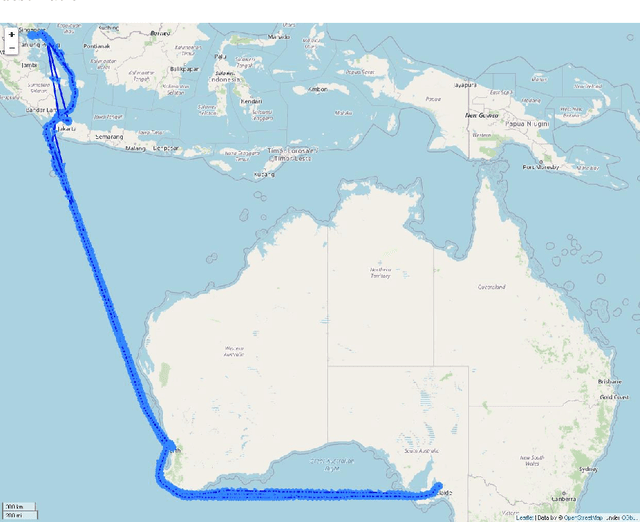
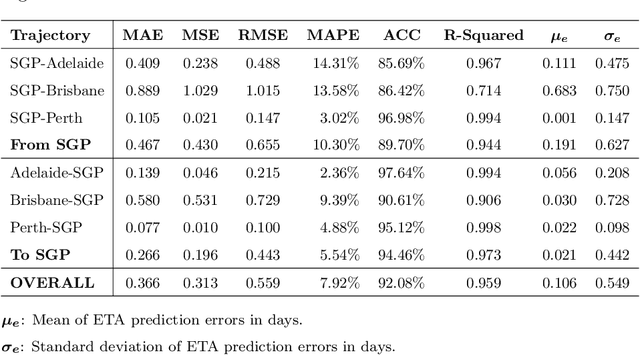
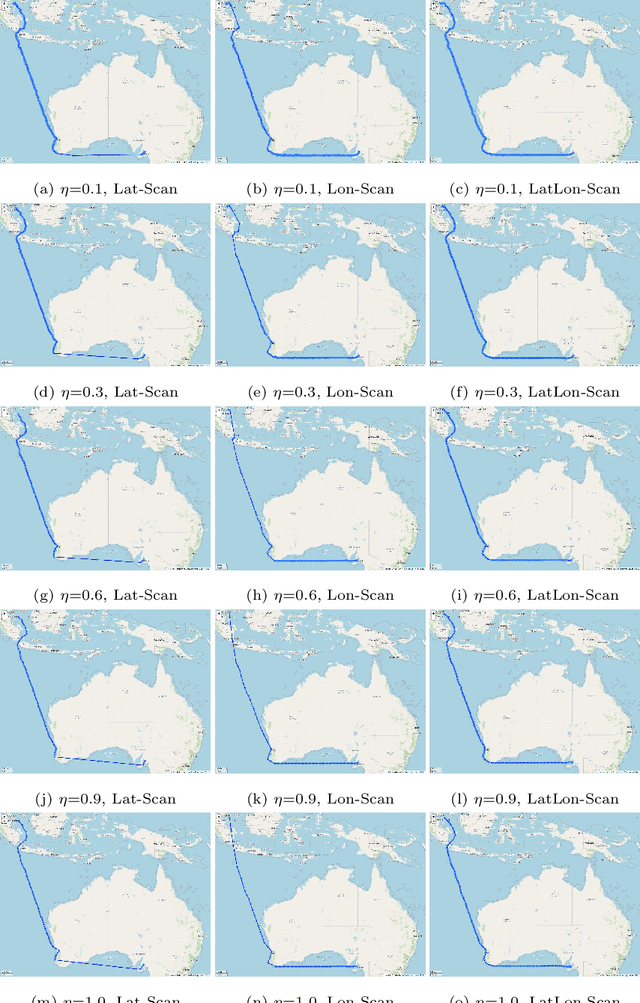
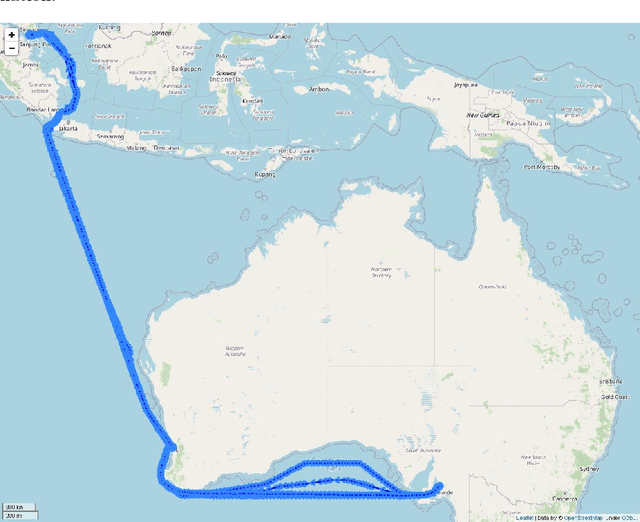
In this study, a probability density-based approach for constructing trajectories is proposed and validated through an typical use-case application: Estimated Time of Arrival (ETA) prediction given origin-destination pairs. The ETA prediction is based on physics and mathematical laws given by the extracted information of probability density-based trajectories constructed. The overall ETA prediction errors are about 0.106 days (i.e. 2.544 hours) on average with 0.549 days (i.e. 13.176 hours) standard deviation, and the proposed approach has an accuracy of 92.08% with 0.959 R-Squared value for overall trajectories between Singapore and Australia ports selected.
Predicting Berth Stay for Tanker Terminals: A Systematic and Dynamic Approach
Apr 08, 2022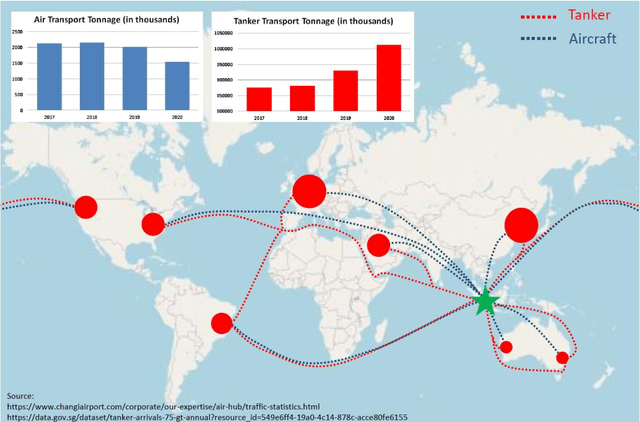
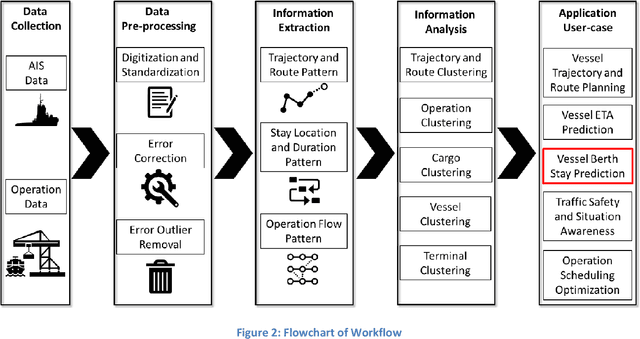
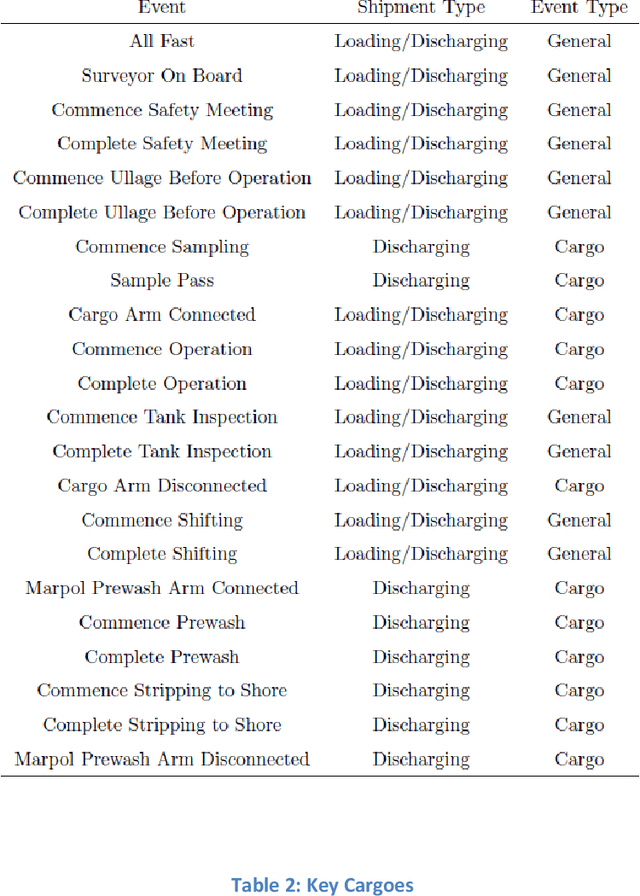
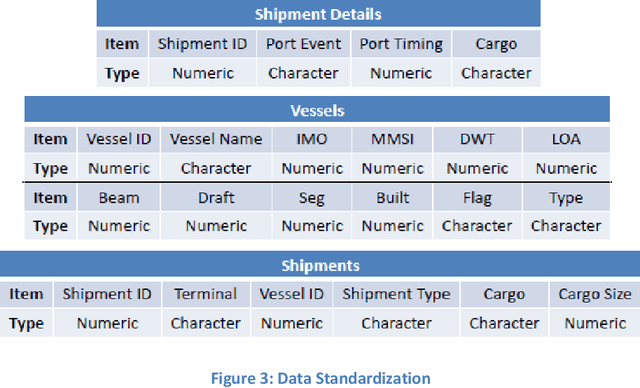
Given the trend of digitization and increasing number of maritime transport, prediction of vessel berth stay has been triggered for requirements of operation research and scheduling optimization problem in the era of maritime big data, which takes a significant part in port efficiency and maritime logistics enhancement. This study proposes a systematic and dynamic approach of predicting berth stay for tanker terminals. The approach covers three innovative aspects: 1) Data source employed is multi-faceted, including cargo operation data from tanker terminals, time-series data from automatic identification system (AIS), etc. 2) The process of berth stay is decomposed into multiple blocks according to data analysis and information extraction innovatively, and practical operation scenarios are also developed accordingly. 3) The predictive models of berth stay are developed on the basis of prior data analysis and information extraction under two methods, including regression and decomposed distribution. The models are evaluated under four dynamic scenarios with certain designated cargoes among two different terminals. The evaluation results show that the proposed approach can predict berth stay with the accuracy up to 98.81% validated by historical baselines, and also demonstrate the proposed approach has dynamic capability of predicting berth stay among the scenarios. The model may be potentially applied for short-term pilot-booking or scheduling optimizations within a reasonable time frame for advancement of port intelligence and logistics efficiency.
Optimizing Coordinative Schedules for Tanker Terminals: An Intelligent Large Spatial-Temporal Data-Driven Approach -- Part 2
Apr 08, 2022
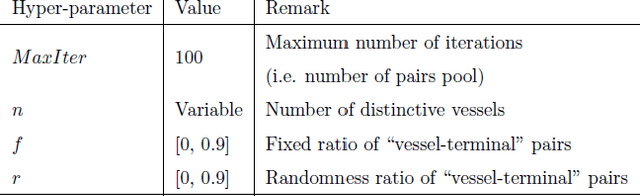
In this study, a novel coordinative scheduling optimization approach is proposed to enhance port efficiency by reducing weighted average turnaround time. The proposed approach is developed as a heuristic algorithm applied and investigated through different observation windows with weekly rolling horizon paradigm method. The experimental results show that the proposed approach is effective and promising on mitigating the turnaround time of vessels. The results demonstrate that largest potential savings of turnaround time (weighted average) are around 17 hours (28%) reduction on baseline of 1-week observation, 45 hours (37%) reduction on baseline of 2-week observation and 70 hours (40%) reduction on baseline of 3-week observation. Even though the experimental results are based on historical datasets, the results potentially present significant benefits if real-time applications were applied under a quadratic computational complexity.
Optimizing Coordinative Schedules for Tanker Terminals: An Intelligent Large Spatial-Temporal Data-Driven Approach -- Part 1
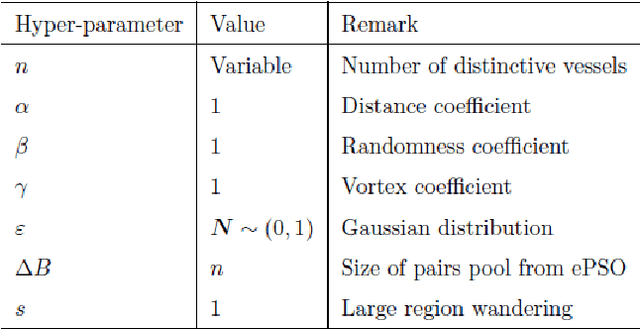
Apr 08, 2022In this study, a novel coordinative scheduling optimization approach is proposed to enhance port efficiency by reducing average wait time and turnaround time. The proposed approach consists of enhanced particle swarm optimization (ePSO) as kernel and augmented firefly algorithm (AFA) as global optimal search. Two paradigm methods of the proposed approach are investigated, which are batch method and rolling horizon method. The experimental results show that both paradigm methods of proposed approach can effectively enhance port efficiency. The average wait time could be significantly reduced by 86.0% - 95.5%, and the average turnaround time could eventually save 38.2% - 42.4% with respect to historical benchmarks. Moreover, the paradigm method of rolling horizon could reduce to 20 mins on running time over 3-month datasets, rather than 4 hrs on batch method at corresponding maximum performance.