 Add to Chrome
 Add to Firefox
 Add to Edge
TriFlow: Generating Artist-Like 3D Mesh Topology via Nearest-Vertex Vector Fields
Jun 18, 2026
We present TriFlow, a new generative approach for producing compact 3D meshes with artist-like triangle topology directly from input geometry conditions such as signed distance fields. Our key insight is to represent mesh topology as a nearest-vertex vector field (NVF) defined over the surface, where each point encodes its association to the nearest triangle vertex in the local barycentric frame. We train a latent flow-matching model to synthesize this field, enabling topology generation conditioned on the input geometry. To extract a coherent mesh, we cluster surface regions using the generated NVF and guide a constrained quadric error metric (QEM) mesh simplification with topology-aware optimization. This yields output meshes that closely match the input geometry while exhibiting structured, artist-like connectivity. Experiments demonstrate that TriFlow achieves stronger generalization and significantly improved topology quality compared to state-of-the-art learning-based approaches, alongside 90% lower Chamfer Distance and an 8x speedup.

MeshGPT: Generating Triangle Meshes with Decoder-Only Transformers
Nov 27, 2023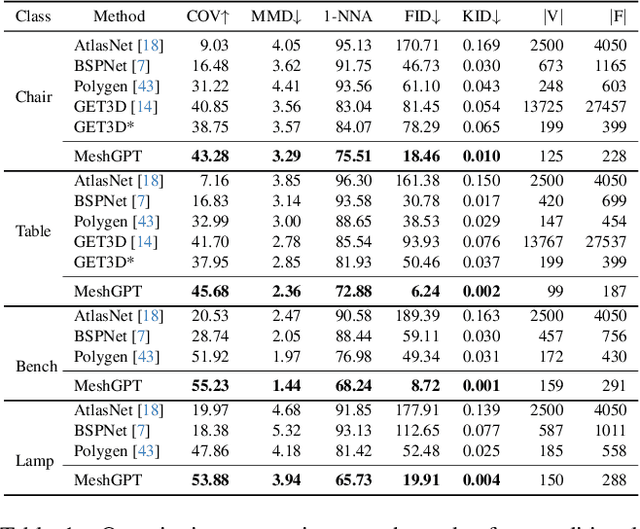
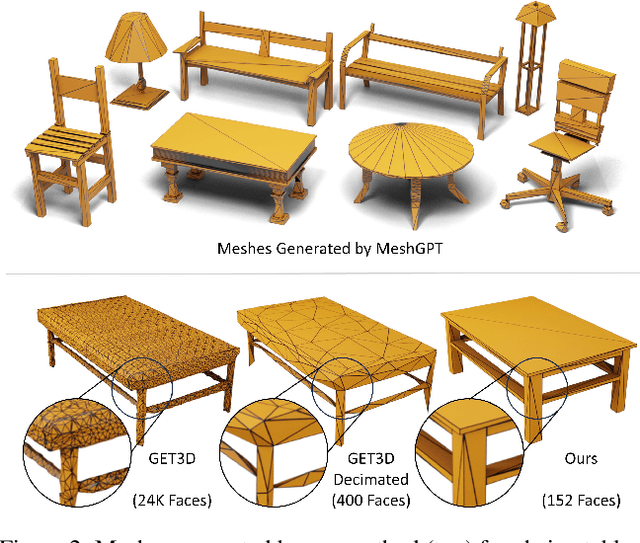
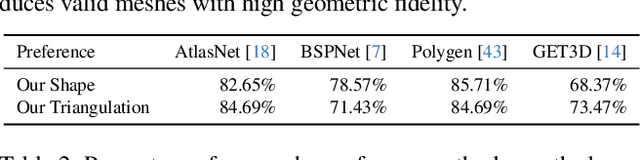
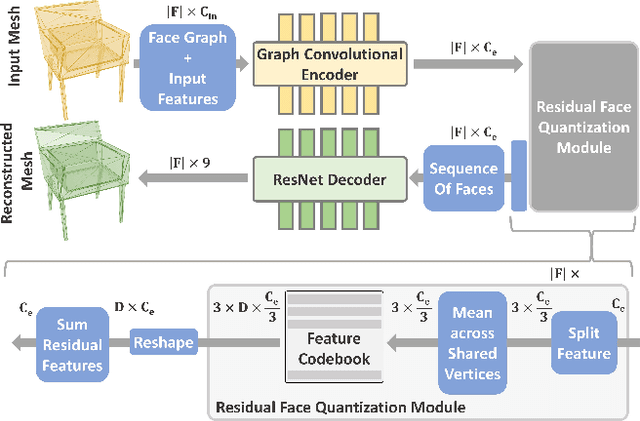
We introduce MeshGPT, a new approach for generating triangle meshes that reflects the compactness typical of artist-created meshes, in contrast to dense triangle meshes extracted by iso-surfacing methods from neural fields. Inspired by recent advances in powerful large language models, we adopt a sequence-based approach to autoregressively generate triangle meshes as sequences of triangles. We first learn a vocabulary of latent quantized embeddings, using graph convolutions, which inform these embeddings of the local mesh geometry and topology. These embeddings are sequenced and decoded into triangles by a decoder, ensuring that they can effectively reconstruct the mesh. A transformer is then trained on this learned vocabulary to predict the index of the next embedding given previous embeddings. Once trained, our model can be autoregressively sampled to generate new triangle meshes, directly generating compact meshes with sharp edges, more closely imitating the efficient triangulation patterns of human-crafted meshes. MeshGPT demonstrates a notable improvement over state of the art mesh generation methods, with a 9% increase in shape coverage and a 30-point enhancement in FID scores across various categories.