 Add to Chrome
 Add to Firefox
 Add to Edge
DECADE: A Temporally-Consistent Unsupervised Diffusion Model for Enhanced Rb-82 Dynamic Cardiac PET Image Denoising
Mar 08, 2026
Rb-82 dynamic cardiac PET imaging is widely used for the clinical diagnosis of coronary artery disease (CAD), but its short half-life results in high noise levels that degrade dynamic frame quality and parametric imaging. The lack of paired clean-noisy training data, rapid tracer kinetics, and frame-dependent noise variations further limit the effectiveness of existing deep learning denoising methods. We propose DECADE (A Temporally-Consistent Unsupervised Diffusion model for Enhanced Rb-82 CArdiac PET DEnoising), an unsupervised diffusion framework that generalizes across early- to late-phase dynamic frames. DECADE incorporates temporal consistency during both training and iterative sampling, using noisy frames as guidance to preserve quantitative accuracy. The method was trained and evaluated on datasets acquired from Siemens Vision 450 and Siemens Biograph Vision Quadra scanners. On the Vision 450 dataset, DECADE consistently produced high-quality dynamic and parametric images with reduced noise while preserving myocardial blood flow (MBF) and myocardial flow reserve (MFR). On the Quadra dataset, using 15%-count images as input and full-count images as reference, DECADE outperformed UNet-based and other diffusion models in image quality and K1/MBF quantification. The proposed framework enables effective unsupervised denoising of Rb-82 dynamic cardiac PET without paired training data, supporting clearer visualization while maintaining quantitative integrity.

FastPET: Near Real-Time PET Reconstruction from Histo-Images Using a Neural Network
Feb 11, 2020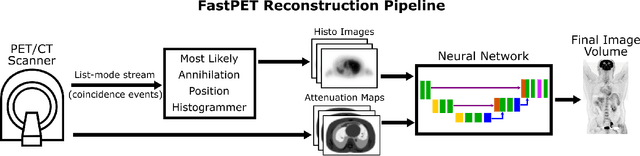
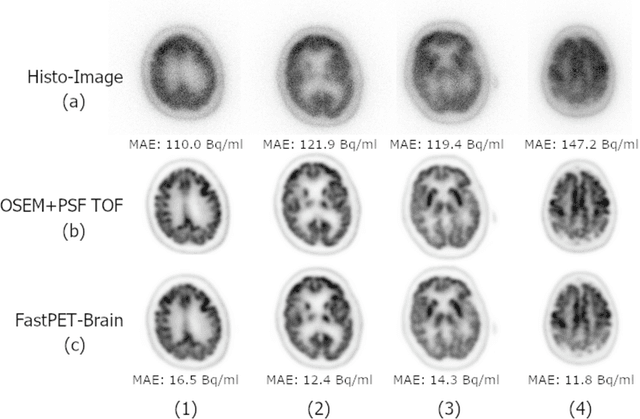
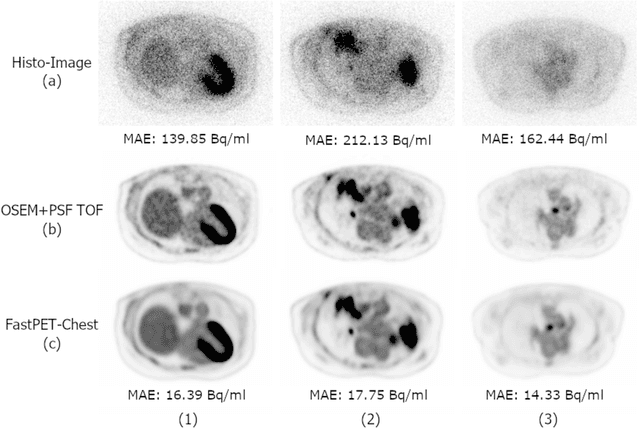
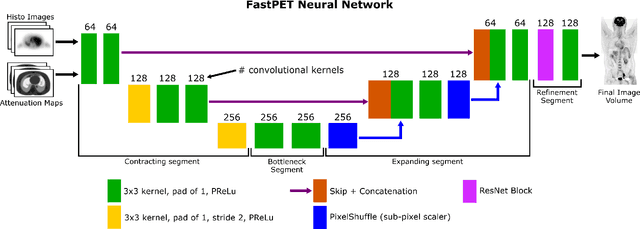
Direct reconstruction of positron emission tomography (PET) data using deep neural networks is a growing field of research. Initial results are promising, but often the networks are complex, memory utilization inefficient, produce relatively small image sizes (e.g. 128x128), and low count rate reconstructions are of varying quality. This paper proposes FastPET, a novel direct reconstruction convolutional neural network that is architecturally simple, memory space efficient, produces larger images (e.g. 440x440) and is capable of processing a wide range of count densities. FastPET operates on noisy and blurred histo-images reconstructing clinical-quality multi-slice image volumes 800x faster than ordered subsets expectation maximization (OSEM). Patient data studies show a higher contrast recovery value than for OSEM with equivalent variance and a higher overall signal-to-noise ratio with both cases due to FastPET's lower noise images. This work also explored the application to low dose PET imaging and found FastPET able to produce images comparable to normal dose with only 50% and 25% counts. We additionally explored the effect of reducing the anatomical region by training specific FastPET variants on brain and chest images and found narrowing the data distribution led to increased performance.