 Add to Chrome
 Add to Firefox
 Add to Edge
Tensorion: A Tensor-Aware Generalization of the Muon Optimizer
Jun 24, 2026
Common first-order optimizers, such as Adam, implicitly treat each parameter block as an unstructured vector, which disregards the multilinear weight structure present in many modern machine learning models. Recent work has shown that exploiting matrix structure can improve optimization dynamics. A notable example is Muon, which performs steepest descent under the spectral norm constraint. We take the next step and introduce Tensorion, a tensor-aware optimizer that extends Muon's constrained optimization perspective from matrices to higher-order tensors. Tensorion is built around a linear minimization oracle (LMO) over a tensor norm ball. The norm is carefully chosen to balance two objectives: tightly bounding the tensor spectral norm, while still keeping the LMO tractable. This LMO becomes computable because it reduces to operations on adaptively selected unfolding matrices. Notably, when restricted to order-2 tensors (i.e., matrices), Tensorion recovers Muon exactly. Experiments on tensor-based computer vision problems suggest that Tensorion can offer improved convergence behavior and more stable gradient updates compared with Adam-based and existing tensor-aware baselines in the evaluated settings.

Rethinking the Role of Tensor Decompositions in Post-Training LLM Compression
Jun 02, 2026Post-training compression is essential for deploying large language models (LLMs) under tight resource constraints. Tensor decompositions have emerged as a promising direction, offering compact parameterizations well suited to Transformer weight structures. However, existing studies evaluate these methods in narrow settings, leaving unclear whether tensorization is effective at large-scale deployment. We systematically evaluate tensor compression across dense and MoE architectures, establishing performance trade-offs grounded in both empirical analysis and theoretical analysis. We identify a fundamental mismatch between the shared subspaces assumed by tensor decompositions and the heterogeneous representations learned by modern LLMs, thereby delineating their practical limits and clarifying their viable role in large-scale deployment. The code is available at https://github.com/brain-lab-research/TT-LLM.
RiemannLoRA: A Unified Riemannian Framework for Ambiguity-Free LoRA Optimization
Jul 16, 2025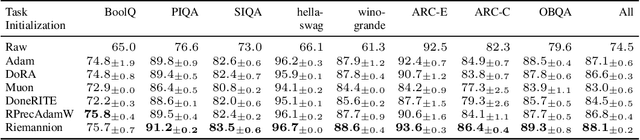
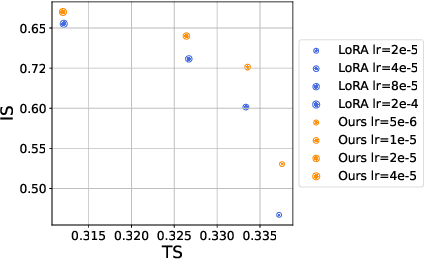
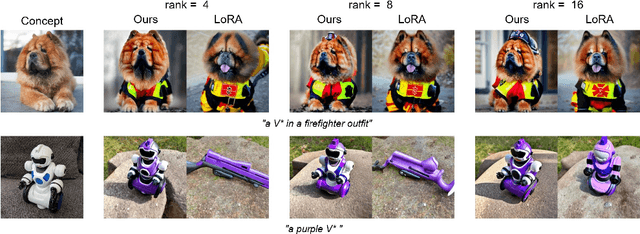

Low-Rank Adaptation (LoRA) has become a widely adopted standard for parameter-efficient fine-tuning of large language models (LLMs), significantly reducing memory and computational demands. However, challenges remain, including finding optimal initialization strategies or mitigating overparametrization in low-rank matrix factorization. In this work, we propose a novel approach that addresses both of the challenges simultaneously within a unified framework. Our method treats a set of fixed-rank LoRA matrices as a smooth manifold. Considering adapters as elements on this manifold removes overparametrization, while determining the direction of the fastest loss decrease along the manifold provides initialization. Special care is taken to obtain numerically stable and computationally efficient implementation of our method, using best practices from numerical linear algebra and Riemannian optimization. Experimental results on LLM and diffusion model architectures demonstrate that RiemannLoRA consistently improves both convergence speed and final performance over standard LoRA and its state-of-the-art modifications.
Trial and Trust: Addressing Byzantine Attacks with Comprehensive Defense Strategy
May 12, 2025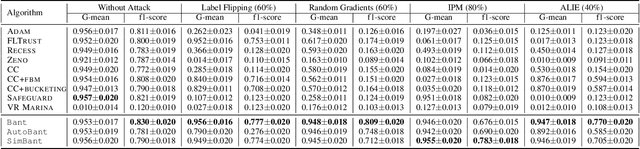
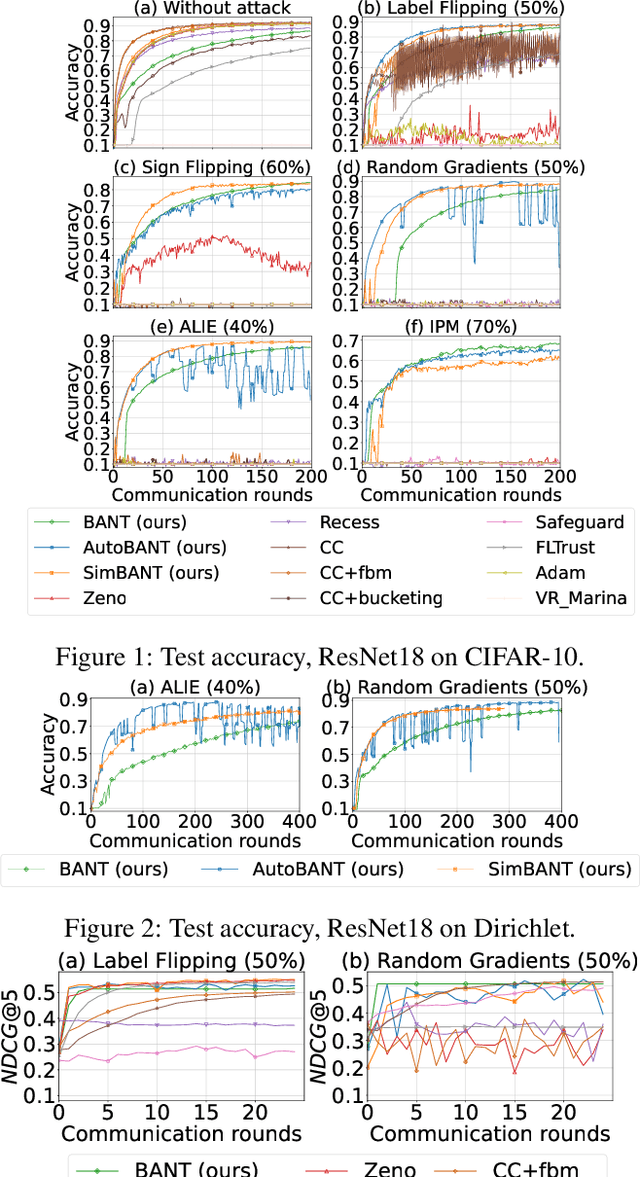
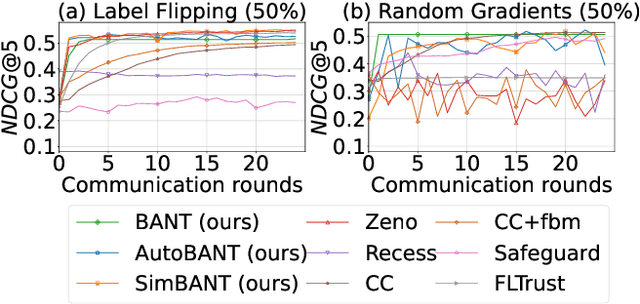
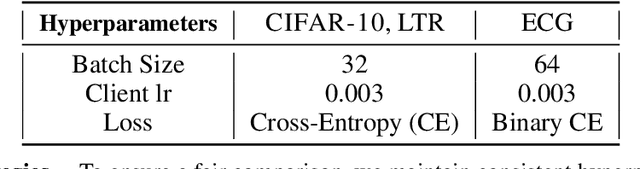
Recent advancements in machine learning have improved performance while also increasing computational demands. While federated and distributed setups address these issues, their structure is vulnerable to malicious influences. In this paper, we address a specific threat, Byzantine attacks, where compromised clients inject adversarial updates to derail global convergence. We combine the trust scores concept with trial function methodology to dynamically filter outliers. Our methods address the critical limitations of previous approaches, allowing functionality even when Byzantine nodes are in the majority. Moreover, our algorithms adapt to widely used scaled methods like Adam and RMSProp, as well as practical scenarios, including local training and partial participation. We validate the robustness of our methods by conducting extensive experiments on both synthetic and real ECG data collected from medical institutions. Furthermore, we provide a broad theoretical analysis of our algorithms and their extensions to aforementioned practical setups. The convergence guarantees of our methods are comparable to those of classical algorithms developed without Byzantine interference.