 Add to Chrome
 Add to Firefox
 Add to Edge
Tensorion: A Tensor-Aware Generalization of the Muon Optimizer
Jun 24, 2026
Common first-order optimizers, such as Adam, implicitly treat each parameter block as an unstructured vector, which disregards the multilinear weight structure present in many modern machine learning models. Recent work has shown that exploiting matrix structure can improve optimization dynamics. A notable example is Muon, which performs steepest descent under the spectral norm constraint. We take the next step and introduce Tensorion, a tensor-aware optimizer that extends Muon's constrained optimization perspective from matrices to higher-order tensors. Tensorion is built around a linear minimization oracle (LMO) over a tensor norm ball. The norm is carefully chosen to balance two objectives: tightly bounding the tensor spectral norm, while still keeping the LMO tractable. This LMO becomes computable because it reduces to operations on adaptively selected unfolding matrices. Notably, when restricted to order-2 tensors (i.e., matrices), Tensorion recovers Muon exactly. Experiments on tensor-based computer vision problems suggest that Tensorion can offer improved convergence behavior and more stable gradient updates compared with Adam-based and existing tensor-aware baselines in the evaluated settings.

OrthoFuse: Training-free Riemannian Fusion of Orthogonal Style-Concept Adapters for Diffusion Models
Apr 06, 2026In a rapidly growing field of model training there is a constant practical interest in parameter-efficient fine-tuning and various techniques that use a small amount of training data to adapt the model to a narrow task. However, there is an open question: how to combine several adapters tuned for different tasks into one which is able to yield adequate results on both tasks? Specifically, merging subject and style adapters for generative models remains unresolved. In this paper we seek to show that in the case of orthogonal fine-tuning (OFT), we can use structured orthogonal parametrization and its geometric properties to get the formulas for training-free adapter merging. In particular, we derive the structure of the manifold formed by the recently proposed Group-and-Shuffle ($\mathcal{GS}$) orthogonal matrices, and obtain efficient formulas for the geodesics approximation between two points. Additionally, we propose a $\text{spectra restoration}$ transform that restores spectral properties of the merged adapter for higher-quality fusion. We conduct experiments in subject-driven generation tasks showing that our technique to merge two $\mathcal{GS}$ orthogonal matrices is capable of uniting concept and style features of different adapters. To the best of our knowledge, this is the first training-free method for merging multiplicative orthogonal adapters. Code is available via the $\href{https://github.com/ControlGenAI/OrthoFuse}{link}$.
RiemannLoRA: A Unified Riemannian Framework for Ambiguity-Free LoRA Optimization
Jul 16, 2025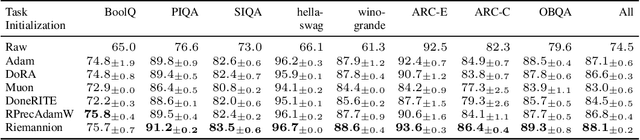
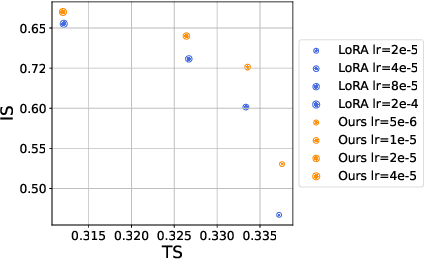
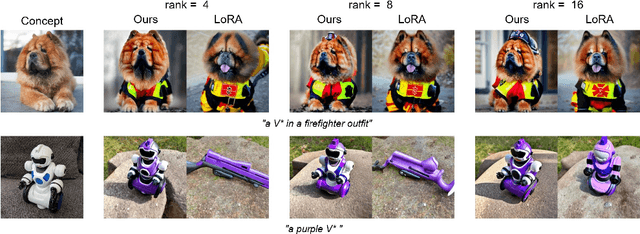

Low-Rank Adaptation (LoRA) has become a widely adopted standard for parameter-efficient fine-tuning of large language models (LLMs), significantly reducing memory and computational demands. However, challenges remain, including finding optimal initialization strategies or mitigating overparametrization in low-rank matrix factorization. In this work, we propose a novel approach that addresses both of the challenges simultaneously within a unified framework. Our method treats a set of fixed-rank LoRA matrices as a smooth manifold. Considering adapters as elements on this manifold removes overparametrization, while determining the direction of the fastest loss decrease along the manifold provides initialization. Special care is taken to obtain numerically stable and computationally efficient implementation of our method, using best practices from numerical linear algebra and Riemannian optimization. Experimental results on LLM and diffusion model architectures demonstrate that RiemannLoRA consistently improves both convergence speed and final performance over standard LoRA and its state-of-the-art modifications.