 Add to Chrome
 Add to Firefox
 Add to Edge
Learning Interpretable Point-Based Clinical Risk Scores via Direct Optimization
May 18, 2026
Many clinical risk scores are deployed as additive rules with nonnegative integer points assigned to relevant binary predictive features. These integer weights not only make the score easier to use in practice but also promote sparsity in the resulting prediction model. Such risk scores are often derived by first fitting a regression model and then rounding the estimated coefficients to the nearest integer after appropriate scaling. This approach is computationally fast but does not guarantee optimality of the resulting score. Alternatively, one may search over all possible integer weights to directly optimize a value function by posing the problem as an integer programming task. However, the associated computational burden can be substantial, especially when the value function is nonconcave or even discontinuous. In this paper, we develop new machine learning algorithms that employ a flexible greedy optimization strategy to learn such additive scoring directly under explicit and sensible optimality objectives. We apply the proposed method to a large electronic health record (EHR) cohort in Epic Cosmos to construct an integer-weighted comorbidity score for measuring the risk of post-discharge mortality. We also conduct a simulation study to examine the finite-sample operating characteristics.

Bootstrapping the Cross-Validation Estimate
Jul 01, 2023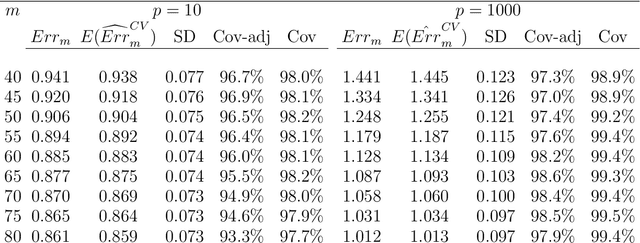
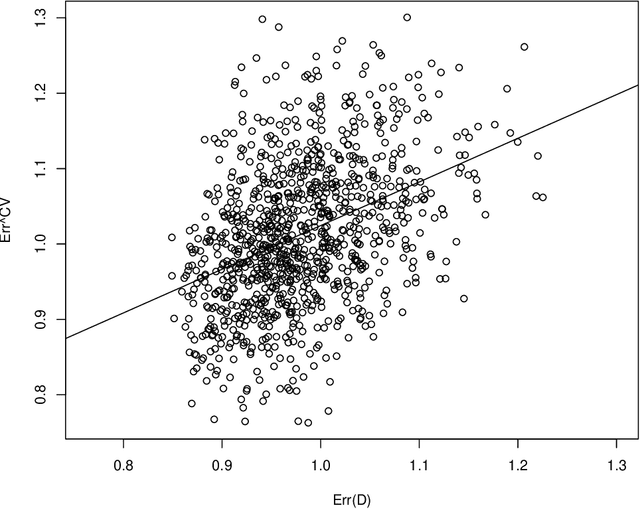
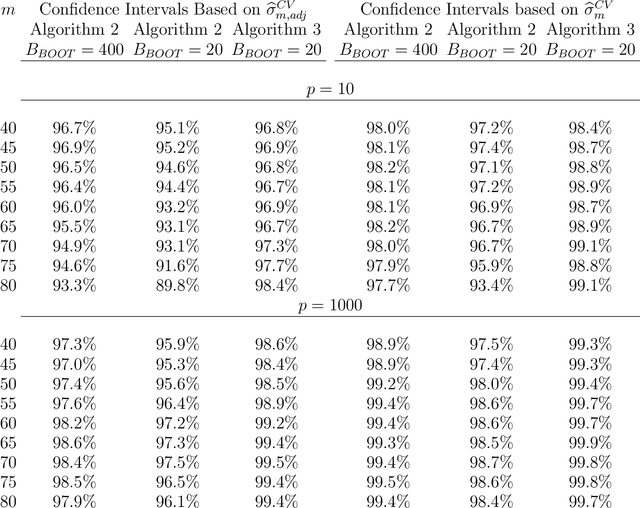
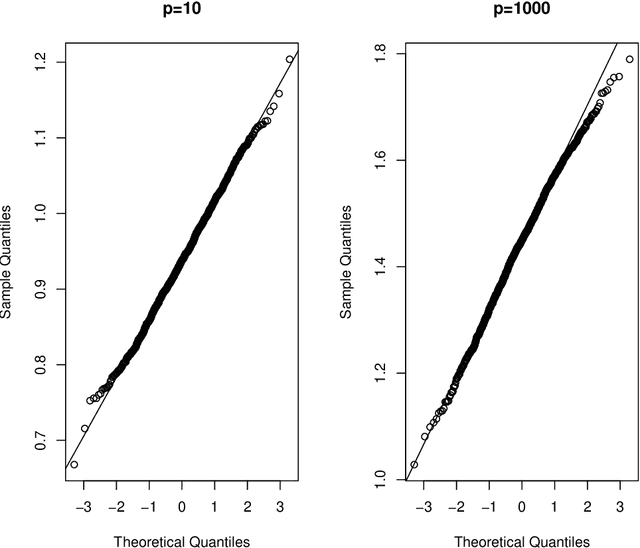
Cross-validation is a widely used technique for evaluating the performance of prediction models. It helps avoid the optimism bias in error estimates, which can be significant for models built using complex statistical learning algorithms. However, since the cross-validation estimate is a random value dependent on observed data, it is essential to accurately quantify the uncertainty associated with the estimate. This is especially important when comparing the performance of two models using cross-validation, as one must determine whether differences in error estimates are a result of chance fluctuations. Although various methods have been developed for making inferences on cross-validation estimates, they often have many limitations, such as stringent model assumptions This paper proposes a fast bootstrap method that quickly estimates the standard error of the cross-validation estimate and produces valid confidence intervals for a population parameter measuring average model performance. Our method overcomes the computational challenge inherent in bootstrapping the cross-validation estimate by estimating the variance component within a random effects model. It is just as flexible as the cross-validation procedure itself. To showcase the effectiveness of our approach, we employ comprehensive simulations and real data analysis across three diverse applications.