 Add to Chrome
 Add to Firefox
 Add to Edge
Tree-Structured Orthonormal Decomposition of the Aitchison Simplex
Jun 10, 2026
Compositional data -- vectors encoding relative proportions -- arise across scientific domains, including ecology, geochemistry, and genomics. The features in these data often come with known hierarchical structure (e.g., taxonomies, phylogenies, ontologies), yet existing methods either ignore this structure, discard the intrinsic Aitchison geometry, are designed for binary trees, or yield incomplete coordinate systems. We describe PolyILR, a canonical orthonormal decomposition of the Aitchison tangent space aligned with any tree topology. Our construction defines a weighted local geometry at each internal node capturing full branching structure, then lifts these to a global orthonormal basis where every coordinate corresponds to a specific tree location. On microbiome and single-cell benchmarks, PolyILR yields stable, interpretable features and enables inference at multiscale tree resolution. We also establish a novel theoretical connection to softmax classifiers, suggesting possible applications to probabilistic modeling.

Recursive Binding on a Budget: Subspace Carving in Order-p Tensor Memories
Jun 09, 2026Tensor Product Representations provide the structural fidelity required for symbolic reasoning in models but suffer from exponential dimensionality growth when encoding deep recursive structures. Conversely, Vector Symbolic Architectures maintain constant dimensionality but sacrifice capacity and fidelity due to noisy compression via superposition. In this work, we propose Orthogonal Subspace Carving (OSC), a memory architecture that binds fillers to roles by projecting onto the null space of the role basis before aggregating into a fixed order-p tensor. OSC uses projections to enforce geometric orthogonality between bound structures within a static memory trace. We show that this mechanism decouples the tensor order from the structural depth, enabling deep recursive binding within a constant memory footprint. By performing retrieval via recognition, this construction allows for component vectors that are orders of magnitude smaller than the memory tensor, giving superior memory efficiency in settings involving high superposition. We also show that TPR is a special case of binding in Clifford algebra, and give a Clifford formulation of OSC.
* 24 pages, 12 figures, 7 tables
Learning to Solve Generative ODEs Beyond the Linear Span
Jun 07, 2026Diffusion and flow generative models sample by integrating a learned ODE, but high quality still requires many sequential model evaluations. Solver learning reduces this cost by adapting scalar coefficients, timesteps, or both, while keeping the backbone model fixed. In this work, we identify a structural bottleneck in this update family: each step remains span-limited. Since the scalar-coefficient update lies in the span of buffered velocity evaluations, it can fit only the in-span component while leaving any out-of-span residual unreachable by scalar recombination alone. We propose SpanLift, a lightweight neural solver that augments scalar-coefficient updates with a spatial residual operator. SpanLift keeps a fixed base solver as an in-span prior and learns a spatial residual operator over the state and velocity buffer. The operator is trained by endpoint teacher matching, preserves the pretrained backbone, and adds no model NFEs. Empirically, the learned correction transfers across base solvers and is predominantly out-of-span. Across pixel-space diffusion, latent flow matching, and precipitation nowcasting, SpanLift achieves state-of-the-art few-step sampling. With only 3 NFE, it improves CIFAR-10 FID from 8.16 to 5.69 and ImageNet FID from 17.37 to 11.83.
Empirical Bayes Conformal Prediction for Vision and Language Models
May 22, 2026Conformal prediction (CP) gives distribution-free coverage for modern vision and language models, but it is often forced to make a ranking decision from a single unstable nonconformity score. Standard CP uses one realization, while average-then-calibrate variants smooth multiple realizations into a point estimate. Both options discard the inconsistency that can help identify whether a candidate is indeed stable. A weak answer can enter the conformal set even if the evidence is not strong, simply because one posterior sample or prompt phrasing made it look strong. But variability can help distinguish a stable signal from noise-driven fluctuations. We describe an empirical Bayes conformal prediction framework that uses $r$-values to convert score variability into an uncertainty informed nonconformity score. The resulting $r$-value estimates how likely a candidate's latent score belongs to the top-ranked group after accounting for both its mean score and its uncertainty. It admits both a closed-form Normal-Normal empirical Bayes estimator and a nonparametric posterior-sampling estimator. Using the $r$-value as the nonconformity score preserves the target conformal coverage while provably reducing the inclusion of high variance false candidates under mild regularity conditions. Across image classification, CLIP-based VLM benchmarks, and LLMs, we show that $r$-value conformal prediction preserves target coverage while improving ranking stability and reducing set size when variability is informative, and reverting to CP-like behavior when variability vanishes.
NeuroScalar: A Deep Learning Framework for Fast, Accurate, and In-the-Wild Cycle-Level Performance Prediction
Sep 26, 2025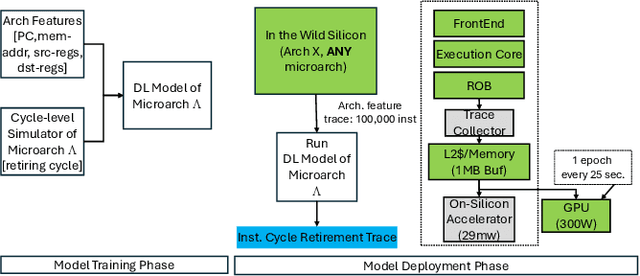

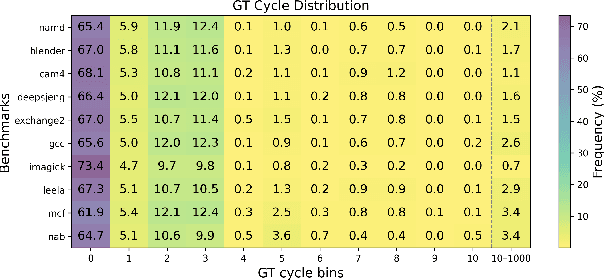
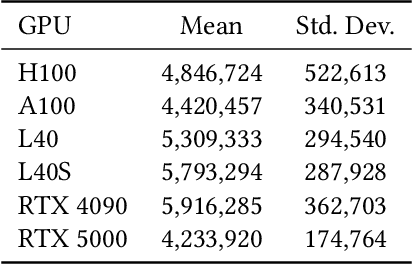
The evaluation of new microprocessor designs is constrained by slow, cycle-accurate simulators that rely on unrepresentative benchmark traces. This paper introduces a novel deep learning framework for high-fidelity, ``in-the-wild'' simulation on production hardware. Our core contribution is a DL model trained on microarchitecture-independent features to predict cycle-level performance for hypothetical processor designs. This unique approach allows the model to be deployed on existing silicon to evaluate future hardware. We propose a complete system featuring a lightweight hardware trace collector and a principled sampling strategy to minimize user impact. This system achieves a simulation speed of 5 MIPS on a commodity GPU, imposing a mere 0.1% performance overhead. Furthermore, our co-designed Neutrino on-chip accelerator improves performance by 85x over the GPU. We demonstrate that this framework enables accurate performance analysis and large-scale hardware A/B testing on a massive scale using real-world applications.
Composing Linear Layers from Irreducibles
Jul 15, 2025Contemporary large models often exhibit behaviors suggesting the presence of low-level primitives that compose into modules with richer functionality, but these fundamental building blocks remain poorly understood. We investigate this compositional structure in linear layers by asking: can we identify/synthesize linear transformations from a minimal set of geometric primitives? Using Clifford algebra, we show that linear layers can be expressed as compositions of bivectors -- geometric objects encoding oriented planes -- and introduce a differentiable algorithm that decomposes them into products of rotors. This construction uses only O(log^2 d) parameters, versus O(d^2) required by dense matrices. Applied to the key, query, and value projections in LLM attention layers, our rotor-based layers match the performance of strong baselines such as block-Hadamard and low-rank approximations. Our findings provide an algebraic perspective on how these geometric primitives can compose into higher-level functions within deep models.
Brain-wide interpolation and conditioning of gene expression in the human brain using Implicit Neural Representations
Jun 11, 2025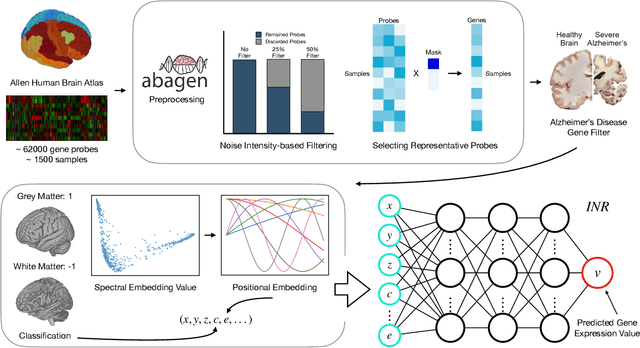


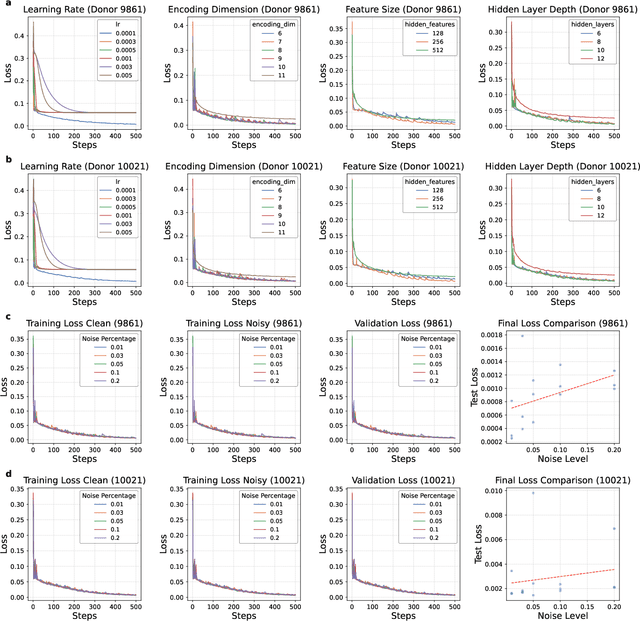
In this paper, we study the efficacy and utility of recent advances in non-local, non-linear image interpolation and extrapolation algorithms, specifically, ideas based on Implicit Neural Representations (INR), as a tool for analysis of spatial transcriptomics data. We seek to utilize the microarray gene expression data sparsely sampled in the healthy human brain, and produce fully resolved spatial maps of any given gene across the whole brain at a voxel-level resolution. To do so, we first obtained the 100 top AD risk genes, whose baseline spatial transcriptional profiles were obtained from the Allen Human Brain Atlas (AHBA). We adapted Implicit Neural Representation models so that the pipeline can produce robust voxel-resolution quantitative maps of all genes. We present a variety of experiments using interpolations obtained from Abagen as a baseline/reference.
Real-Time Brain Tumor Detection in Intraoperative Ultrasound Using YOLO11: From Model Training to Deployment in the Operating Room
Jan 27, 2025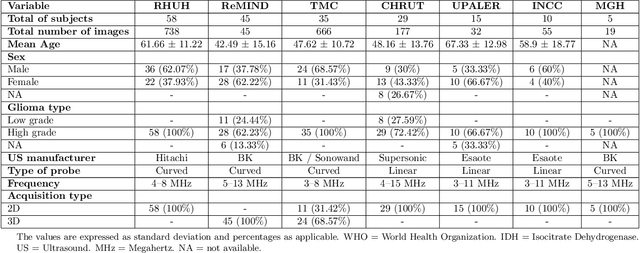


Intraoperative ultrasound (ioUS) is a valuable tool in brain tumor surgery due to its versatility, affordability, and seamless integration into the surgical workflow. However, its adoption remains limited, primarily because of the challenges associated with image interpretation and the steep learning curve required for effective use. This study aimed to enhance the interpretability of ioUS images by developing a real-time brain tumor detection system deployable in the operating room. We collected 2D ioUS images from the Brain Tumor Intraoperative Database (BraTioUS) and the public ReMIND dataset, annotated with expert-refined tumor labels. Using the YOLO11 architecture and its variants, we trained object detection models to identify brain tumors. The dataset included 1,732 images from 192 patients, divided into training, validation, and test sets. Data augmentation expanded the training set to 11,570 images. In the test dataset, YOLO11s achieved the best balance of precision and computational efficiency, with a mAP@50 of 0.95, mAP@50-95 of 0.65, and a processing speed of 34.16 frames per second. The proposed solution was prospectively validated in a cohort of 15 consecutively operated patients diagnosed with brain tumors. Neurosurgeons confirmed its seamless integration into the surgical workflow, with real-time predictions accurately delineating tumor regions. These findings highlight the potential of real-time object detection algorithms to enhance ioUS-guided brain tumor surgery, addressing key challenges in interpretation and providing a foundation for future development of computer vision-based tools for neuro-oncological surgery.
Hotel Booking Cancellation Prediction Using Applied Bayesian Models
Oct 23, 2024This study applies Bayesian models to predict hotel booking cancellations, a key challenge affecting resource allocation, revenue, and customer satisfaction in the hospitality industry. Using a Kaggle dataset with 36,285 observations and 17 features, Bayesian Logistic Regression and Beta-Binomial models were implemented. The logistic model, applied to 12 features and 5,000 randomly selected observations, outperformed the Beta-Binomial model in predictive accuracy. Key predictors included the number of adults, children, stay duration, lead time, car parking space, room type, and special requests. Model evaluation using Leave-One-Out Cross-Validation (LOO-CV) confirmed strong alignment between observed and predicted outcomes, demonstrating the model's robustness. Special requests and parking availability were found to be the strongest predictors of cancellation. This Bayesian approach provides a valuable tool for improving booking management and operational efficiency in the hotel industry.
Variational Sampling of Temporal Trajectories
Mar 18, 2024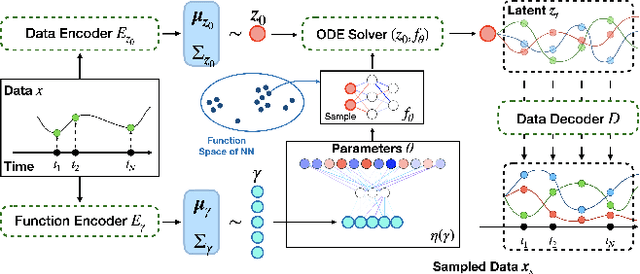
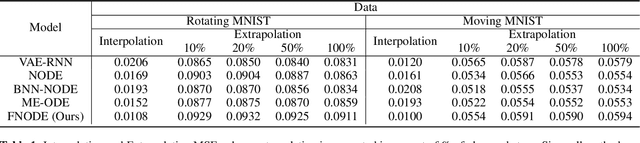
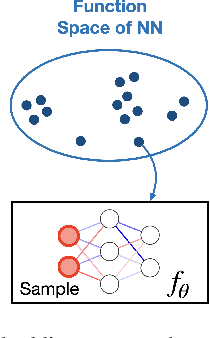

A deterministic temporal process can be determined by its trajectory, an element in the product space of (a) initial condition $z_0 \in \mathcal{Z}$ and (b) transition function $f: (\mathcal{Z}, \mathcal{T}) \to \mathcal{Z}$ often influenced by the control of the underlying dynamical system. Existing methods often model the transition function as a differential equation or as a recurrent neural network. Despite their effectiveness in predicting future measurements, few results have successfully established a method for sampling and statistical inference of trajectories using neural networks, partially due to constraints in the parameterization. In this work, we introduce a mechanism to learn the distribution of trajectories by parameterizing the transition function $f$ explicitly as an element in a function space. Our framework allows efficient synthesis of novel trajectories, while also directly providing a convenient tool for inference, i.e., uncertainty estimation, likelihood evaluations and out of distribution detection for abnormal trajectories. These capabilities can have implications for various downstream tasks, e.g., simulation and evaluation for reinforcement learning.