 Add to Chrome
 Add to Firefox
 Add to Edge
Granite Embedding Multilingual R2 Models
May 13, 2026
We introduce the multilingual Granite Embedding R2 models, a family of encoder-based embedding models for enterprise-scale dense retrieval across 200+ languages. Extending our English-focused R2 release, these models add enhanced support for 52 languages and programming code, a 32,768-token context window (a 64x expansion over R1), and state-of-the-art overall performance across multilingual and cross-lingual text search, code retrieval, long-document search, and reasoning retrieval datasets. The release consists of two bi-encoder models based on the ModernBERT architecture with an expanded multilingual vocabulary: a 311M-parameter full-size, and a 97M-parameter compact model built via model pruning and vocabulary selection that achieves the highest retrieval score of any open multilingual embedding model under 100M parameters. The full-size also supports Matryoshka Representation Learning for flexible embedding dimensionality. Both models are trained on enterprise-appropriate data with governance oversight, and released under the Apache 2.0 license at https://huggingface.co/collections/ibm-granite, designed to support responsible use and enable unrestricted research and enterprise adoption.

Granite Embedding Models
Feb 27, 2025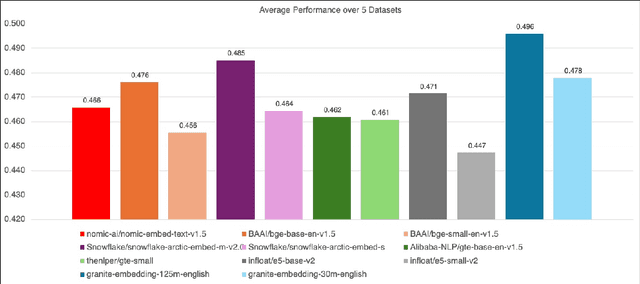
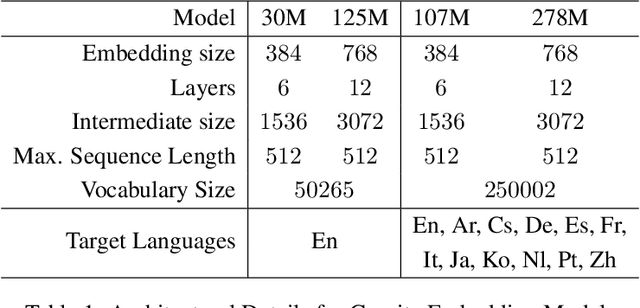
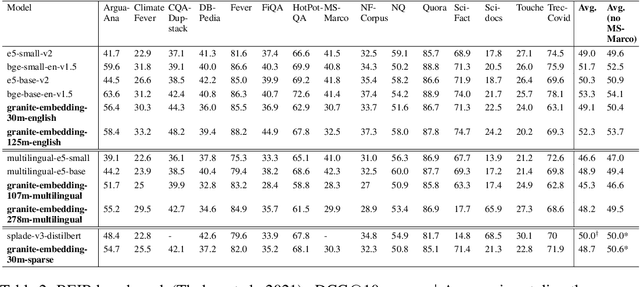

We introduce the Granite Embedding models, a family of encoder-based embedding models designed for retrieval tasks, spanning dense-retrieval and sparse retrieval architectures, with both English and Multilingual capabilities. This report provides the technical details of training these highly effective 12 layer embedding models, along with their efficient 6 layer distilled counterparts. Extensive evaluations show that the models, developed with techniques like retrieval oriented pretraining, contrastive finetuning, knowledge distillation, and model merging significantly outperform publicly available models of similar sizes on both internal IBM retrieval and search tasks, and have equivalent performance on widely used information retrieval benchmarks, while being trained on high-quality data suitable for enterprise use. We publicly release all our Granite Embedding models under the Apache 2.0 license, allowing both research and commercial use at https://huggingface.co/collections/ibm-granite.
Mistral-SPLADE: LLMs for better Learned Sparse Retrieval
Aug 22, 2024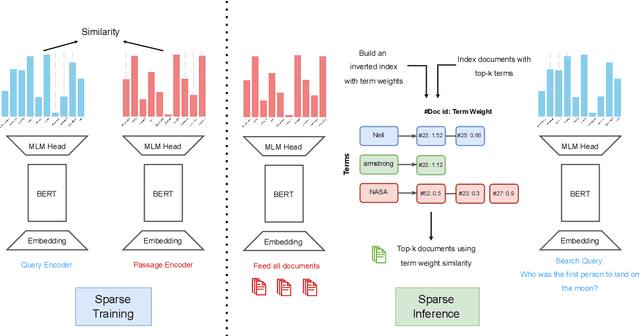
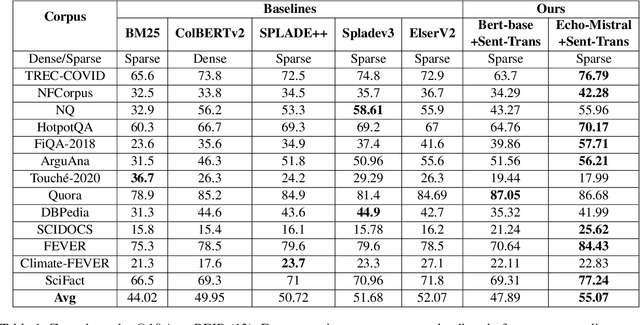
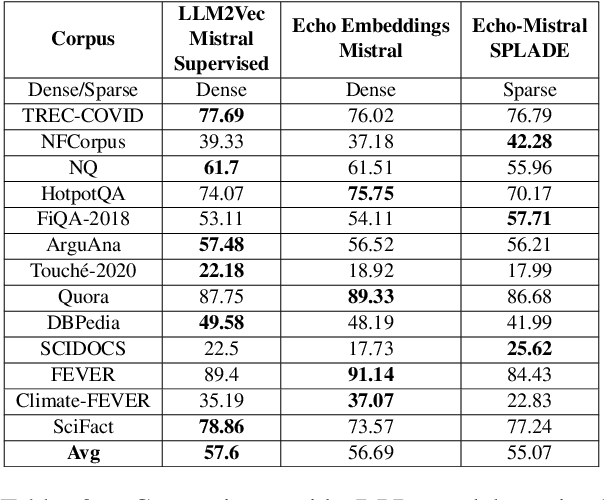
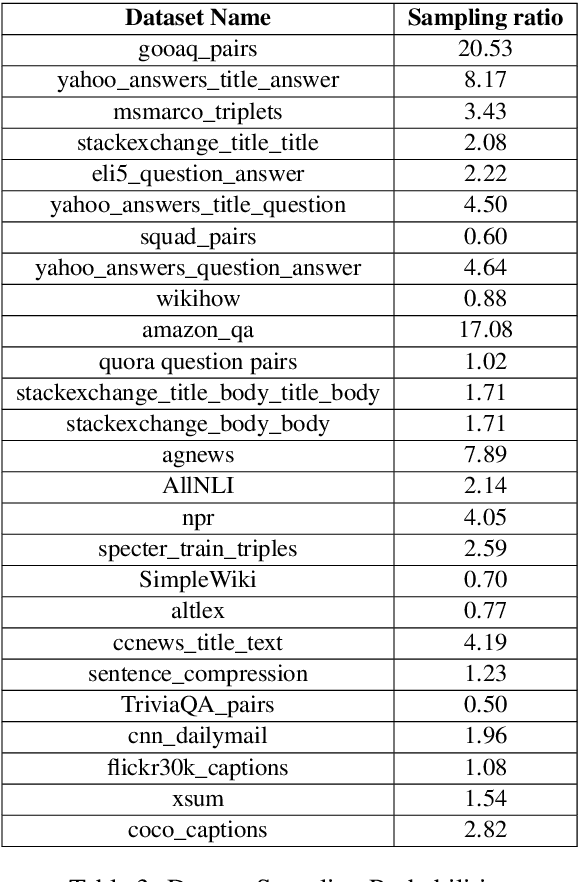
Learned Sparse Retrievers (LSR) have evolved into an effective retrieval strategy that can bridge the gap between traditional keyword-based sparse retrievers and embedding-based dense retrievers. At its core, learned sparse retrievers try to learn the most important semantic keyword expansions from a query and/or document which can facilitate better retrieval with overlapping keyword expansions. LSR like SPLADE has typically been using encoder only models with MLM (masked language modeling) style objective in conjunction with known ways of retrieval performance improvement such as hard negative mining, distillation, etc. In this work, we propose to use decoder-only model for learning semantic keyword expansion. We posit, decoder only models that have seen much higher magnitudes of data are better equipped to learn keyword expansions needed for improved retrieval. We use Mistral as the backbone to develop our Learned Sparse Retriever similar to SPLADE and train it on a subset of sentence-transformer data which is often used for training text embedding models. Our experiments support the hypothesis that a sparse retrieval model based on decoder only large language model (LLM) surpasses the performance of existing LSR systems, including SPLADE and all its variants. The LLM based model (Echo-Mistral-SPLADE) now stands as a state-of-the-art learned sparse retrieval model on the BEIR text retrieval benchmark.