 Add to Chrome
 Add to Firefox
 Add to Edge
REFLEX: Reflexive Equilibrium Fixed-point Learning for Endogenous eXchanges
Aug 17, 2026
In over-the-counter corporate bond markets, dealers compete for client trades by quoting bid and ask prices. Tighter quotes attract more business, but also informed customers more likely to trade ahead of adverse price moves, leaving the dealer holding the risk. As dealers increasingly use machine learning to set quotes, they retrain these models on the trades their own quotes attract, creating a feedback loop in which each model reshapes the market that generates its next training data. The question is therefore not only whether a quoting model performs well, but whether the market it creates stays stable as the model learns from it. Existing performative prediction theory gives a sharp stability condition, yet expresses it through abstract properties of the learning objective a trading desk cannot measure before deployment. We introduce REFLEX, a framework that replaces those unobservable quantities with three measurable features of dealer behavior: how strongly trading volume responds to tighter quotes, how sharply the dealer's objective bends around its optimum, and how quickly informed flow increases as spreads narrow. REFLEX combines these into a single retraining modulus, a pre-deployment stability margin estimated from a desk's own quote and execution history that predicts whether repeated retraining will converge or amplify itself. In simulation, predicted and measured stability agree within 8%, and competing dealers increase instability by 1.74x with two and 3.16x with three, as predicted. Where ordinary retraining becomes unstable at modulus 1.21, a structurally anchored correction converges as blind retraining collapses. Calibrated over 36 years of public market data, stability headroom falls roughly 4.4x for investment grade and 4.3x for high yield from calm to crisis regimes. Ultimately, REFLEX turns an abstract convergence theorem into a market-level safety margin.

MIRROR: Multimodal Intelligent Radiology Reasoning and Observation Reporter
Aug 17, 2026A radiologist reading a model's output faces two problems. The model returns a number and no reason, and any system that turns that number into readable prose can quietly add claims the model never made. MIRROR is a research prototype built to separate those failures. It chains a multi-label classifier, a Grad-CAM localizer that turns each positive finding into a named anatomical region, and a report writer that receives the labels, probabilities, and regions but never the image. Because the language layer cannot see pixels, it cannot assert a finding the classifier did not make. We are precise about what that buys: a MIRROR report's findings are auditable against the probability vector, while the sentences framing them are ordinary generated text, and we show one stating a cardiothoracic ratio the system never measured. One registry holds the taxonomy, anatomy, and phrasing for chest X-ray, brain MRI, and head CT, so adding a modality is a data change; all three are routed and tested, one is trained. On ChestMNIST that classifier reaches macro AUROC 0.729 and ranks better than chance on all 14 labels, at 1.6 to 6.8 times the precision a random ranker would get. Yet at the default 0.5 threshold it emits no positive prediction at all for 11 of them, and its excellent-looking Brier score of 0.045 sits beside the 0.047 earned by a predictor that ignores the image. The discrimination is real; the decisions are not. Under the class imbalance normal in radiology, aggregate metrics flatter models that do nothing, and should be reported against that floor.
Svarah: Evaluating English ASR Systems on Indian Accents
May 25, 2023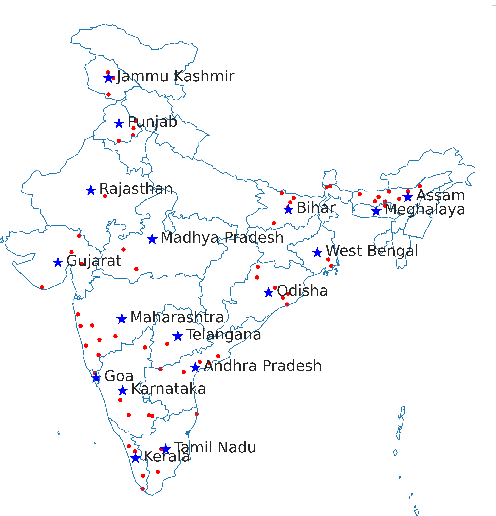
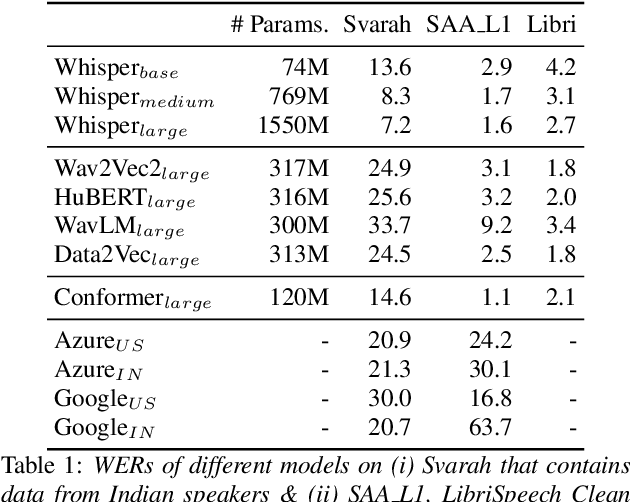

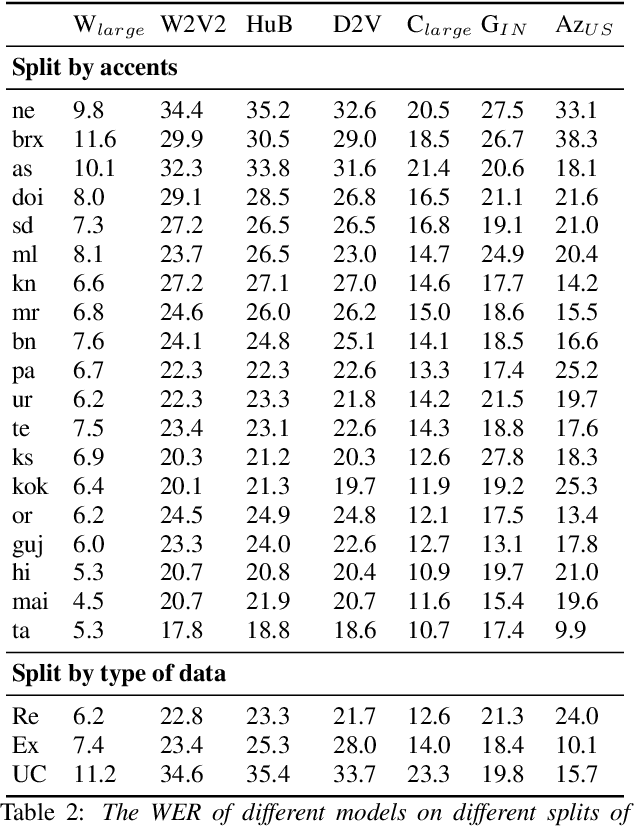
India is the second largest English-speaking country in the world with a speaker base of roughly 130 million. Thus, it is imperative that automatic speech recognition (ASR) systems for English should be evaluated on Indian accents. Unfortunately, Indian speakers find a very poor representation in existing English ASR benchmarks such as LibriSpeech, Switchboard, Speech Accent Archive, etc. In this work, we address this gap by creating Svarah, a benchmark that contains 9.6 hours of transcribed English audio from 117 speakers across 65 geographic locations throughout India, resulting in a diverse range of accents. Svarah comprises both read speech and spontaneous conversational data, covering various domains, such as history, culture, tourism, etc., ensuring a diverse vocabulary. We evaluate 6 open source ASR models and 2 commercial ASR systems on Svarah and show that there is clear scope for improvement on Indian accents. Svarah as well as all our code will be publicly available.
IndicMT Eval: A Dataset to Meta-Evaluate Machine Translation metrics for Indian Languages
Dec 20, 2022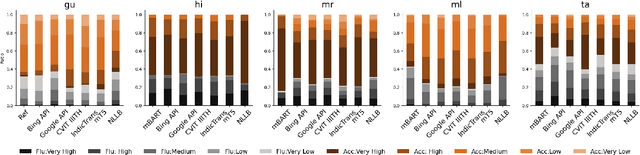
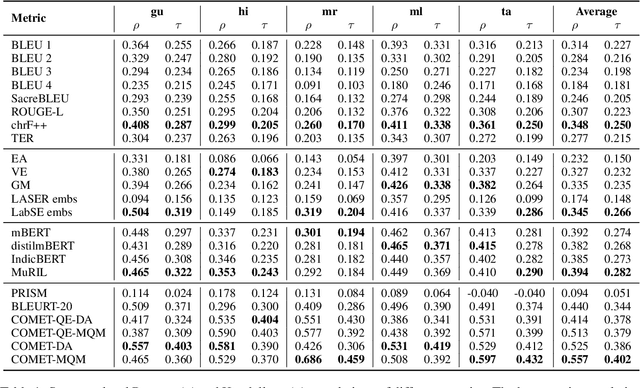
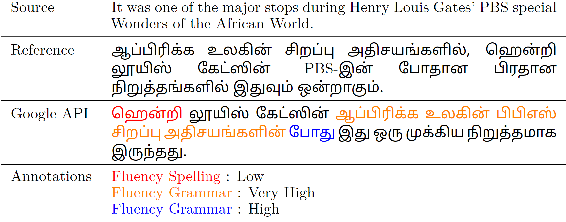
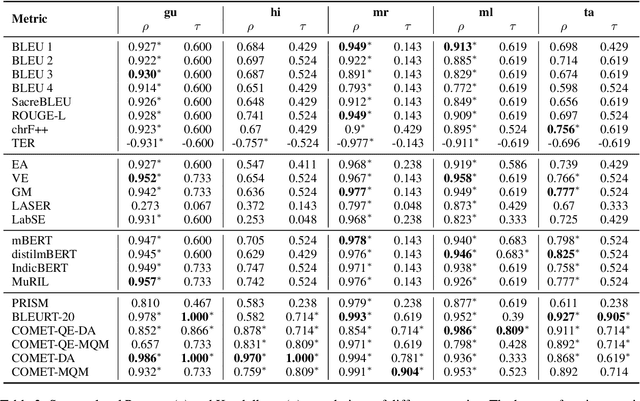
The rapid growth of machine translation (MT) systems has necessitated comprehensive studies to meta-evaluate evaluation metrics being used, which enables a better selection of metrics that best reflect MT quality. Unfortunately, most of the research focuses on high-resource languages, mainly English, the observations for which may not always apply to other languages. Indian languages, having over a billion speakers, are linguistically different from English, and to date, there has not been a systematic study of evaluating MT systems from English into Indian languages. In this paper, we fill this gap by creating an MQM dataset consisting of 7000 fine-grained annotations, spanning 5 Indian languages and 7 MT systems, and use it to establish correlations between annotator scores and scores obtained using existing automatic metrics. Our results show that pre-trained metrics, such as COMET, have the highest correlations with annotator scores. Additionally, we find that the metrics do not adequately capture fluency-based errors in Indian languages, and there is a need to develop metrics focused on Indian languages. We hope that our dataset and analysis will help promote further research in this area.