 Add to Chrome
 Add to Firefox
 Add to Edge
CALM: Class-Conditional Sparse Attention Vectors for Large Audio-Language Models
Feb 06, 2026
Large audio-language models (LALMs) exhibit strong zero-shot capabilities in multiple downstream tasks, such as audio question answering (AQA) and abstract reasoning; however, these models still lag behind specialized models for certain discriminative tasks (e.g., audio classification). Recent studies show that sparse subsets of attention heads within an LALM can serve as strong discriminative feature extractors for downstream tasks such as classification via simple voting schemes. However, these methods assign uniform weights to all selected heads, implicitly assuming that each head contributes equally across all semantic categories. In this work, we propose Class-Conditional Sparse Attention Vectors for Large Audio-Language Models, a few-shot classification method that learns class-dependent importance weights over attention heads. This formulation allows individual heads to specialize in distinct semantic categories and to contribute to ensemble predictions proportionally to their estimated reliability. Experiments on multiple few-shot audio and audiovisual classification benchmarks and tasks demonstrate that our method consistently outperforms state-of-the-art uniform voting-based approaches by up to 14.52%, 1.53%, 8.35% absolute gains for audio classification, audio-visual classification, and spoofing detection respectively.

Anomaly Detection in Satellite Videos using Diffusion Models
May 25, 2023
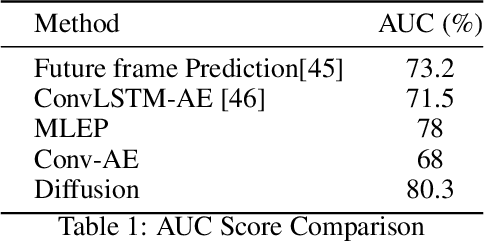
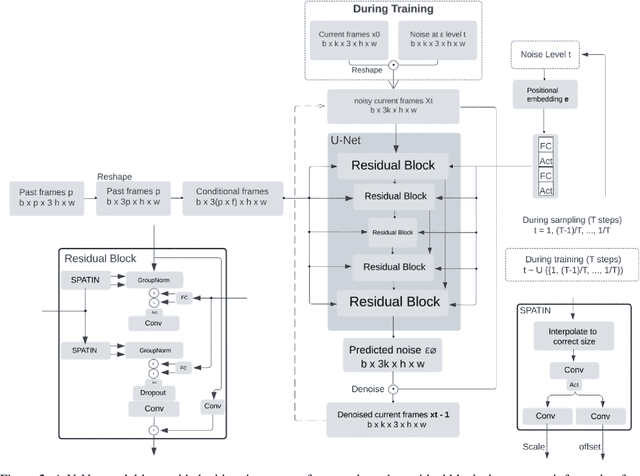
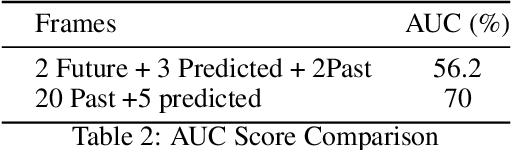
The definition of anomaly detection is the identification of an unexpected event. Real-time detection of extreme events such as wildfires, cyclones, or floods using satellite data has become crucial for disaster management. Although several earth-observing satellites provide information about disasters, satellites in the geostationary orbit provide data at intervals as frequent as every minute, effectively creating a video from space. There are many techniques that have been proposed to identify anomalies in surveillance videos; however, the available datasets do not have dynamic behavior, so we discuss an anomaly framework that can work on very high-frequency datasets to find very fast-moving anomalies. In this work, we present a diffusion model which does not need any motion component to capture the fast-moving anomalies and outperforms the other baseline methods.