 Add to Chrome
 Add to Firefox
 Add to Edge
AI Adoption Across a Multinational Workforce: Sociotechnical Conditions for GenAI Acceptance in Human Resources
Jun 16, 2026
Generative AI (GenAI) deployment in the workplace is accelerating rapidly. Nevertheless, questions of who adopts, who benefits, and who is left behind and why are still understudied. In this paper, we investigate these dynamics in the context of a multinational tech company transitioning from a legacy Human Resources (HR) search system to a GenAI-supported system, analyzing search log data, survey data (n=25), and ten semi-structured interviews. Our findings show that adoption depended on the fit between the GenAI system's design assumptions and employees' work positionalities (role, spoken language, tenure). Further, we find that employees' trust in GenAI answers was built through source-checking, comparison among systems, and seeking input from colleagues or HR when in doubt. Our contribution is twofold. First, we provide empirical evidence of workplace GenAI adoption during a live organizational transition, showing that adoption is influenced by factors such as situational fit, search literacy, and trust calibration. It is also further shaped by knowledge conditions such as the system's content quality, employee training, and guidance. Second, we translate these findings into design considerations for inclusive deployment and adoption in high-stakes environments such as HR. We argue that organizations should design systems considering the role and context-sensitive benefits they yield to different social groups. They also need to treat the organizational knowledge infrastructure as AI infrastructure to improve the accountability and usability of GenAI systems

Towards the Use of Saliency Maps for Explaining Low-Quality Electrocardiograms to End Users
Jul 06, 2022

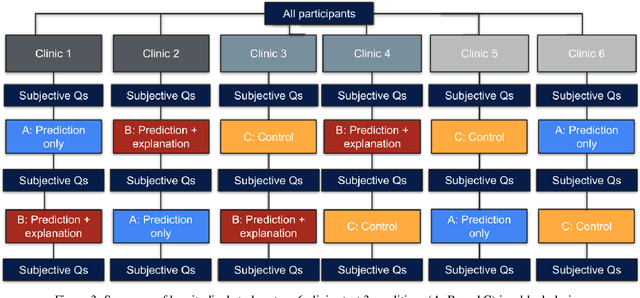
When using medical images for diagnosis, either by clinicians or artificial intelligence (AI) systems, it is important that the images are of high quality. When an image is of low quality, the medical exam that produced the image often needs to be redone. In telemedicine, a common problem is that the quality issue is only flagged once the patient has left the clinic, meaning they must return in order to have the exam redone. This can be especially difficult for people living in remote regions, who make up a substantial portion of the patients at Portal Telemedicina, a digital healthcare organization based in Brazil. In this paper, we report on ongoing work regarding (i) the development of an AI system for flagging and explaining low-quality medical images in real-time, (ii) an interview study to understand the explanation needs of stakeholders using the AI system at OurCompany, and, (iii) a longitudinal user study design to examine the effect of including explanations on the workflow of the technicians in our clinics. To the best of our knowledge, this would be the first longitudinal study on evaluating the effects of XAI methods on end-users -- stakeholders that use AI systems but do not have AI-specific expertise. We welcome feedback and suggestions on our experimental setup.