 Add to Chrome
 Add to Firefox
 Add to Edge
Nemotron 3 Ultra: Open, Efficient Mixture-of-Experts Hybrid Mamba-Transformer Model for Agentic Reasoning
Jun 12, 2026
We introduce Nemotron 3 Ultra, a 550 billion total and 55 billion active parameter Mixture-of-Experts Hybrid Mamba-Attention language model. We pre-trained Nemotron 3 Ultra on 20 trillion text tokens, then extended the context length to 1M tokens, and post-trained using Supervised Fine Tuning (SFT), Reinforcement Learning (RL), and Multi-teacher On-Policy Distillation (MOPD). Nemotron 3 Ultra is our most capable model yet, employing multiple key technologies - LatentMoE, Multi Token Prediction (MTP), NVFP4 pre-training, multi-environment RLVR, MOPD, and reasoning budget control. Nemotron 3 Ultra achieves up to ~6x higher inference throughput as compared to state-of-the-art publicly available LLMs while attaining on-par accuracy. The state-of-the-art accuracy, high inference throughput, and 1M token context length make Nemotron 3 Ultra ideal for long-running autonomous agentic tasks. We open-source the base, post-trained, and quantized checkpoints, along with the training data and recipe on HuggingFace.

Gyan: An Explainable Neuro-Symbolic Language Model
May 06, 2026Transformer based pre-trained large language models have become ubiquitous. There is increasing evidence to suggest that even with large scale pre-training, these models do not capture complete compositional context and certainly not, the full human analogous context. Besides, by the very nature of the architecture, these models hallucinate, are difficult to maintain, are not easily interpretable and require enormous compute resources for training and inference. Here, we describe Gyan, an explainable language model based on a novel non-transformer architecture, without any of these limitations. Gyan achieves SOTA performance on 3 widely cited data sets and superior performance on two proprietary data sets. The novel architecture decouples the language model from knowledge acquisition and representation. The model draws on rhetorical structure theory, semantic role theory and knowledge-based computational linguistics. Gyan's meaning representation structure captures the complete compositional context and attempts to mimic humans by expanding the context to a 'world model'. AI model adoption critically depends on trust and transparency especially in mission critical use cases. Collectively, our results demonstrate that it is possible to create models which are trustable and reliable for mission critical tasks. We believe our work has tremendous potential for guiding the development of transparent and trusted architectures for language models.
Nemotron 3 Nano Omni: Efficient and Open Multimodal Intelligence
Apr 27, 2026We introduce Nemotron 3 Nano Omni, the latest model in the Nemotron multimodal series and the first to natively support audio inputs alongside text, images, and video. Nemotron 3 Nano Omni delivers consistent accuracy improvements over its predecessor, Nemotron Nano V2 VL, across all modalities, enabled by advances in architecture, training data and recipes. In particular, Nemotron 3 delivers leading results in real-world document understanding, long audio-video comprehension, and agentic computer use. Built on the highly efficient Nemotron 3 Nano 30B-A3B backbone, Nemotron 3 Nano Omni further incorporates innovative multimodal token-reduction techniques to deliver substantially lower inference latency and higher throughput than other models of similar size. We are releasing model checkpoints in BF16, FP8, and FP4 formats, along with portions of the training data and codebase to facilitate further research and development.
Nemotron 3 Super: Open, Efficient Mixture-of-Experts Hybrid Mamba-Transformer Model for Agentic Reasoning
Apr 14, 2026We describe the pre-training, post-training, and quantization of Nemotron 3 Super, a 120 billion (active 12 billion) parameter hybrid Mamba-Attention Mixture-of-Experts model. Nemotron 3 Super is the first model in the Nemotron 3 family to 1) be pre-trained in NVFP4, 2) leverage LatentMoE, a new Mixture-of-Experts architecture that optimizes for both accuracy per FLOP and accuracy per parameter, and 3) include MTP layers for inference acceleration through native speculative decoding. We pre-trained Nemotron 3 Super on 25 trillion tokens followed by post-training using supervised fine tuning (SFT) and reinforcement learning (RL). The final model supports up to 1M context length and achieves comparable accuracy on common benchmarks, while also achieving up to 2.2x and 7.5x higher inference throughput compared to GPT-OSS-120B and Qwen3.5-122B, respectively. Nemotron 3 Super datasets, along with the base, post-trained, and quantized checkpoints, are open-sourced on HuggingFace.
PivotRL: High Accuracy Agentic Post-Training at Low Compute Cost
Mar 22, 2026Post-training for long-horizon agentic tasks has a tension between compute efficiency and generalization. While supervised fine-tuning (SFT) is compute efficient, it often suffers from out-of-domain (OOD) degradation. Conversely, end-to-end reinforcement learning (E2E RL) preserves OOD capabilities, but incurs high compute costs due to many turns of on-policy rollout. We introduce PivotRL, a novel framework that operates on existing SFT trajectories to combine the compute efficiency of SFT with the OOD accuracy of E2E RL. PivotRL relies on two key mechanisms: first, it executes local, on-policy rollouts and filters for pivots: informative intermediate turns where sampled actions exhibit high variance in outcomes; second, it utilizes rewards for functional-equivalent actions rather than demanding strict string matching with the SFT data demonstration. We theoretically show that these mechanisms incentivize strong learning signals with high natural gradient norm, while maximally preserving policy probability ordering on actions unrelated to training tasks. In comparison to standard SFT on identical data, we demonstrate that PivotRL achieves +4.17% higher in-domain accuracy on average across four agentic domains, and +10.04% higher OOD accuracy in non-agentic tasks. Notably, on agentic coding tasks, PivotRL achieves competitive accuracy with E2E RL with 4x fewer rollout turns. PivotRL is adopted by NVIDIA's Nemotron-3-Super-120B-A12B, acting as the workhorse in production-scale agentic post-training.
NVIDIA Nemotron 3: Efficient and Open Intelligence
Dec 24, 2025We introduce the Nemotron 3 family of models - Nano, Super, and Ultra. These models deliver strong agentic, reasoning, and conversational capabilities. The Nemotron 3 family uses a Mixture-of-Experts hybrid Mamba-Transformer architecture to provide best-in-class throughput and context lengths of up to 1M tokens. Super and Ultra models are trained with NVFP4 and incorporate LatentMoE, a novel approach that improves model quality. The two larger models also include MTP layers for faster text generation. All Nemotron 3 models are post-trained using multi-environment reinforcement learning enabling reasoning, multi-step tool use, and support granular reasoning budget control. Nano, the smallest model, outperforms comparable models in accuracy while remaining extremely cost-efficient for inference. Super is optimized for collaborative agents and high-volume workloads such as IT ticket automation. Ultra, the largest model, provides state-of-the-art accuracy and reasoning performance. Nano is released together with its technical report and this white paper, while Super and Ultra will follow in the coming months. We will openly release the model weights, pre- and post-training software, recipes, and all data for which we hold redistribution rights.
Nemotron 3 Nano: Open, Efficient Mixture-of-Experts Hybrid Mamba-Transformer Model for Agentic Reasoning
Dec 23, 2025We present Nemotron 3 Nano 30B-A3B, a Mixture-of-Experts hybrid Mamba-Transformer language model. Nemotron 3 Nano was pretrained on 25 trillion text tokens, including more than 3 trillion new unique tokens over Nemotron 2, followed by supervised fine tuning and large-scale RL on diverse environments. Nemotron 3 Nano achieves better accuracy than our previous generation Nemotron 2 Nano while activating less than half of the parameters per forward pass. It achieves up to 3.3x higher inference throughput than similarly-sized open models like GPT-OSS-20B and Qwen3-30B-A3B-Thinking-2507, while also being more accurate on popular benchmarks. Nemotron 3 Nano demonstrates enhanced agentic, reasoning, and chat abilities and supports context lengths up to 1M tokens. We release both our pretrained Nemotron 3 Nano 30B-A3B Base and post-trained Nemotron 3 Nano 30B-A3B checkpoints on Hugging Face.
NVIDIA Nemotron Nano 2: An Accurate and Efficient Hybrid Mamba-Transformer Reasoning Model
Aug 21, 2025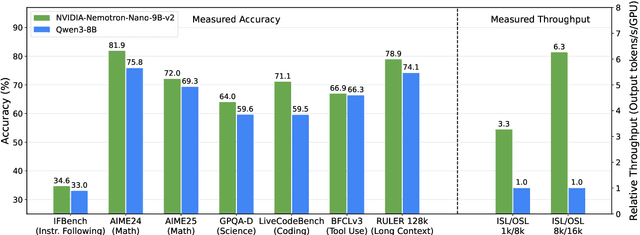

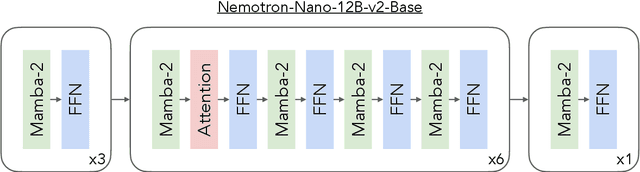
We introduce Nemotron-Nano-9B-v2, a hybrid Mamba-Transformer language model designed to increase throughput for reasoning workloads while achieving state-of-the-art accuracy compared to similarly-sized models. Nemotron-Nano-9B-v2 builds on the Nemotron-H architecture, in which the majority of the self-attention layers in the common Transformer architecture are replaced with Mamba-2 layers, to achieve improved inference speed when generating the long thinking traces needed for reasoning. We create Nemotron-Nano-9B-v2 by first pre-training a 12-billion-parameter model (Nemotron-Nano-12B-v2-Base) on 20 trillion tokens using an FP8 training recipe. After aligning Nemotron-Nano-12B-v2-Base, we employ the Minitron strategy to compress and distill the model with the goal of enabling inference on up to 128k tokens on a single NVIDIA A10G GPU (22GiB of memory, bfloat16 precision). Compared to existing similarly-sized models (e.g., Qwen3-8B), we show that Nemotron-Nano-9B-v2 achieves on-par or better accuracy on reasoning benchmarks while achieving up to 6x higher inference throughput in reasoning settings like 8k input and 16k output tokens. We are releasing Nemotron-Nano-9B-v2, Nemotron-Nano12B-v2-Base, and Nemotron-Nano-9B-v2-Base checkpoints along with the majority of our pre- and post-training datasets on Hugging Face.
On the Performance of an Explainable Language Model on PubMedQA
Apr 07, 2025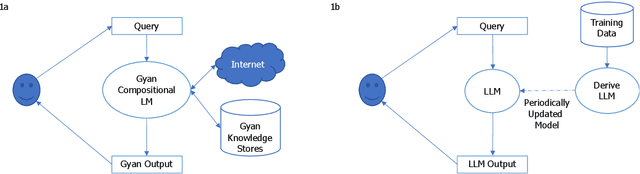
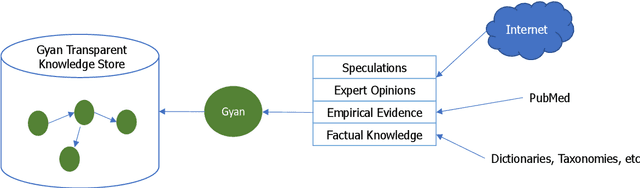
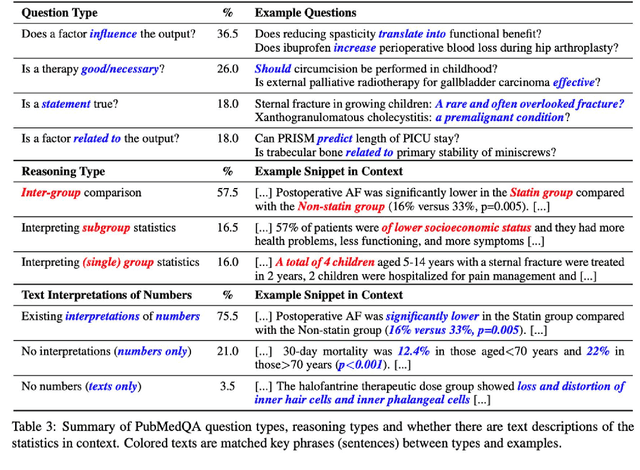
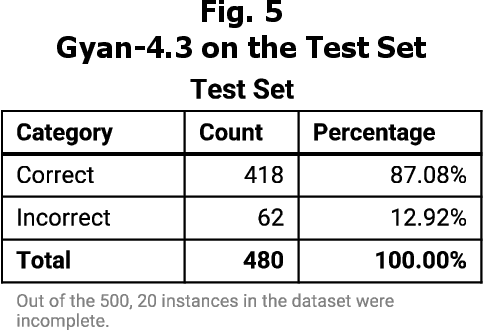
Large language models (LLMs) have shown significant abilities in retrieving medical knowledge, reasoning over it and answering medical questions comparably to physicians. However, these models are not interpretable, hallucinate, are difficult to maintain and require enormous compute resources for training and inference. In this paper, we report results from Gyan, an explainable language model based on an alternative architecture, on the PubmedQA data set. The Gyan LLM is a compositional language model and the model is decoupled from knowledge. Gyan is trustable, transparent, does not hallucinate and does not require significant training or compute resources. Gyan is easily transferable across domains. Gyan-4.3 achieves SOTA results on PubmedQA with 87.1% accuracy compared to 82% by MedPrompt based on GPT-4 and 81.8% by Med-PaLM 2 (Google and DeepMind). We will be reporting results for other medical data sets - MedQA, MedMCQA, MMLU - Medicine in the future.
Training Large Language Models Efficiently with Sparsity and Dataflow
Apr 11, 2023Large foundation language models have shown their versatility in being able to be adapted to perform a wide variety of downstream tasks, such as text generation, sentiment analysis, semantic search etc. However, training such large foundational models is a non-trivial exercise that requires a significant amount of compute power and expertise from machine learning and systems experts. As models get larger, these demands are only increasing. Sparsity is a promising technique to relieve the compute requirements for training. However, sparsity introduces new challenges in training the sparse model to the same quality as the dense counterparts. Furthermore, sparsity drops the operation intensity and introduces irregular memory access patterns that makes it challenging to efficiently utilize compute resources. This paper demonstrates an end-to-end training flow on a large language model - 13 billion GPT - using sparsity and dataflow. The dataflow execution model and architecture enables efficient on-chip irregular memory accesses as well as native kernel fusion and pipelined parallelism that helps recover device utilization. We show that we can successfully train GPT 13B to the same quality as the dense GPT 13B model, while achieving an end-end speedup of 4.5x over dense A100 baseline.