 Add to Chrome
 Add to Firefox
 Add to Edge
BRIM: Workload-Balanced Dual-Sided Bit-Serial Sparse Inference Accelerator
Jul 20, 2026
Bit-serial accelerators exploit bit-level sparsity to reduce DNN inference cost, but existing designs exploit sparsity on only one operand, bounding the speedup. Extending sparsity exploitation to both operands simultaneously yields compounding reductions in partial products but introduces a critical new bottleneck: workload imbalance. Because each concurrent weight - activation pair's execution cost depends on the product of two independently varying operand non-zero bit counts, pairs that must complete together finish at vastly different times, leaving faster computations idle. We show this limits PE utilization to 56 - 64% in existing dual-sided designs. We present BRIM, a hardware - software co-designed dual-sided bit-serial sparse accelerator that directly targets this bottleneck. BRIM combines two integrated mechanisms: 1) Cyclic-Balanced Pruning (CBP), a post-training weight optimization that reshapes weight representations based on profiled activation statistics to equalize expected workloads across concurrently processed pairs offline; and 2) Pairwise Slot Donation, a lightweight hardware mechanism that absorbs residual runtime imbalance with negligible area overhead. Evaluated across CNNs, ViTs, and LLMs under iso-area constraints, BRIM achieves over 90% PE utilization, up to 2.37x speedup, and up to 1.63x energy efficiency improvement over prior dual-sided designs.

NeuroFlex: Column-Exact ANN-SNN Co-Execution Accelerator with Cost-Guided Scheduling
Nov 07, 2025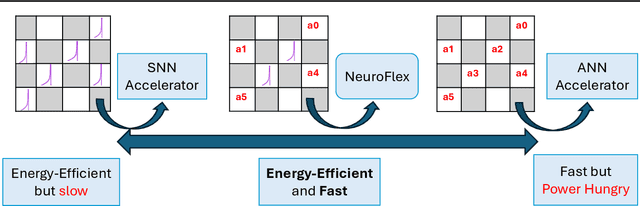
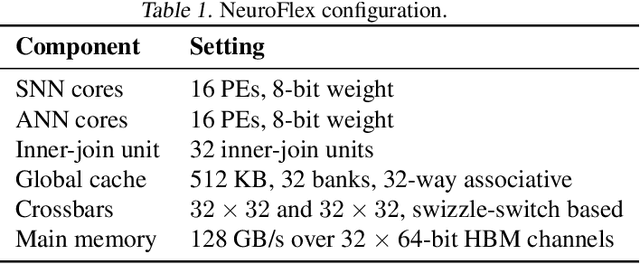
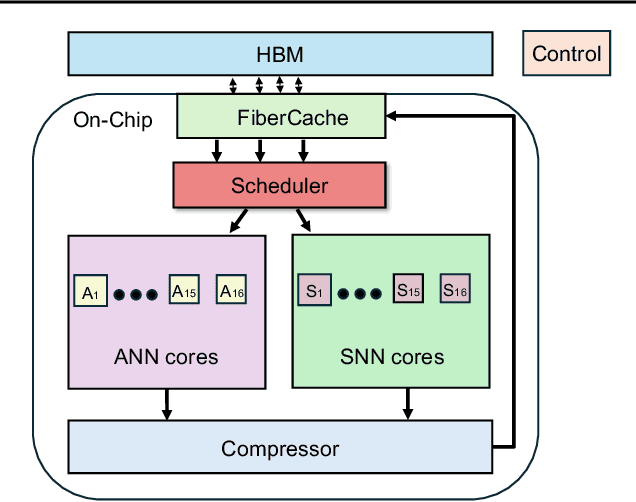
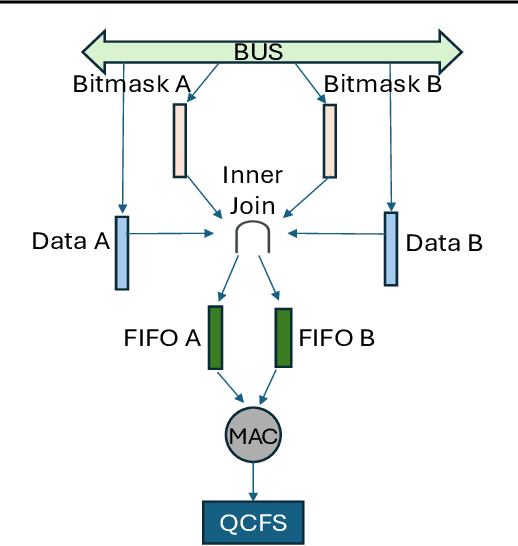
NeuroFlex is a column-level accelerator that co-executes artificial and spiking neural networks to minimize energy-delay product on sparse edge workloads with competitive accuracy. The design extends integer-exact QCFS ANN-SNN conversion from layers to independent columns. It unifies INT8 storage with on-the-fly spike generation using an offline cost model to assign columns to ANN or SNN cores and pack work across processing elements with deterministic runtime. Our cost-guided scheduling algorithm improves throughput by 16-19% over random mapping and lowers EDP by 57-67% versus a strong ANN-only baseline across VGG-16, ResNet-34, GoogLeNet, and BERT models. NeuroFlex also delivers up to 2.5x speedup over LoAS and 2.51x energy reduction over SparTen. These results indicate that fine-grained and integer-exact hybridization outperforms single-mode designs on energy and latency without sacrificing accuracy.