 Add to Chrome
 Add to Firefox
 Add to Edge
BRIM: Workload-Balanced Dual-Sided Bit-Serial Sparse Inference Accelerator
Jul 20, 2026
Bit-serial accelerators exploit bit-level sparsity to reduce DNN inference cost, but existing designs exploit sparsity on only one operand, bounding the speedup. Extending sparsity exploitation to both operands simultaneously yields compounding reductions in partial products but introduces a critical new bottleneck: workload imbalance. Because each concurrent weight - activation pair's execution cost depends on the product of two independently varying operand non-zero bit counts, pairs that must complete together finish at vastly different times, leaving faster computations idle. We show this limits PE utilization to 56 - 64% in existing dual-sided designs. We present BRIM, a hardware - software co-designed dual-sided bit-serial sparse accelerator that directly targets this bottleneck. BRIM combines two integrated mechanisms: 1) Cyclic-Balanced Pruning (CBP), a post-training weight optimization that reshapes weight representations based on profiled activation statistics to equalize expected workloads across concurrently processed pairs offline; and 2) Pairwise Slot Donation, a lightweight hardware mechanism that absorbs residual runtime imbalance with negligible area overhead. Evaluated across CNNs, ViTs, and LLMs under iso-area constraints, BRIM achieves over 90% PE utilization, up to 2.37x speedup, and up to 1.63x energy efficiency improvement over prior dual-sided designs.

Approximate ADCs for In-Memory Computing
Aug 11, 2024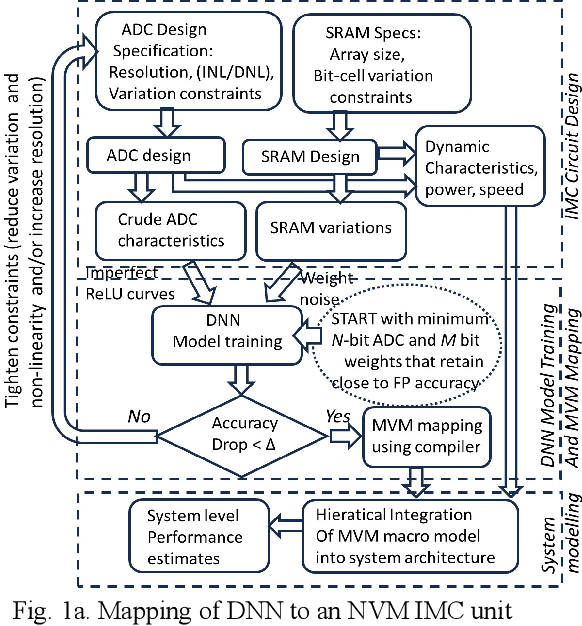
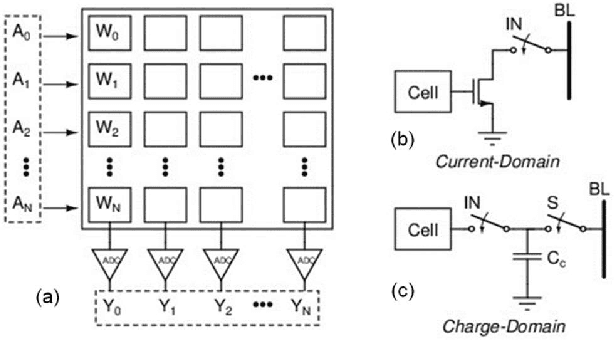

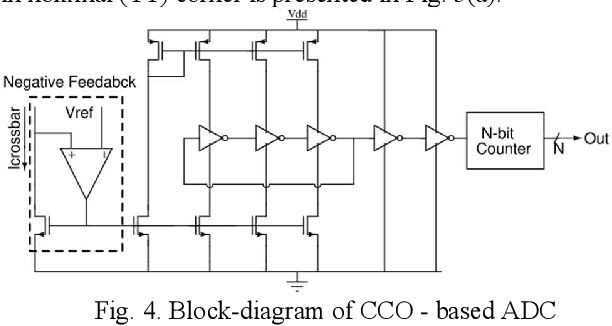
In memory computing (IMC) architectures for deep learning (DL) accelerators leverage energy-efficient and highly parallel matrix vector multiplication (MVM) operations, implemented directly in memory arrays. Such IMC designs have been explored based on CMOS as well as emerging non-volatile memory (NVM) technologies like RRAM. IMC architectures generally involve a large number of cores consisting of memory arrays, storing the trained weights of the DL model. Peripheral units like DACs and ADCs are also used for applying inputs and reading out the output values. Recently reported designs reveal that the ADCs required for reading out the MVM results, consume more than 85% of the total compute power and also dominate the area, thereby eschewing the benefits of the IMC scheme. Mitigation of imperfections in the ADCs, namely, non-linearity and variations, incur significant design overheads, due to dedicated calibration units. In this work we present peripheral aware design of IMC cores, to mitigate such overheads. It involves incorporating the non-idealities of ADCs in the training of the DL models, along with that of the memory units. The proposed approach applies equally well to both current mode as well as charge mode MVM operations demonstrated in recent years., and can significantly simplify the design of mixed-signal IMC units.