 Add to Chrome
 Add to Firefox
 Add to Edge
NeuroFlex: Column-Exact ANN-SNN Co-Execution Accelerator with Cost-Guided Scheduling
Nov 07, 2025
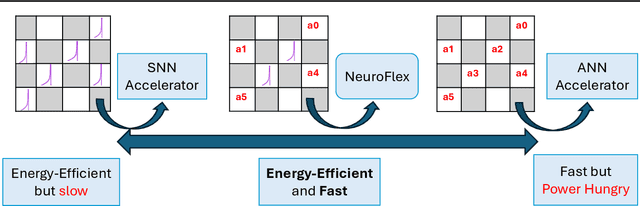
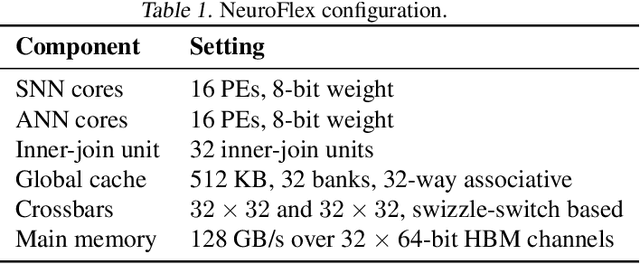
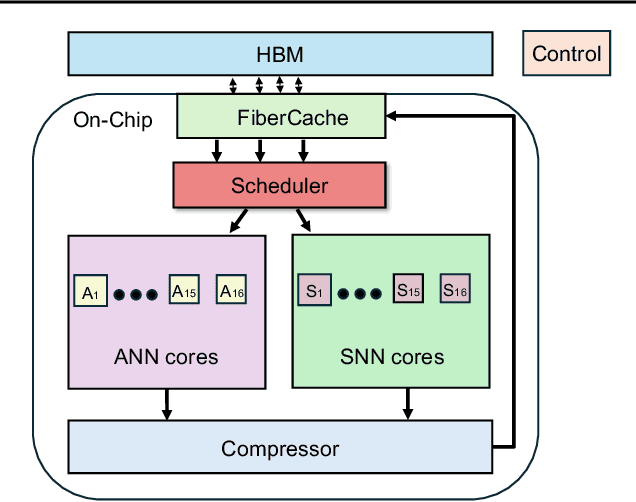
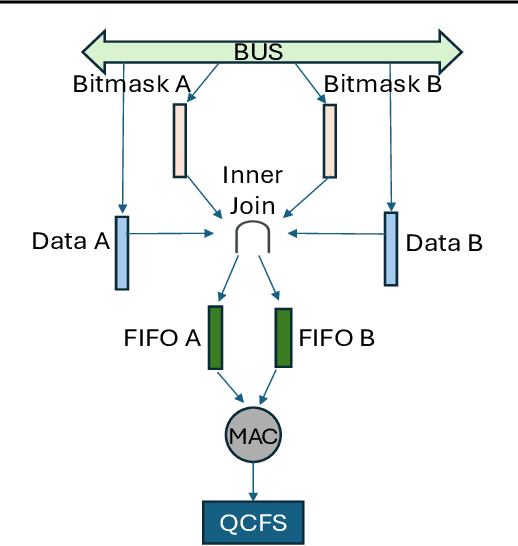
NeuroFlex is a column-level accelerator that co-executes artificial and spiking neural networks to minimize energy-delay product on sparse edge workloads with competitive accuracy. The design extends integer-exact QCFS ANN-SNN conversion from layers to independent columns. It unifies INT8 storage with on-the-fly spike generation using an offline cost model to assign columns to ANN or SNN cores and pack work across processing elements with deterministic runtime. Our cost-guided scheduling algorithm improves throughput by 16-19% over random mapping and lowers EDP by 57-67% versus a strong ANN-only baseline across VGG-16, ResNet-34, GoogLeNet, and BERT models. NeuroFlex also delivers up to 2.5x speedup over LoAS and 2.51x energy reduction over SparTen. These results indicate that fine-grained and integer-exact hybridization outperforms single-mode designs on energy and latency without sacrificing accuracy.

PASCAL: Precise and Efficient ANN- SNN Conversion using Spike Accumulation and Adaptive Layerwise Activation
May 03, 2025
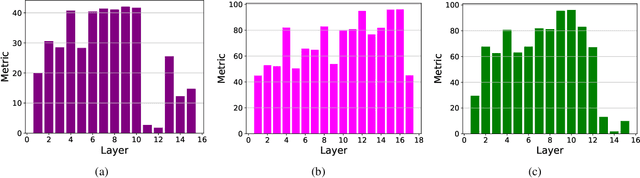
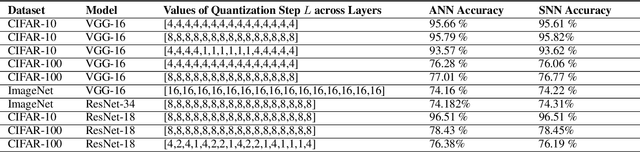
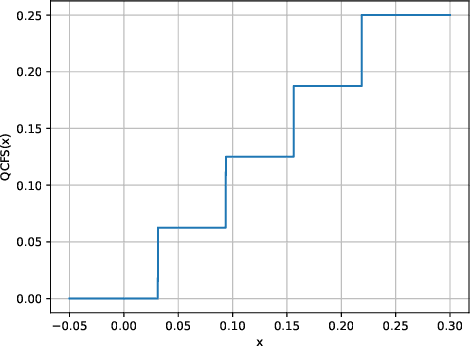
Spiking Neural Networks (SNNs) have been put forward as an energy-efficient alternative to Artificial Neural Networks (ANNs) since they perform sparse Accumulate operations instead of the power-hungry Multiply-and-Accumulate operations. ANN-SNN conversion is a widely used method to realize deep SNNs with accuracy comparable to that of ANNs.~\citeauthor{bu2023optimal} recently proposed the Quantization-Clip-Floor-Shift (QCFS) activation as an alternative to ReLU to minimize the accuracy loss during ANN-SNN conversion. Nevertheless, SNN inferencing requires a large number of timesteps to match the accuracy of the source ANN for real-world datasets. In this work, we propose PASCAL, which performs ANN-SNN conversion in such a way that the resulting SNN is mathematically equivalent to an ANN with QCFS-activation, thereby yielding similar accuracy as the source ANN with minimal inference timesteps. In addition, we propose a systematic method to configure the quantization step of QCFS activation in a layerwise manner, which effectively determines the optimal number of timesteps per layer for the converted SNN. Our results show that the ResNet-34 SNN obtained using PASCAL achieves an accuracy of $\approx$74\% on ImageNet with a 64$\times$ reduction in the number of inference timesteps compared to existing approaches.