 Add to Chrome
 Add to Firefox
 Add to Edge
WiRD-Gest: Gesture Recognition In The Real World Using Range-Doppler Wi-Fi Sensing on COTS Hardware
Mar 23, 2026
Wi-Fi sensing has emerged as a promising technique for gesture recognition, yet its practical deployment is hindered by environmental sensitivity and device placement challenges. To overcome these limitations we propose Wi-Fi Range and Doppler (WiRD)-Gest, a novel system that performs gesture recognition using a single, unmodified Wi-Fi transceiver on a commercial off-the-shelf (COTS) laptop. The system leverages an monostatic full duplex sensing pipeline capable of extracting Range-Doppler (RD) information. Utilizing this, we present the first benchmark of deep learning models for gesture recognition based on monostatic sensing. The key innovation lies in how monostatic sensing and spatial (range) information fundamentally transforms accuracy, robustness and generalization compared to prior approaches. We demonstrate excellent performance in crowded, unseen public spaces with dynamic interference and additional moving targets even when trained on data from controlled environments only. These are scenarios where prior Wi-Fi sensing approaches often fail, however, our system suffers minor degradation. The WiRD-Gest benchmark and dataset will also be released as open source.

Human Presence Detection via Wi-Fi Range-Filtered Doppler Spectrum on Commodity Laptops
Mar 11, 2026Human Presence Detection (HPD) is key to enable intelligent power management and security features in everyday devices. In this paper we propose the first HPD solution that leverages monostatic Wi-Fi sensing and detects user position using only the built-in Wi-Fi hardware of a device, with no need for external devices, access points, or additional sensors. In contrast, existing HPD solutions for laptops require external dedicated sensors which add cost and complexity, or rely on camera-based approaches that introduce significant privacy concerns. We herewith introduce the Range-Filtered Doppler Spectrum (RF-DS), a novel Wi-Fi sensing technique for presence estimation that enables both range-selective and temporally windowed detection of user presence. By applying targeted range-area filtering in the Channel Impulse Response (CIR) domain before Doppler analysis, our method focuses processing on task-relevant spatial zones, significantly reducing computational complexity. In addition, the use of temporal windows in the spectrum domain provides greater estimator stability compared to conventional 2D Range-Doppler detectors. Furthermore, we propose an adaptive multi-rate processing framework that dynamically adjusts Channel State Information (CSI) sampling rates-operating at low frame rates (10Hz) during idle periods and high rates (100Hz) only when motion is detected. To our knowledge, this is the first low-complexity solution for occupancy detection using monostatic Wi-Fi sensing on a built-in Wi-Fi network interface controller (NIC) of a commercial off-the-shelf laptop that requires no external network infrastructure or specialized sensors. Our solution can scale across different environments and devices without calibration or retraining.
An Efficient Privacy-aware Split Learning Framework for Satellite Communications
Sep 13, 2024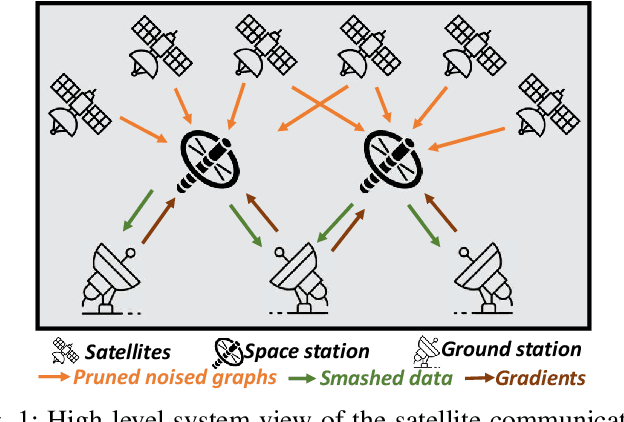
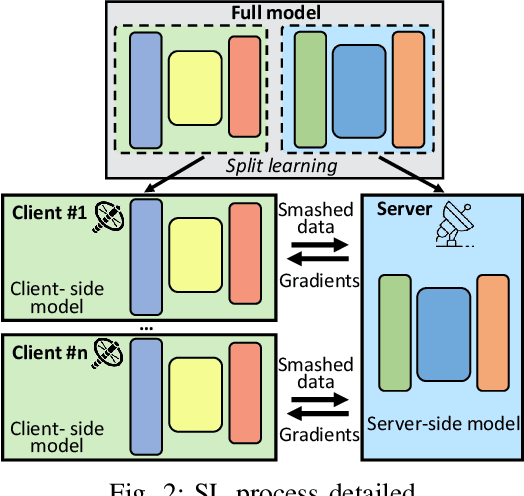

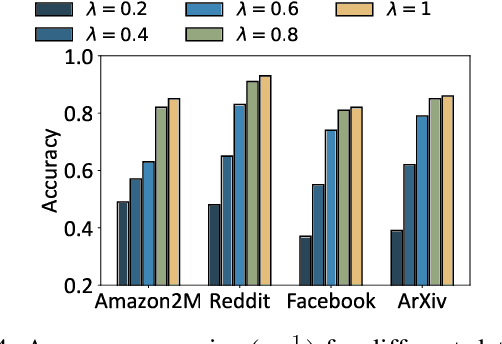
In the rapidly evolving domain of satellite communications, integrating advanced machine learning techniques, particularly split learning, is crucial for enhancing data processing and model training efficiency across satellites, space stations, and ground stations. Traditional ML approaches often face significant challenges within satellite networks due to constraints such as limited bandwidth and computational resources. To address this gap, we propose a novel framework for more efficient SL in satellite communications. Our approach, Dynamic Topology Informed Pruning, namely DTIP, combines differential privacy with graph and model pruning to optimize graph neural networks for distributed learning. DTIP strategically applies differential privacy to raw graph data and prunes GNNs, thereby optimizing both model size and communication load across network tiers. Extensive experiments across diverse datasets demonstrate DTIP's efficacy in enhancing privacy, accuracy, and computational efficiency. Specifically, on Amazon2M dataset, DTIP maintains an accuracy of 0.82 while achieving a 50% reduction in floating-point operations per second. Similarly, on ArXiv dataset, DTIP achieves an accuracy of 0.85 under comparable conditions. Our framework not only significantly improves the operational efficiency of satellite communications but also establishes a new benchmark in privacy-aware distributed learning, potentially revolutionizing data handling in space-based networks.