 Add to Chrome
 Add to Firefox
 Add to Edge
ASCHOPLEX encounters Dafne: a federated continuous learning project for the generalizability of the Choroid Plexus automatic segmentation
Dec 23, 2025
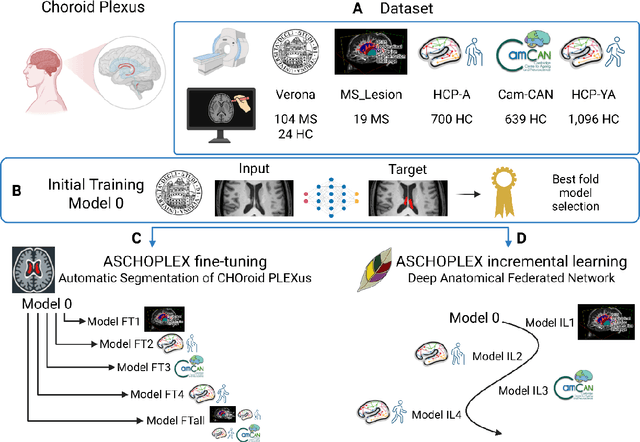
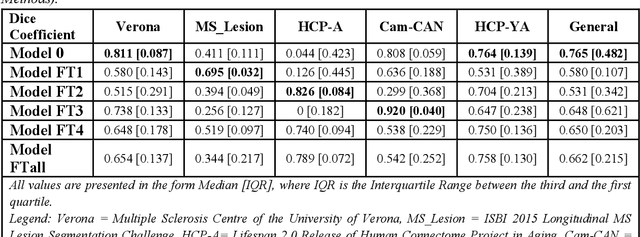
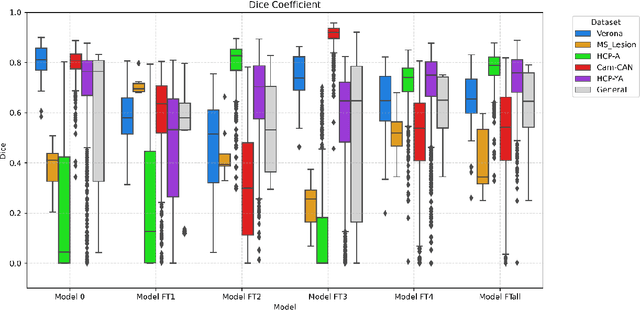

The Choroid Plexus (ChP) is a highly vascularized brain structure that plays a critical role in several physiological processes. ASCHOPLEX, a deep learning-based segmentation toolbox with an integrated fine-tuning stage, provides accurate ChP delineations on non-contrast-enhanced T1-weighted MRI scans; however, its performance is hindered by inter-dataset variability. This study introduces the first federated incremental learning approach for automated ChP segmentation from 3D T1-weighted brain MRI, by integrating an enhanced version of ASCHOPLEX within the Dafne (Deep Anatomical Federated Network) framework. A comparative evaluation is conducted to assess whether federated incremental learning through Dafne improves model generalizability across heterogeneous imaging conditions, relative to the conventional fine-tuning strategy employed by standalone ASCHOPLEX. The experimental cohort comprises 2,284 subjects, including individuals with Multiple Sclerosis as well as healthy controls, collected from five independent MRI datasets. Results indicate that the fine-tuning strategy provides high performance on homogeneous data (e.g., same MRI sequence, same cohort of subjects), but limited generalizability when the data variability is high (e.g., multiple MRI sequences, multiple and new cohorts of subjects). By contrast, the federated incremental learning variant of ASCHOPLEX constitutes a robust alternative consistently achieving higher generalizability and more stable performance across diverse acquisition settings.

Advances in Automated Fetal Brain MRI Segmentation and Biometry: Insights from the FeTA 2024 Challenge
May 05, 2025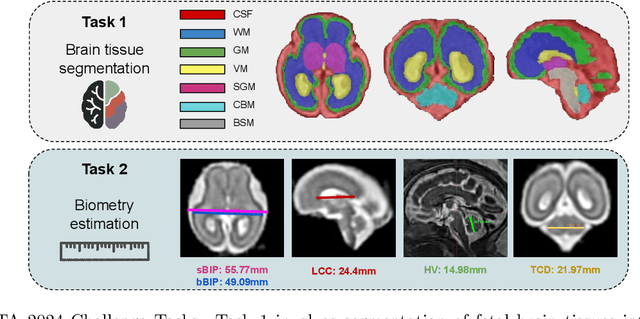
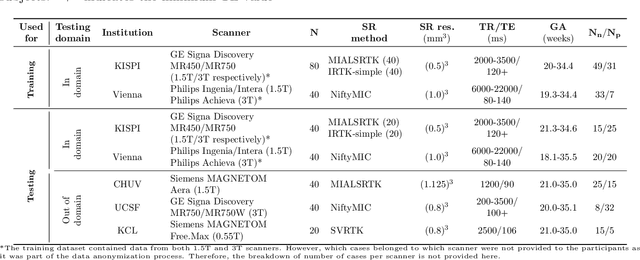
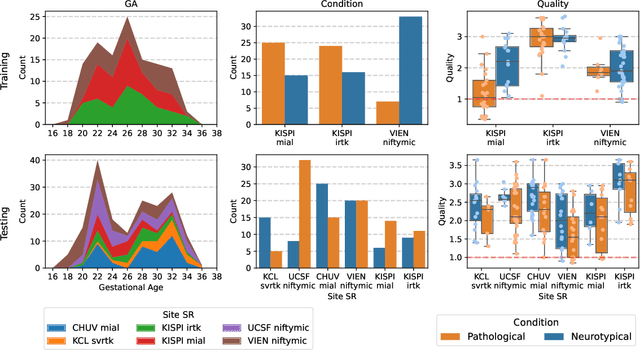
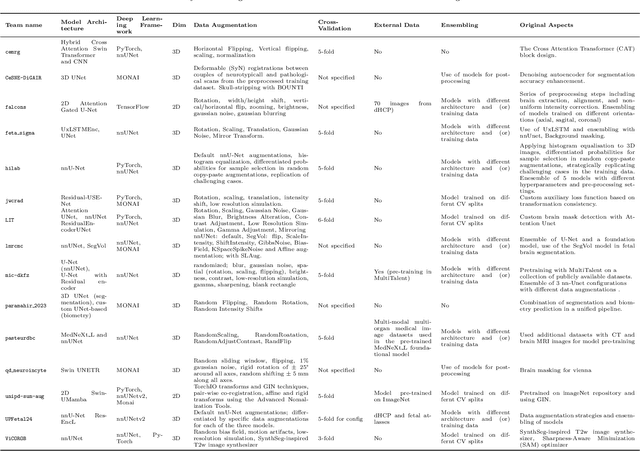
Accurate fetal brain tissue segmentation and biometric analysis are essential for studying brain development in utero. The FeTA Challenge 2024 advanced automated fetal brain MRI analysis by introducing biometry prediction as a new task alongside tissue segmentation. For the first time, our diverse multi-centric test set included data from a new low-field (0.55T) MRI dataset. Evaluation metrics were also expanded to include the topology-specific Euler characteristic difference (ED). Sixteen teams submitted segmentation methods, most of which performed consistently across both high- and low-field scans. However, longitudinal trends indicate that segmentation accuracy may be reaching a plateau, with results now approaching inter-rater variability. The ED metric uncovered topological differences that were missed by conventional metrics, while the low-field dataset achieved the highest segmentation scores, highlighting the potential of affordable imaging systems when paired with high-quality reconstruction. Seven teams participated in the biometry task, but most methods failed to outperform a simple baseline that predicted measurements based solely on gestational age, underscoring the challenge of extracting reliable biometric estimates from image data alone. Domain shift analysis identified image quality as the most significant factor affecting model generalization, with super-resolution pipelines also playing a substantial role. Other factors, such as gestational age, pathology, and acquisition site, had smaller, though still measurable, effects. Overall, FeTA 2024 offers a comprehensive benchmark for multi-class segmentation and biometry estimation in fetal brain MRI, underscoring the need for data-centric approaches, improved topological evaluation, and greater dataset diversity to enable clinically robust and generalizable AI tools.