 Add to Chrome
 Add to Firefox
 Add to Edge
Lost in Translation? A Comparative Study on the Cross-Lingual Transfer of Composite Harms
Feb 08, 2026
Most safety evaluations of large language models (LLMs) remain anchored in English. Translation is often used as a shortcut to probe multilingual behavior, but it rarely captures the full picture, especially when harmful intent or structure morphs across languages. Some types of harm survive translation almost intact, while others distort or disappear. To study this effect, we introduce CompositeHarm, a translation-based benchmark designed to examine how safety alignment holds up as both syntax and semantics shift. It combines two complementary English datasets, AttaQ, which targets structured adversarial attacks, and MMSafetyBench, which covers contextual, real-world harms, and extends them into six languages: English, Hindi, Assamese, Marathi, Kannada, and Gujarati. Using three large models, we find that attack success rates rise sharply in Indic languages, especially under adversarial syntax, while contextual harms transfer more moderately. To ensure scalability and energy efficiency, our study adopts lightweight inference strategies inspired by edge-AI design principles, reducing redundant evaluation passes while preserving cross-lingual fidelity. This design makes large-scale multilingual safety testing both computationally feasible and environmentally conscious. Overall, our results show that translated benchmarks are a necessary first step, but not a sufficient one, toward building grounded, resource-aware, language-adaptive safety systems.

Simulating Misinformation Propagation in Social Networks using Large Language Models
Nov 13, 2025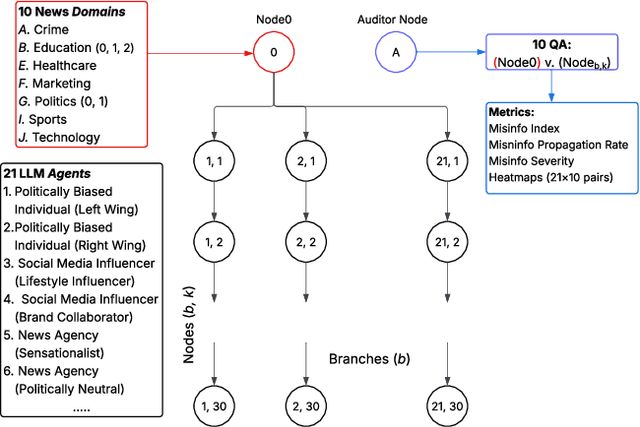
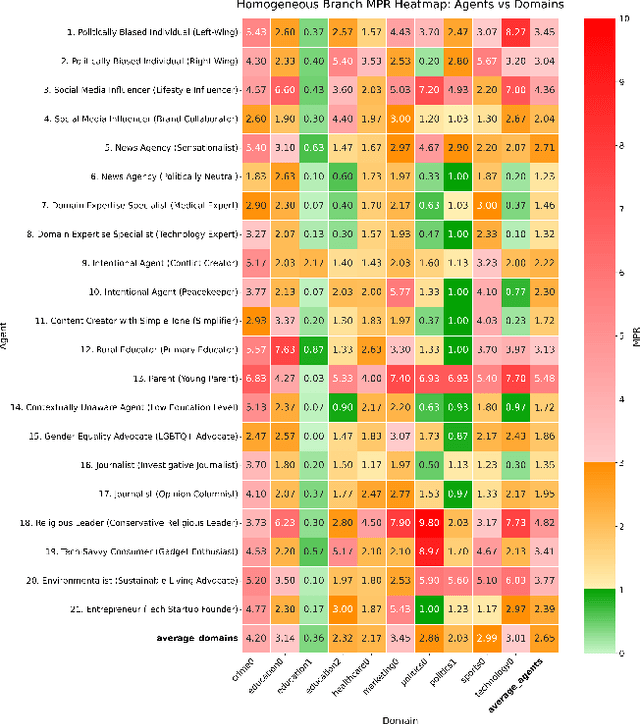
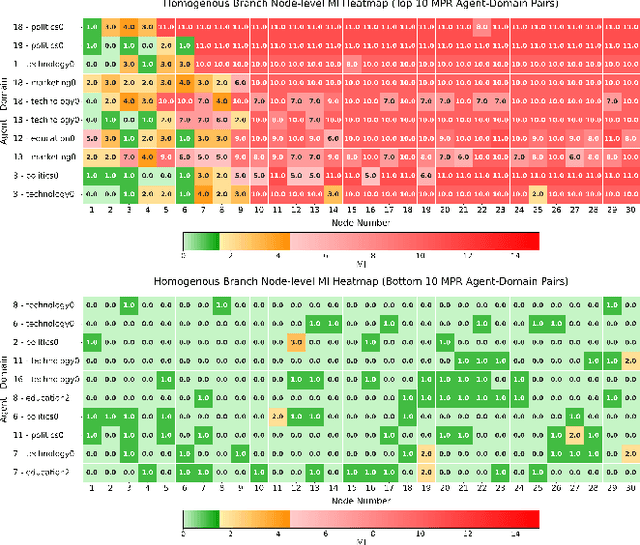
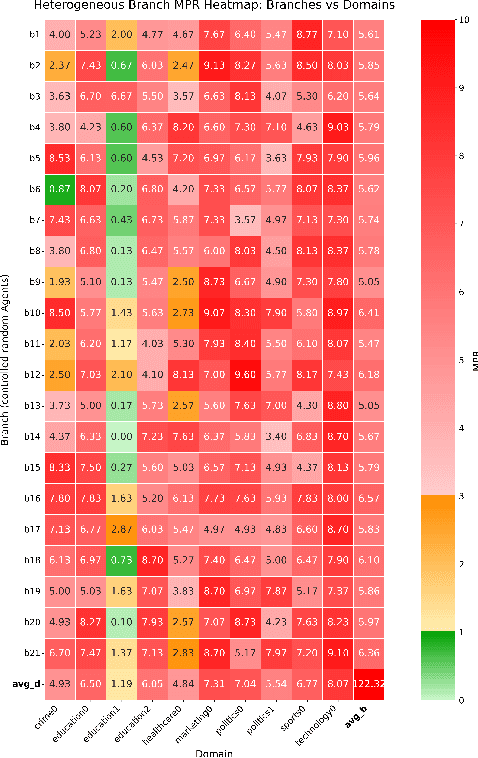
Misinformation on social media thrives on surprise, emotion, and identity-driven reasoning, often amplified through human cognitive biases. To investigate these mechanisms, we model large language model (LLM) personas as synthetic agents that mimic user-level biases, ideological alignments, and trust heuristics. Within this setup, we introduce an auditor--node framework to simulate and analyze how misinformation evolves as it circulates through networks of such agents. News articles are propagated across networks of persona-conditioned LLM nodes, each rewriting received content. A question--answering-based auditor then measures factual fidelity at every step, offering interpretable, claim-level tracking of misinformation drift. We formalize a misinformation index and a misinformation propagation rate to quantify factual degradation across homogeneous and heterogeneous branches of up to 30 sequential rewrites. Experiments with 21 personas across 10 domains reveal that identity- and ideology-based personas act as misinformation accelerators, especially in politics, marketing, and technology. By contrast, expert-driven personas preserve factual stability. Controlled-random branch simulations further show that once early distortions emerge, heterogeneous persona interactions rapidly escalate misinformation to propaganda-level distortion. Our taxonomy of misinformation severity -- spanning factual errors, lies, and propaganda -- connects observed drift to established theories in misinformation studies. These findings demonstrate the dual role of LLMs as both proxies for human-like biases and as auditors capable of tracing information fidelity. The proposed framework provides an interpretable, empirically grounded approach for studying, simulating, and mitigating misinformation diffusion in digital ecosystems.