 Add to Chrome
 Add to Firefox
 Add to Edge
Design and Experimental Validation of a Multiband Cross-Polarization Conversion (CPC) Metasurface for Radar Cross Section (RCS) Reduction
Jul 12, 2026
Radar cross-section (RCS) reduction is a fundamental requirement in modern stealth technology, playing a critical role in the low-observable performance of aerial and naval platforms. Among the various passive RCS reduction strategies, including radar-absorbing materials, absorptive coatings, and artificially engineered surfaces, metasurface-based cross-polarization conversion has emerged as a compelling approach owing to its structural simplicity and low profile. In this work, a single-layer cross-polarization conversion (CPC) metasurface developed on a cost-effective FR4 dielectric substrate (relative permittivity 4.4, loss tangent 0.02) is proposed for multiband RCS reduction. The designed structure achieves a polarization conversion ratio (PCR) exceeding 95% at three distinct operating frequencies of 7.8 GHz, 11.7 GHz, and 18 GHz, spanning the C-, X-, and Ku-bands, which directly translates into a monostatic RCS reduction exceeding 10 dBsm at the corresponding bands. The metasurface further demonstrates stable polarization conversion performance under oblique incidence up to 60 degrees, confirming its suitability for wide-angle illumination conditions encountered in practical deployment scenarios. Experimental validation conducted in an anechoic chamber confirms close agreement with full-wave electromagnetic simulations, substantiating the reliability of the fabricated prototype. The proposed design offers a lightweight, low-cost, and high-performance candidate for multiband stealth and low-observable platform applications.

WordVIS: A Color Worth A Thousand Words
Dec 13, 2024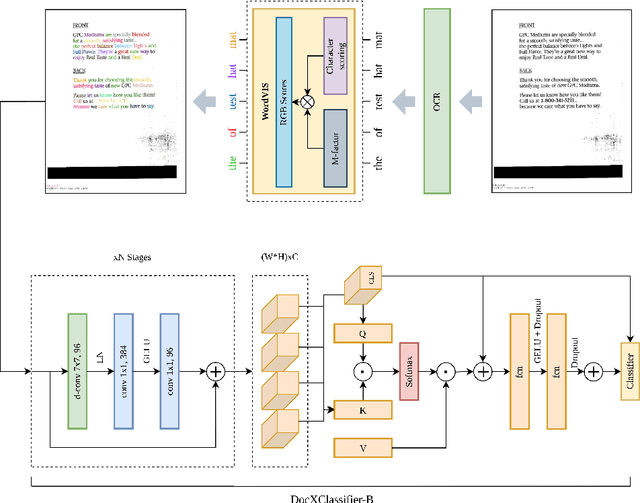
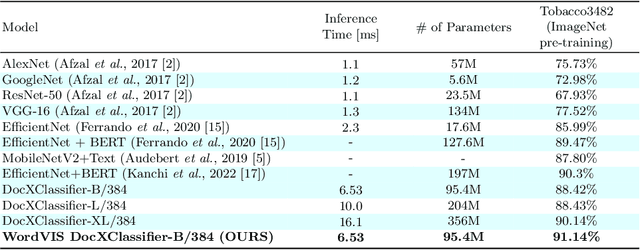
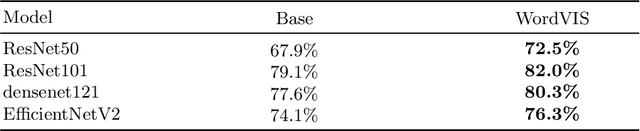
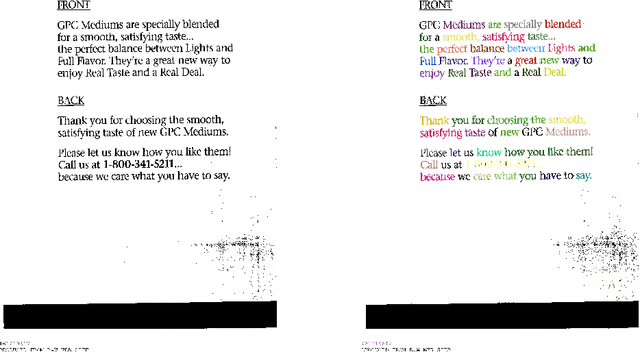
Document classification is considered a critical element in automated document processing systems. In recent years multi-modal approaches have become increasingly popular for document classification. Despite their improvements, these approaches are underutilized in the industry due to their requirement for a tremendous volume of training data and extensive computational power. In this paper, we attempt to address these issues by embedding textual features directly into the visual space, allowing lightweight image-based classifiers to achieve state-of-the-art results using small-scale datasets in document classification. To evaluate the efficacy of the visual features generated from our approach on limited data, we tested on the standard dataset Tobacco-3482. Our experiments show a tremendous improvement in image-based classifiers, achieving an improvement of 4.64% using ResNet50 with no document pre-training. It also sets a new record for the best accuracy of the Tobacco-3482 dataset with a score of 91.14% using the image-based DocXClassifier with no document pre-training. The simplicity of the approach, its resource requirements, and subsequent results provide a good prospect for its use in industrial use cases.
TabAug: Data Driven Augmentation for Enhanced Table Structure Recognition
May 15, 2021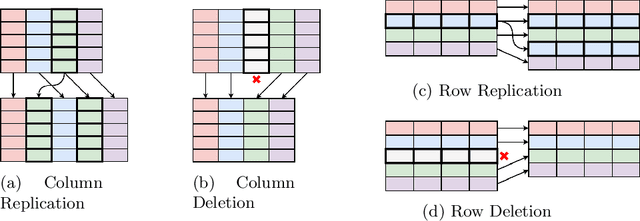
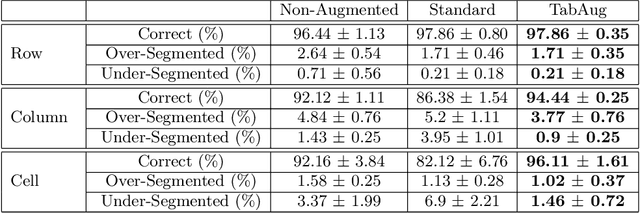
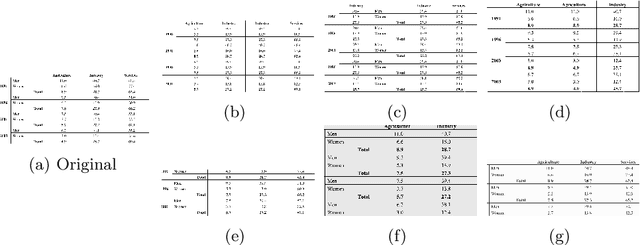
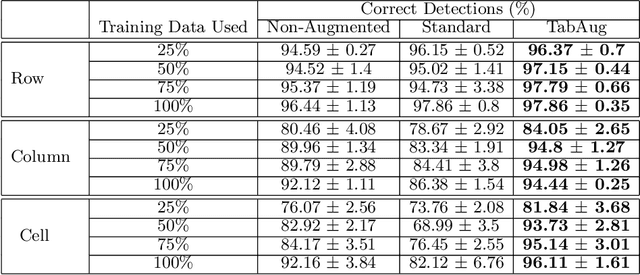
Table Structure Recognition is an essential part of end-to-end tabular data extraction in document images. The recent success of deep learning model architectures in computer vision remains to be non-reflective in table structure recognition, largely because extensive datasets for this domain are still unavailable while labeling new data is expensive and time-consuming. Traditionally, in computer vision, these challenges are addressed by standard augmentation techniques that are based on image transformations like color jittering and random cropping. As demonstrated by our experiments, these techniques are not effective for the task of table structure recognition. In this paper, we propose TabAug, a re-imagined Data Augmentation technique that produces structural changes in table images through replication and deletion of rows and columns. It also consists of a data-driven probabilistic model that allows control over the augmentation process. To demonstrate the efficacy of our approach, we perform experimentation on ICDAR 2013 dataset where our approach shows consistent improvements in all aspects of the evaluation metrics, with cell-level correct detections improving from 92.16% to 96.11% over the baseline.