 Add to Chrome
 Add to Firefox
 Add to Edge
HandMvNet: Real-Time 3D Hand Pose Estimation Using Multi-View Cross-Attention Fusion
Aug 20, 2026
In this work, we present HandMvNet, one of the first real-time method designed to estimate 3D hand motion and shape from multi-view camera images. Unlike previous monocular approaches, which suffer from scale-depth ambiguities, our method ensures consistent and accurate absolute hand poses and shapes. This is achieved through a multi-view attention-fusion mechanism that effectively integrates features from multiple viewpoints. In contrast to previous multi-view methods, our approach eliminates the need for camera parameters as input to learn 3D geometry. HandMvNet also achieves a substantial reduction in inference time while delivering competitive results compared to the state-of-the-art methods, making it suitable for real-time applications. Evaluated on publicly available datasets, HandMvNet qualitatively and quantitatively outperforms previous methods under identical settings. Code is available at github.com/pyxploiter/handmvnet.
* 8 pages, 7 figures. Published at VISAPP 2025

TabAug: Data Driven Augmentation for Enhanced Table Structure Recognition
May 15, 2021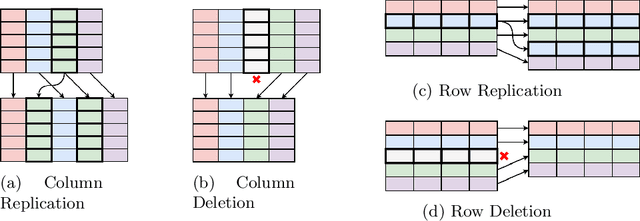
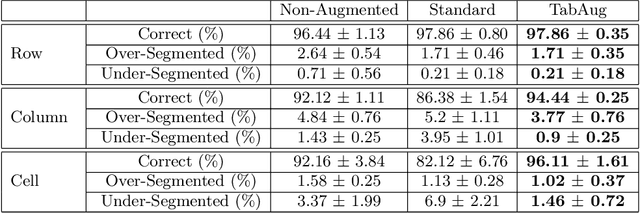
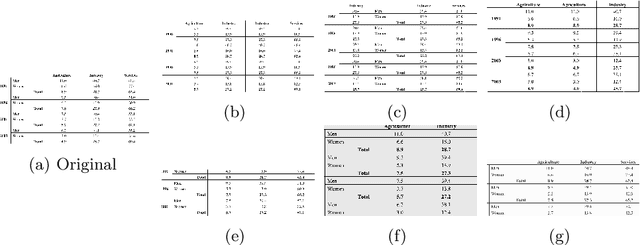
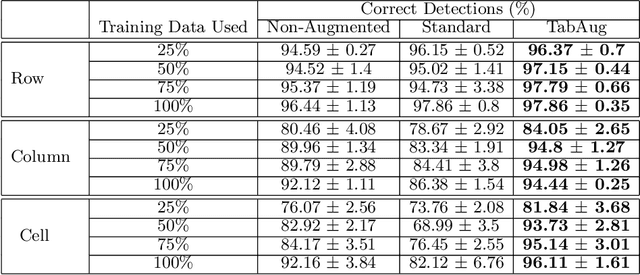
Table Structure Recognition is an essential part of end-to-end tabular data extraction in document images. The recent success of deep learning model architectures in computer vision remains to be non-reflective in table structure recognition, largely because extensive datasets for this domain are still unavailable while labeling new data is expensive and time-consuming. Traditionally, in computer vision, these challenges are addressed by standard augmentation techniques that are based on image transformations like color jittering and random cropping. As demonstrated by our experiments, these techniques are not effective for the task of table structure recognition. In this paper, we propose TabAug, a re-imagined Data Augmentation technique that produces structural changes in table images through replication and deletion of rows and columns. It also consists of a data-driven probabilistic model that allows control over the augmentation process. To demonstrate the efficacy of our approach, we perform experimentation on ICDAR 2013 dataset where our approach shows consistent improvements in all aspects of the evaluation metrics, with cell-level correct detections improving from 92.16% to 96.11% over the baseline.