 Add to Chrome
 Add to Firefox
 Add to Edge
Feature-Level Robustness of Physics-Guided Micro-Doppler Descriptors for classification of Drones and Birds
Apr 14, 2026
Micro-Doppler signatures are a proven modality for discriminating between drones and birds, but their reliability degrades in low-SNR, data-constrained settings where deep learning models often fail. This paper presents a systematic study of ten statistical and physics-motivated handcrafted features for micro-Doppler classification under controlled signal degradation, using a publicly available 77 GHz FMCW radar dataset. Spectrograms are corrupted with additive white Gaussian noise, phase noise, and their combination across SNRs from -10 dB to 10 dB and phase noise levels from 1 to 10 degrees. Features are evaluated using stratified 5-fold cross-validation with Support Vector Machine and Random Forest classifiers, using fixed hyperparameters across all noise conditions. On clean data, both models achieve mean accuracy of 0.916, with F1 scores of 0.909 (SVM) and 0.892 (Random Forest). Under severe noise, entropy-based and side-lobe features remain robust, yielding F1 scores up to 0.773 and 0.831, respectively. Permutation-based importance analysis shows that some features retain complementary discriminative power even when their individual importance is low. These results highlight the value of principled feature design and provide insight into feature robustness for interpretable radar classification systems.

SDR-Based Metal Classification using Spectrogram Images from Micro-Doppler Signatures
Oct 25, 2024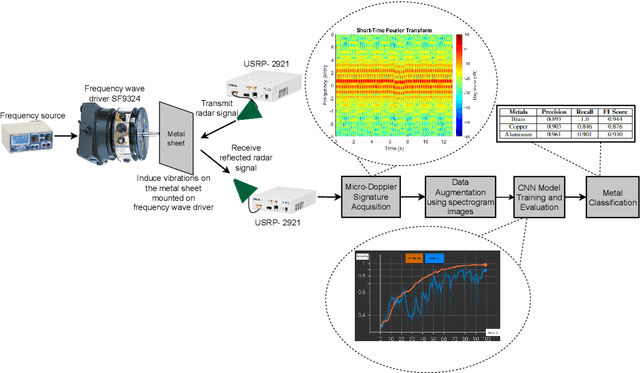
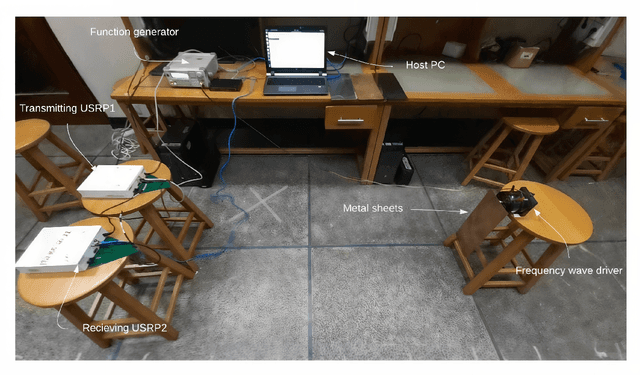
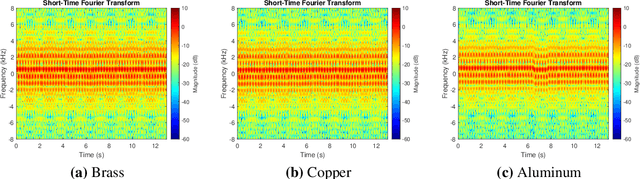
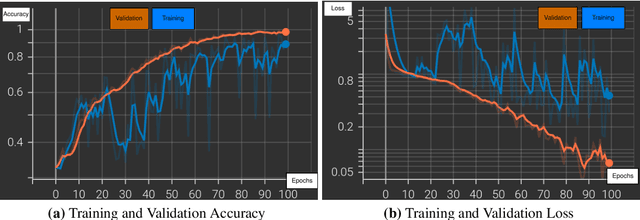
Metallic materials such as brass, copper, and aluminum are used in numerous applications, including industrial manufacturing. The vibration characteristics of these objects are unique and can be used to identify these objects from a distance. This research presents a methodology for detecting and classifying these metallic objects using the vibration dynamics induced by their micro-Doppler signatures. The proposed approach utilizes image processing techniques to extract pivotal features from spectrograms. These spectrograms originate from micro-Doppler signatures of data collected during controlled laboratory experiments where signals were transmitted towards vibrating metal sheets, and the ensuing reflections were recorded using a software-defined radio (SDR). The spectrogram data was augmented using geometric transformation to train a convolutional neural network (CNN) based machine learning model for object classification. The results indicate that the proposed CNN model achieved an accuracy of more than 95% in classifying metals into brass, copper, and aluminum. This research could be used to understand the foundations of classifying spectrogram images using micro-Doppler signatures for its applications towards enhancing the sensing capabilities in industrial and defense applications.