 Add to Chrome
 Add to Firefox
 Add to Edge
CAMO: Causality-Guided Adversarial Multimodal Domain Generalization for Crisis Classification
Dec 08, 2025
Crisis classification in social media aims to extract actionable disaster-related information from multimodal posts, which is a crucial task for enhancing situational awareness and facilitating timely emergency responses. However, the wide variation in crisis types makes achieving generalizable performance across unseen disasters a persistent challenge. Existing approaches primarily leverage deep learning to fuse textual and visual cues for crisis classification, achieving numerically plausible results under in-domain settings. However, they exhibit poor generalization across unseen crisis types because they 1. do not disentangle spurious and causal features, resulting in performance degradation under domain shift, and 2. fail to align heterogeneous modality representations within a shared space, which hinders the direct adaptation of established single-modality domain generalization (DG) techniques to the multimodal setting. To address these issues, we introduce a causality-guided multimodal domain generalization (MMDG) framework that combines adversarial disentanglement with unified representation learning for crisis classification. The adversarial objective encourages the model to disentangle and focus on domain-invariant causal features, leading to more generalizable classifications grounded in stable causal mechanisms. The unified representation aligns features from different modalities within a shared latent space, enabling single-modality DG strategies to be seamlessly extended to multimodal learning. Experiments on the different datasets demonstrate that our approach achieves the best performance in unseen disaster scenarios.

BlueTempNet: A Temporal Multi-network Dataset of Social Interactions in Bluesky Social
Jul 24, 2024Decentralized social media platforms like Bluesky Social (Bluesky) have made it possible to publicly disclose some user behaviors with millisecond-level precision. Embracing Bluesky's principles of open-source and open-data, we present the first collection of the temporal dynamics of user-driven social interactions. BlueTempNet integrates multiple types of networks into a single multi-network, including user-to-user interactions (following and blocking users) and user-to-community interactions (creating and joining communities). Communities are user-formed groups in custom Feeds, where users subscribe to posts aligned with their interests. Following Bluesky's public data policy, we collect existing Bluesky Feeds, including the users who liked and generated these Feeds, and provide tools to gather users' social interactions within a date range. This data-collection strategy captures past user behaviors and supports the future data collection of user behavior.
Nothing Stands Alone: Relational Fake News Detection with Hypergraph Neural Networks
Dec 24, 2022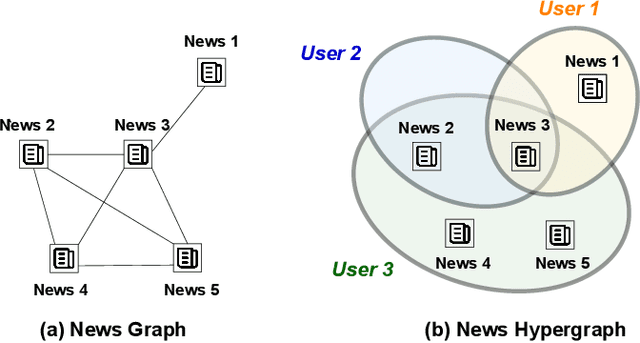
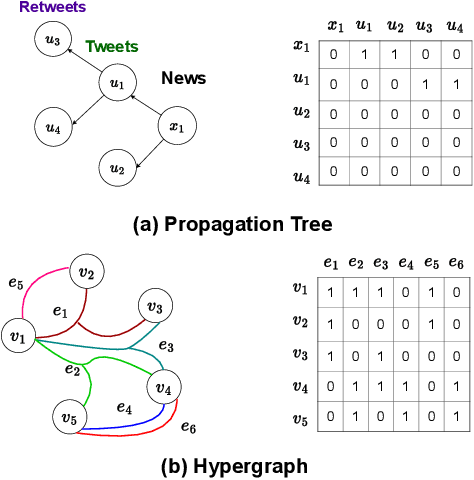
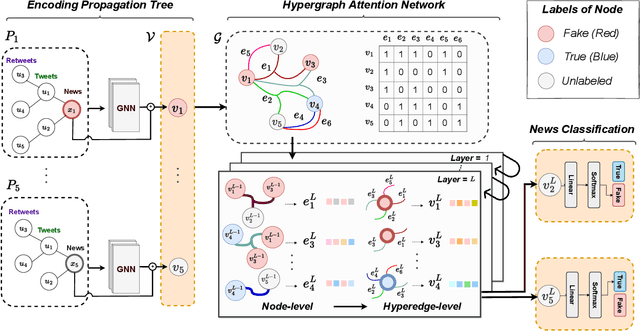
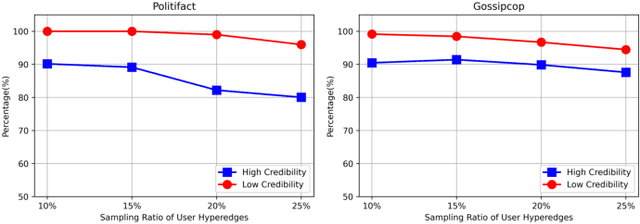
Nowadays, fake news easily propagates through online social networks and becomes a grand threat to individuals and society. Assessing the authenticity of news is challenging due to its elaborately fabricated contents, making it difficult to obtain large-scale annotations for fake news data. Due to such data scarcity issues, detecting fake news tends to fail and overfit in the supervised setting. Recently, graph neural networks (GNNs) have been adopted to leverage the richer relational information among both labeled and unlabeled instances. Despite their promising results, they are inherently focused on pairwise relations between news, which can limit the expressive power for capturing fake news that spreads in a group-level. For example, detecting fake news can be more effective when we better understand relations between news pieces shared among susceptible users. To address those issues, we propose to leverage a hypergraph to represent group-wise interaction among news, while focusing on important news relations with its dual-level attention mechanism. Experiments based on two benchmark datasets show that our approach yields remarkable performance and maintains the high performance even with a small subset of labeled news data.
FBAdTracker: An Interactive Data Collection and Analysis Tool for Facebook Advertisements
May 31, 2021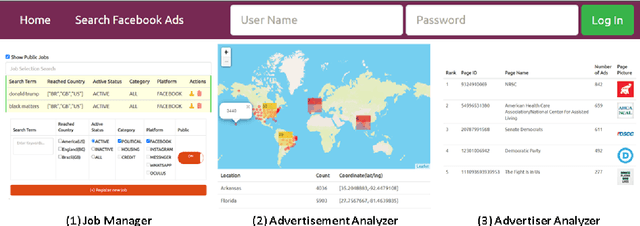
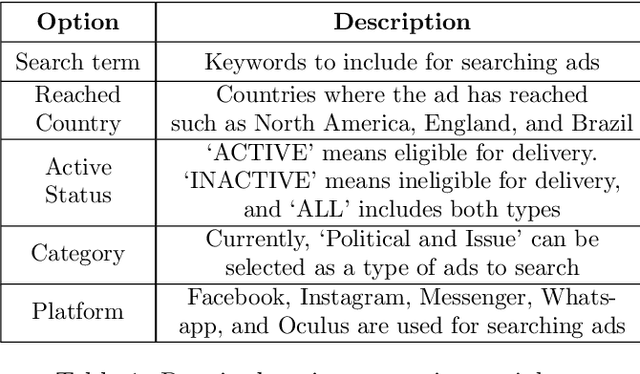
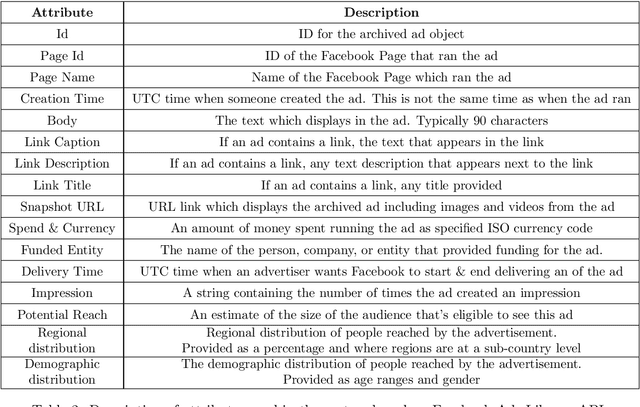
The growing use of social media has led to drastic changes in our decision-making. Especially, Facebook offers marketing API which promotes business to target potential groups who are likely to consume their items. However, this service can be abused by malicious advertisers who attempt to deceive people by disinformation such as propaganda and divisive opinion. To counter this problem, we introduce a new application named FBAdTracker. The purpose of this application is to provide an integrated data collection and analysis system for current research on fact-checking related to Facebook advertisements. Our system is capable of monitoring up-to-date Facebook ads and analyzing ads retrieved from Facebook Ads Library.