 Add to Chrome
 Add to Firefox
 Add to Edge
Seeing Isn't Believing: Uncovering Blind Spots in Evaluator Vision-Language Models
Apr 23, 2026
Large Vision-Language Models (VLMs) are increasingly used to evaluate outputs of other models, for image-to-text (I2T) tasks such as visual question answering, and text-to-image (T2I) generation tasks. Despite this growing reliance, the reliability of these Evaluator VLMs remains under explored. In this work, we systematically evaluate the reliability of Evaluator VLMs across both I2T and T2I tasks. We introduce targeted perturbations that degrade output quality along key error dimensions, including object hallucinations, spatial reasoning, factual grounding, and visual fidelity. These perturbations test whether Evaluator VLMs can reliably account for these quality degrading errors in their evaluations. Using a comprehensive benchmark of over 4000 perturbed instances spanning 40 perturbation dimensions, we evaluate 4 prominent VLMs using single-answer scoring, pairwise comparison, and reference-guided paradigms. Our findings reveal that current VLM evaluators exhibit substantial blind spots: they often fail to detect perturbed outputs - in some cases exceeding 50%, struggle particularly with fine-grained compositional and spatial errors, and are often insensitive to hallucinated content that contradicts the input image. Pairwise comparison proves more reliable, though failure rates persist. These results highlight the unreliable nature of current Evaluator VLMs and urge caution in their deployment for benchmarking and development decisions. Code and data have been made publicly available.

A2Z-10M+: Geometric Deep Learning with A-to-Z BRep Annotations for AI-Assisted CAD Modeling and Reverse Engineering
Mar 13, 2026Reverse engineering and rapid prototyping of computer-aided design (CAD) models from 3D scans, sketches, or simple text prompts are vital in industrial product design. However, recent advances in geometric deep learning techniques lack a multi-modal understanding of parametric CAD features stored in their boundary representation (BRep). This study presents the largest compilation of 10 million multi-modal annotations and metadata for 1 million ABC CAD models, namely A2Z, to unlock an unprecedented level of BRep learning. A2Z comprises (i) high-resolution meshes with salient 3D scanning features, (ii) 3D hand-drawn sketches equipped with (iii) geometric and topological information about BRep co-edges, corners, and surfaces, and (iv) textual captions and tags describing the product in the mechanical world. Creating such carefully structured, large-scale data, which requires nearly 5 terabytes of storage to leverage unparalleled CAD learning/retrieval tasks, is very challenging. The scale, quality, and diversity of our multi-modal annotations are assessed using novel metrics, GPT-5, Gemini, and extensive human feedback mechanisms. To this end, we also merge an additional 25,000 CAD models of electronic enclosures (e.g., tablets, ports) designed by skilled professionals with our A2Z dataset. Subsequently, we train and benchmark a foundation model on a subset of 150K CAD models to detect BRep co-edges and corner vertices from 3D scans, a key downstream task in CAD reverse engineering. The annotated dataset, metrics, and checkpoints will be publicly released to support numerous research directions.
DenVisCoM: Dense Vision Correspondence Mamba for Efficient and Real-time Optical Flow and Stereo Estimation
Feb 02, 2026In this work, we propose a novel Mamba block DenVisCoM, as well as a novel hybrid architecture specifically tailored for accurate and real-time estimation of optical flow and disparity estimation. Given that such multi-view geometry and motion tasks are fundamentally related, we propose a unified architecture to tackle them jointly. Specifically, the proposed hybrid architecture is based on DenVisCoM and a Transformer-based attention block that efficiently addresses real-time inference, memory footprint, and accuracy at the same time for joint estimation of motion and 3D dense perception tasks. We extensively analyze the benchmark trade-off of accuracy and real-time processing on a large number of datasets. Our experimental results and related analysis suggest that our proposed model can accurately estimate optical flow and disparity estimation in real time. All models and associated code are available at https://github.com/vimstereo/DenVisCoM.
DensePercept-NCSSD: Vision Mamba towards Real-time Dense Visual Perception with Non-Causal State Space Duality
Nov 16, 2025In this work, we propose an accurate and real-time optical flow and disparity estimation model by fusing pairwise input images in the proposed non-causal selective state space for dense perception tasks. We propose a non-causal Mamba block-based model that is fast and efficient and aptly manages the constraints present in a real-time applications. Our proposed model reduces inference times while maintaining high accuracy and low GPU usage for optical flow and disparity map generation. The results and analysis, and validation in real-life scenario justify that our proposed model can be used for unified real-time and accurate 3D dense perception estimation tasks. The code, along with the models, can be found at https://github.com/vimstereo/DensePerceptNCSSD
ViM-Disparity: Bridging the Gap of Speed, Accuracy and Memory for Disparity Map Generation
Dec 21, 2024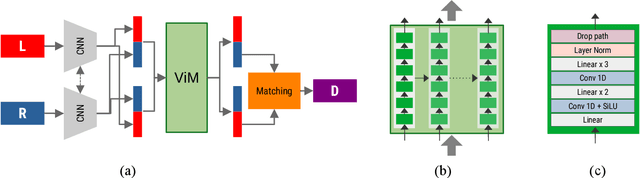

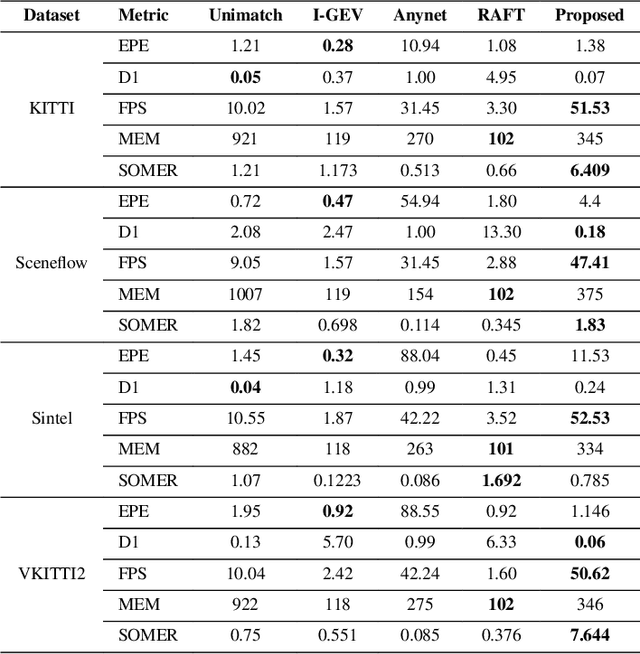

In this work we propose a Visual Mamba (ViM) based architecture, to dissolve the existing trade-off for real-time and accurate model with low computation overhead for disparity map generation (DMG). Moreover, we proposed a performance measure that can jointly evaluate the inference speed, computation overhead and the accurateness of a DMG model.