 Add to Chrome
 Add to Firefox
 Add to Edge
FOCA: Future-Oriented Conditioning for Data-Efficient Vision-Language-Action Adaptation
Jun 18, 2026
Vision-Language-Action (VLA) models enable general-purpose robotic control via large-scale multimodal pretraining, yet their effectiveness under few-shot imitation learning remains limited. We conduct a systematic stress test of state-of-the-art VLA models and show that performance degrades sharply as demonstrations are reduced, revealing a key weakness of existing adaptation strategies. To address this, we introduce FOCA, a future-oriented conditioning framework for data-efficient VLA adaptation. FOCA combines explicit prediction of task-grounded future interaction embeddings with implicit alignment to future goal observations, enabling long-horizon reasoning in latent space without pixel-level prediction. This formulation naturally supports action-free co-training with synthetic videos from video world models and can be interpreted as learning a future-conditioned value-like representation. Extensive experiments demonstrate FOCA achieves 95.7% success with 20 demonstrations on LIBERO, improves 7-12% on RoboCasa, and delivers up to 26% absolute gains on real robots, establishing a new state of the art in few-shot VLA adaptation.

Accelerating Road Sign Ground Truth Construction with Knowledge Graph and Machine Learning
Dec 04, 2020
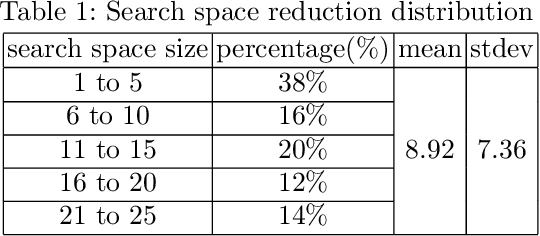
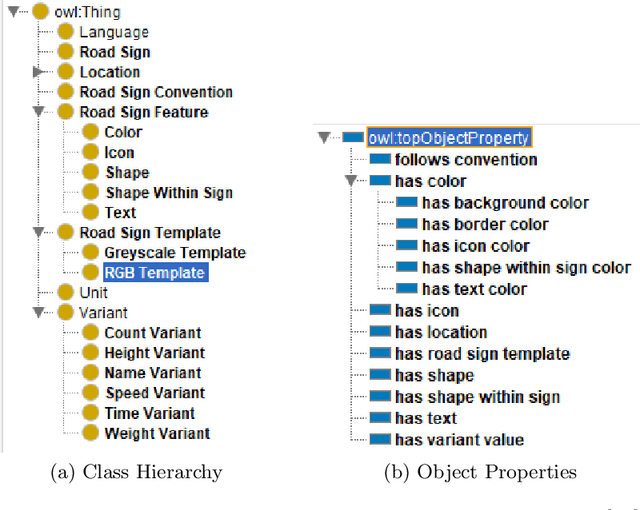

Having a comprehensive, high-quality dataset of road sign annotation is critical to the success of AI-based Road Sign Recognition (RSR) systems. In practice, annotators often face difficulties in learning road sign systems of different countries; hence, the tasks are often time-consuming and produce poor results. We propose a novel approach using knowledge graphs and a machine learning algorithm - variational prototyping-encoder (VPE) - to assist human annotators in classifying road signs effectively. Annotators can query the Road Sign Knowledge Graph using visual attributes and receive closest matching candidates suggested by the VPE model. The VPE model uses the candidates from the knowledge graph and a real sign image patch as inputs. We show that our knowledge graph approach can reduce sign search space by 98.9%. Furthermore, with VPE, our system can propose the correct single candidate for 75% of signs in the tested datasets, eliminating the human search effort entirely in those cases.
* 12 pages, 5 figures