 Add to Chrome
 Add to Firefox
 Add to Edge
ViInfographicVQA: A Benchmark for Single and Multi-image Visual Question Answering on Vietnamese Infographics
Dec 13, 2025
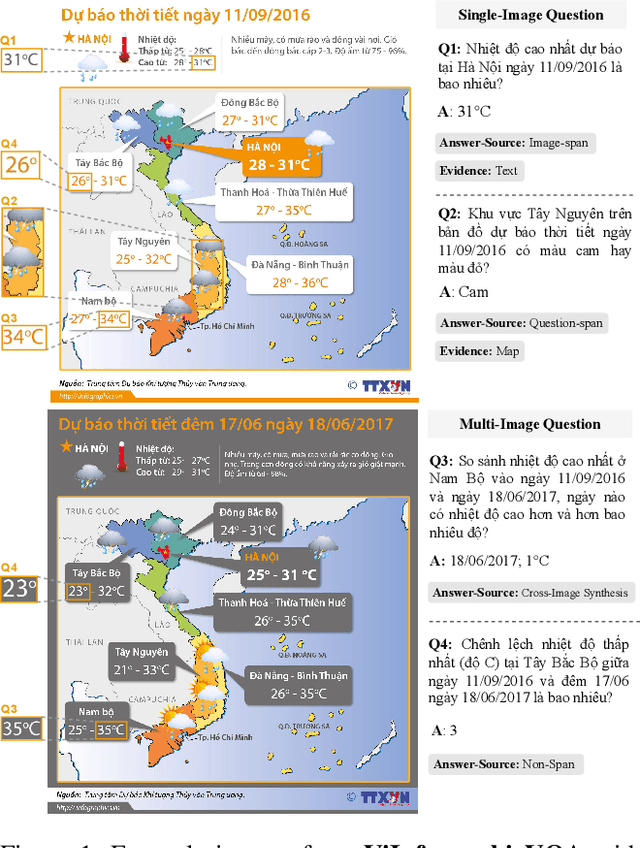
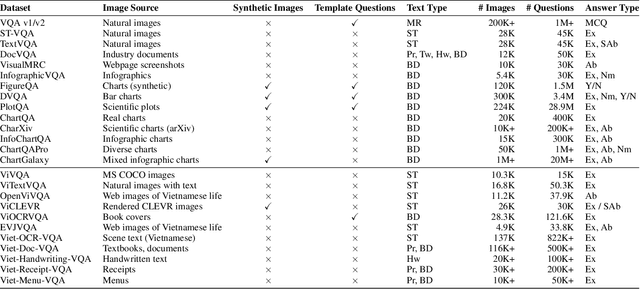
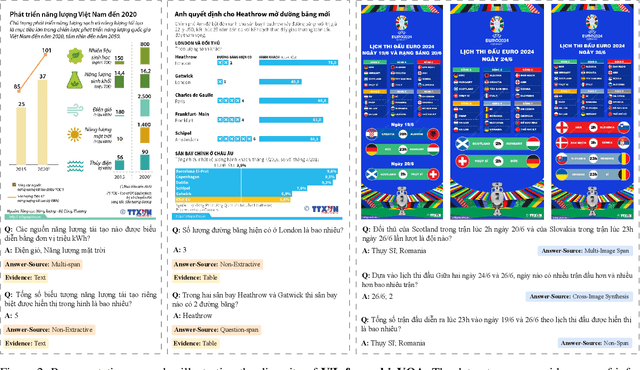
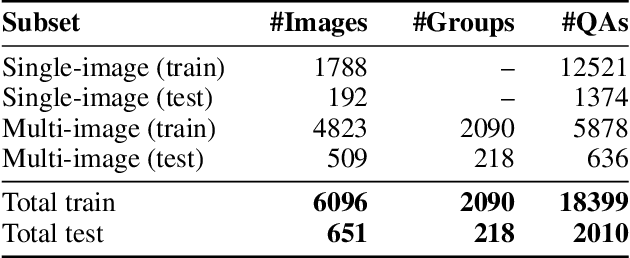
Infographic Visual Question Answering (InfographicVQA) evaluates a model's ability to read and reason over data-rich, layout-heavy visuals that combine text, charts, icons, and design elements. Compared with scene-text or natural-image VQA, infographics require stronger integration of OCR, layout understanding, and numerical and semantic reasoning. We introduce ViInfographicVQA, the first benchmark for Vietnamese InfographicVQA, comprising over 6747 real-world infographics and 20409 human-verified question-answer pairs across economics, healthcare, education, and more. The benchmark includes two evaluation settings. The Single-image task follows the traditional setup in which each question is answered using a single infographic. The Multi-image task requires synthesizing evidence across multiple semantically related infographics and is, to our knowledge, the first Vietnamese evaluation of cross-image reasoning in VQA. We evaluate a range of recent vision-language models on this benchmark, revealing substantial performance disparities, with the most significant errors occurring on Multi-image questions that involve cross-image integration and non-span reasoning. ViInfographicVQA contributes benchmark results for Vietnamese InfographicVQA and sheds light on the limitations of current multimodal models in low-resource contexts, encouraging future exploration of layout-aware and cross-image reasoning methods.

Describe Anything Model for Visual Question Answering on Text-rich Images
Jul 16, 2025Recent progress has been made in region-aware vision-language modeling, particularly with the emergence of the Describe Anything Model (DAM). DAM is capable of generating detailed descriptions of any specific image areas or objects without the need for additional localized image-text alignment supervision. We hypothesize that such region-level descriptive capability is beneficial for the task of Visual Question Answering (VQA), especially in challenging scenarios involving images with dense text. In such settings, the fine-grained extraction of textual information is crucial to producing correct answers. Motivated by this, we introduce DAM-QA, a framework with a tailored evaluation protocol, developed to investigate and harness the region-aware capabilities from DAM for the text-rich VQA problem that requires reasoning over text-based information within images. DAM-QA incorporates a mechanism that aggregates answers from multiple regional views of image content, enabling more effective identification of evidence that may be tied to text-related elements. Experiments on six VQA benchmarks show that our approach consistently outperforms the baseline DAM, with a notable 7+ point gain on DocVQA. DAM-QA also achieves the best overall performance among region-aware models with fewer parameters, significantly narrowing the gap with strong generalist VLMs. These results highlight the potential of DAM-like models for text-rich and broader VQA tasks when paired with efficient usage and integration strategies. Our code is publicly available at https://github.com/Linvyl/DAM-QA.git.