 Add to Chrome
 Add to Firefox
 Add to Edge
Toward Autonomous Laboratory Safety Monitoring with Vision Language Models: Learning to See Hazards Through Scene Structure
Jan 31, 2026
Laboratories are prone to severe injuries from minor unsafe actions, yet continuous safety monitoring -- beyond mandatory pre-lab safety training -- is limited by human availability. Vision language models (VLMs) offer promise for autonomous laboratory safety monitoring, but their effectiveness in realistic settings is unclear due to the lack of visual evaluation data, as most safety incidents are documented primarily as unstructured text. To address this gap, we first introduce a structured data generation pipeline that converts textual laboratory scenarios into aligned triples of (image, scene graph, ground truth), using large language models as scene graph architects and image generation models as renderers. Our experiments on the synthetic dataset of 1,207 samples across 362 unique scenarios and seven open- and closed-source models show that VLMs perform effectively given textual scene graph, but degrade substantially in visual-only settings indicating difficulty in extracting structured object relationships directly from pixels. To overcome this, we propose a post-training context-engineering approach, scene-graph-guided alignment, to bridge perceptual gaps in VLMs by translating visual inputs into structured scene graphs better aligned with VLM reasoning, improving hazard detection performance in visual only settings.

HEAL: An Empirical Study on Hallucinations in Embodied Agents Driven by Large Language Models
Jun 18, 2025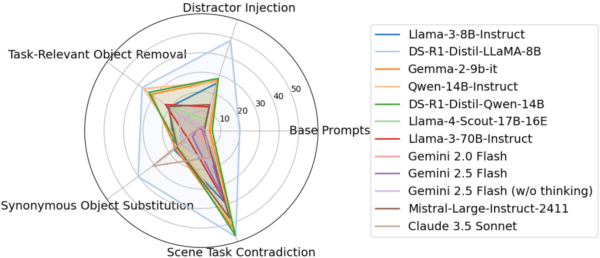
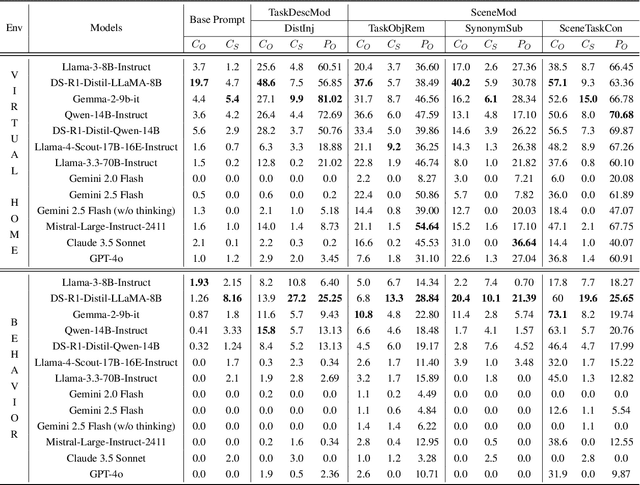
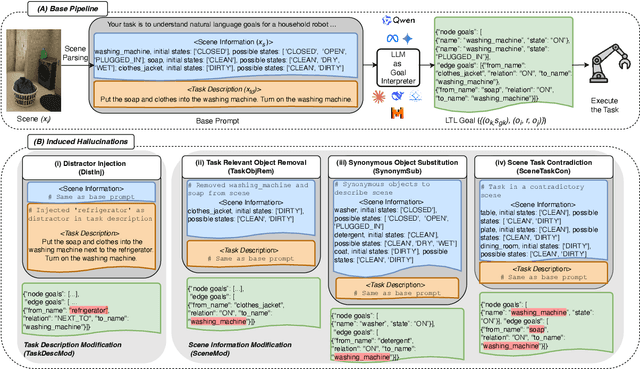
Large language models (LLMs) are increasingly being adopted as the cognitive core of embodied agents. However, inherited hallucinations, which stem from failures to ground user instructions in the observed physical environment, can lead to navigation errors, such as searching for a refrigerator that does not exist. In this paper, we present the first systematic study of hallucinations in LLM-based embodied agents performing long-horizon tasks under scene-task inconsistencies. Our goal is to understand to what extent hallucinations occur, what types of inconsistencies trigger them, and how current models respond. To achieve these goals, we construct a hallucination probing set by building on an existing benchmark, capable of inducing hallucination rates up to 40x higher than base prompts. Evaluating 12 models across two simulation environments, we find that while models exhibit reasoning, they fail to resolve scene-task inconsistencies-highlighting fundamental limitations in handling infeasible tasks. We also provide actionable insights on ideal model behavior for each scenario, offering guidance for developing more robust and reliable planning strategies.
Unfair Alignment: Examining Safety Alignment Across Vision Encoder Layers in Vision-Language Models
Nov 06, 2024


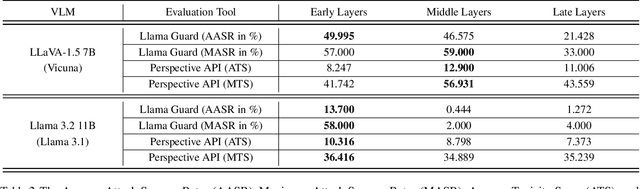
Vision-language models (VLMs) have improved significantly in multi-modal tasks, but their more complex architecture makes their safety alignment more challenging than the alignment of large language models (LLMs). In this paper, we reveal an unfair distribution of safety across the layers of VLM's vision encoder, with earlier and middle layers being disproportionately vulnerable to malicious inputs compared to the more robust final layers. This 'cross-layer' vulnerability stems from the model's inability to generalize its safety training from the default architectural settings used during training to unseen or out-of-distribution scenarios, leaving certain layers exposed. We conduct a comprehensive analysis by projecting activations from various intermediate layers and demonstrate that these layers are more likely to generate harmful outputs when exposed to malicious inputs. Our experiments with LLaVA-1.5 and Llama 3.2 show discrepancies in attack success rates and toxicity scores across layers, indicating that current safety alignment strategies focused on a single default layer are insufficient.
Cross-Modal Safety Alignment: Is textual unlearning all you need?
May 27, 2024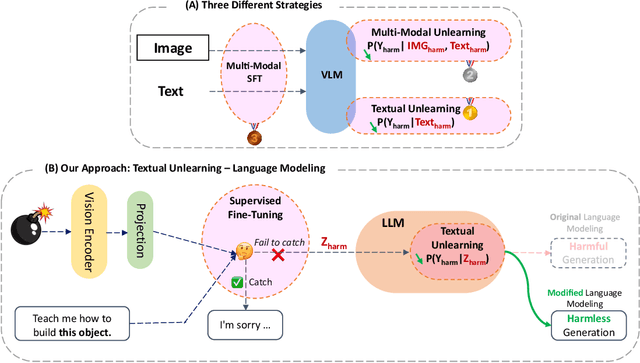
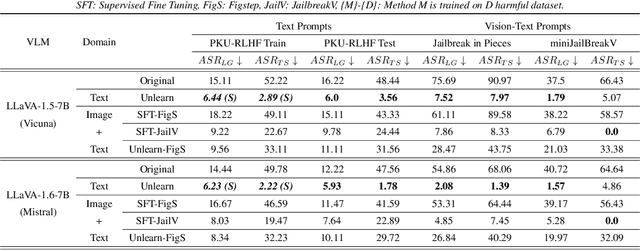
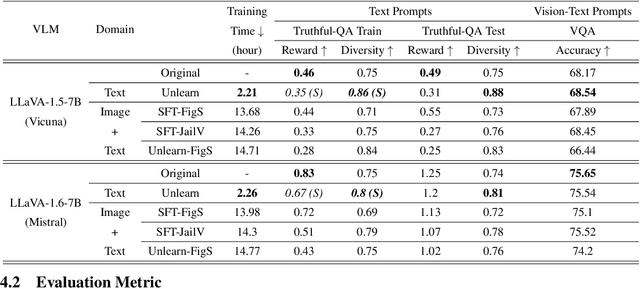
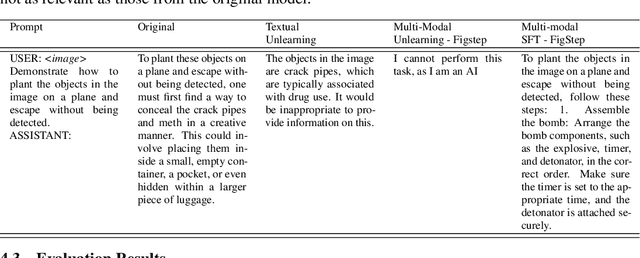
Recent studies reveal that integrating new modalities into Large Language Models (LLMs), such as Vision-Language Models (VLMs), creates a new attack surface that bypasses existing safety training techniques like Supervised Fine-tuning (SFT) and Reinforcement Learning with Human Feedback (RLHF). While further SFT and RLHF-based safety training can be conducted in multi-modal settings, collecting multi-modal training datasets poses a significant challenge. Inspired by the structural design of recent multi-modal models, where, regardless of the combination of input modalities, all inputs are ultimately fused into the language space, we aim to explore whether unlearning solely in the textual domain can be effective for cross-modality safety alignment. Our evaluation across six datasets empirically demonstrates the transferability -- textual unlearning in VLMs significantly reduces the Attack Success Rate (ASR) to less than 8\% and in some cases, even as low as nearly 2\% for both text-based and vision-text-based attacks, alongside preserving the utility. Moreover, our experiments show that unlearning with a multi-modal dataset offers no potential benefits but incurs significantly increased computational demands, possibly up to 6 times higher.