 Add to Chrome
 Add to Firefox
 Add to Edge
Modeling Branches for Active Manipulation using Iterative Parameter Estimation
Jun 17, 2026
This study presents a method for modeling diverse plant branches by iteratively estimating material parameters to support delicate branch manipulation. Branch manipulation is necessary in agricultural robotics for plant repositioning, stabilizing, and clearing visual obstructions in dense foliage. The proposed method builds a tetrahedral branch model from point-cloud data and simulates its behavior using the finite element method. Using real observed deformation data, it iteratively estimates branch parameters and then computes an optimal path with a deformation-aware motion planner to move and stabilize branches within another robot's field of view. Across 30 trials on branches with varying geometries and material properties, the proposed method reduced the deformation energy by 35.69% while increasing the path length by 8.10% on average.

Force Aware Branch Manipulation To Assist Agricultural Tasks
Mar 11, 2025This study presents a methodology to safely manipulate branches to aid various agricultural tasks. Humans in a real agricultural environment often manipulate branches to perform agricultural tasks effectively, but current agricultural robots lack this capability. This proposed strategy to manipulate branches can aid in different precision agriculture tasks, such as fruit picking in dense foliage, pollinating flowers under occlusion, and moving overhanging vines and branches for navigation. The proposed method modifies RRT* to plan a path that satisfies the branch geometric constraints and obeys branch deformable characteristics. Re-planning is done to obtain a path that helps the robot exert force within a desired range so that branches are not damaged during manipulation. Experimentally, this method achieved a success rate of 78% across 50 trials, successfully moving a branch from different starting points to a target region.
Design of Stickbug: a Six-Armed Precision Pollination Robot
Apr 04, 2024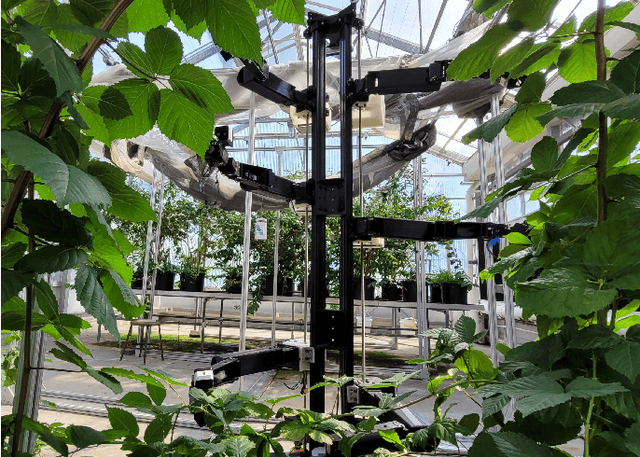
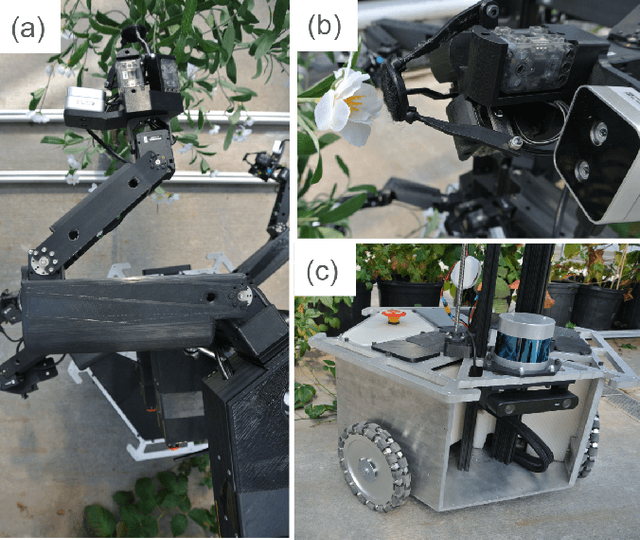
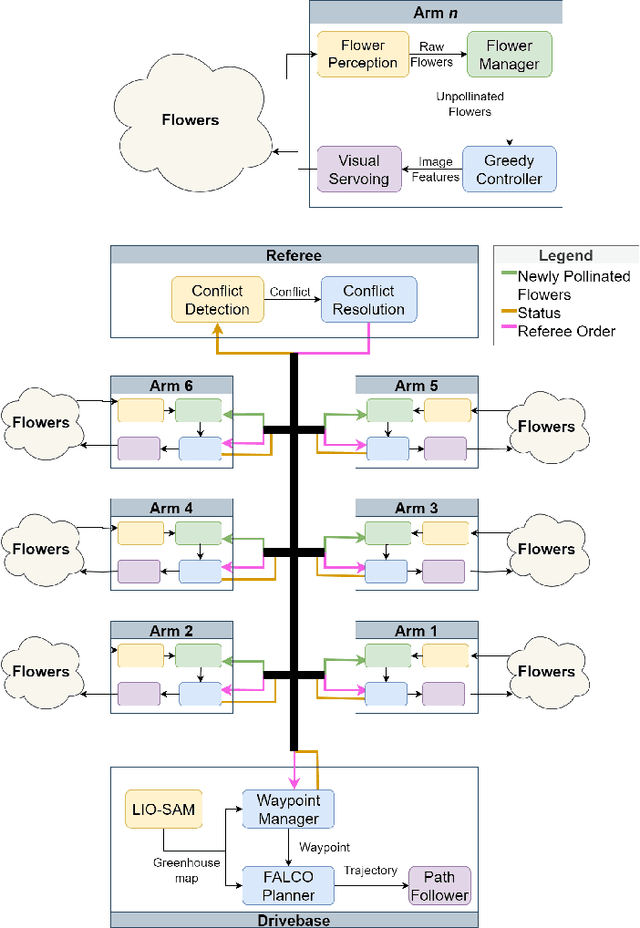
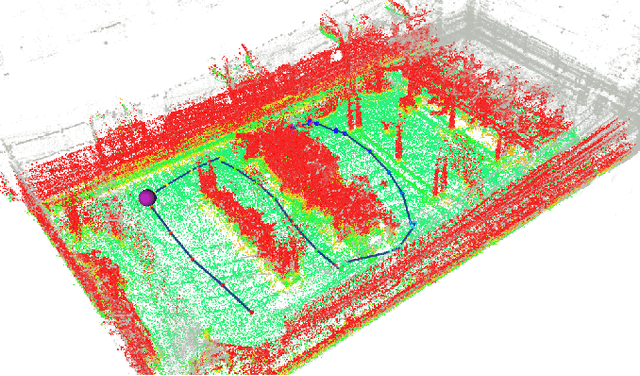
This work presents the design of Stickbug, a six-armed, multi-agent, precision pollination robot that combines the accuracy of single-agent systems with swarm parallelization in greenhouses. Precision pollination robots have often been proposed to offset the effects of a decreasing population of natural pollinators, but they frequently lack the required parallelization and scalability. Stickbug achieves this by allowing each arm and drive base to act as an individual agent, significantly reducing planning complexity. Stickbug uses a compact holonomic Kiwi drive to navigate narrow greenhouse rows, a tall mast to support multiple manipulators and reach plant heights, a detection model and classifier to identify Bramble flowers, and a felt-tipped end-effector for contact-based pollination. Initial experimental validation demonstrates that Stickbug can attempt over 1.5 pollinations per minute with a 50% success rate. Additionally, a Bramble flower perception dataset was created and is publicly available alongside Stickbug's software and design files.
Swarm of One: Bottom-up Emergence of Stable Robot Bodies from Identical Cells
Jun 22, 2023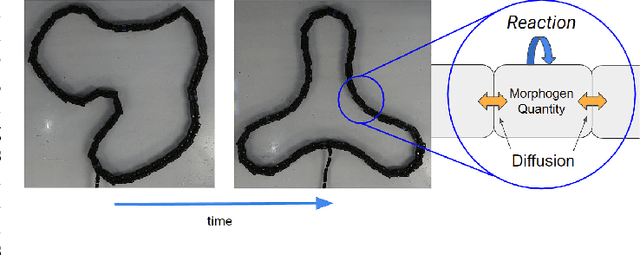
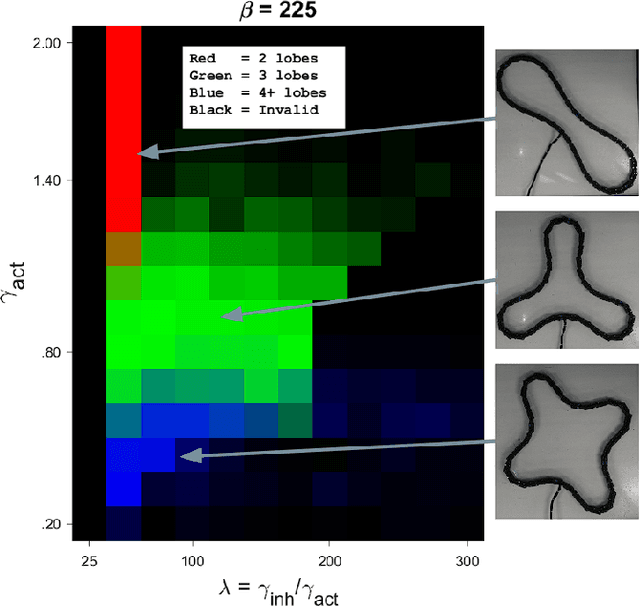
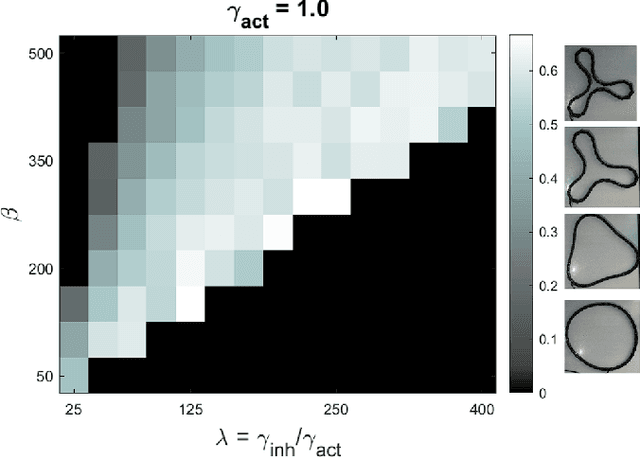
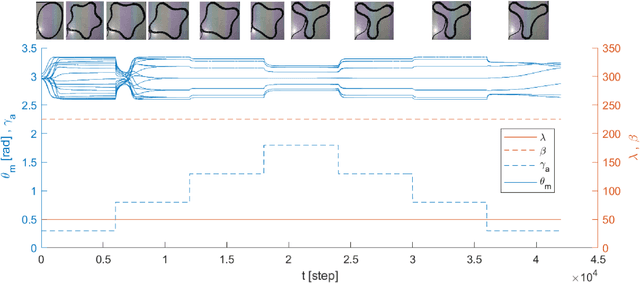
Unlike most human-engineered systems, biological systems are emergent from low-level interactions, allowing much broader diversity and superior adaptation to the complex environments. Inspired by the process of morphogenesis in nature, a bottom-up design approach for robot morphology is proposed to treat a robot's body as an emergent response to underlying processes rather than a predefined shape. This paper presents Loopy, a "Swarm-of-One" polymorphic robot testbed that can be viewed simultaneously as a robotic swarm and a single robot. Loopy's shape is determined jointly by self-organization and morphological computing using physically linked homogeneous cells. Experimental results show that Loopy can form symmetric shapes consisting of lobes. Using the the same set of parameters, even small amounts of initial noise can change the number of lobes formed. However, once in a stable configuration, Loopy has an "inertia" to transfiguring in response to dynamic parameters. By making the connections among self-organization, morphological computing, and robot design, this paper lays the foundation for more adaptable robot designs in the future.