 Add to Chrome
 Add to Firefox
 Add to Edge
Learned Non-Maximum Suppression for 3D Object Detection
Jun 02, 2026
Post-processing is a critical stage in LiDAR-based 3D object detection, where dense and overlapping proposals must be filtered for compact and reliable perception. This work introduces two learned filtering modules that replace heuristic non-maximum suppression (NMS) by leveraging relations among detections. D2D-Rescore employs transformer-based detection-to-detection (D2D) attention, while GossipNet3D adapts the 2D GossipNet concept to 3D through localized message passing in bird's-eye view. A metric-aware matching strategy aligned with the nuScenes evaluation protocol ensures consistent training and validation behavior, improving overall detection performance. Both approaches improve mean average precision (mAP), nuScenes detection score (NDS), and true positive quality compared to CircleNMS, particularly for small and infrequent classes, while adding minimal computational overhead. These results demonstrate that learned, detection-level filtering can enhance 3D detector reliability without modifying the base network, offering a principled alternative to heuristic suppression. Code is available at https://github.com/rst-tu-dortmund/learned-3d-nms .

CANMOT: Class-Aware Noise Modeling for Multi-Object Tracking in Autonomous Driving
Jun 02, 2026Kalman filter (KF)-based multi-object tracking (MOT) remains a strong baseline for autonomous driving due to its strong performance, computational efficiency and interpretability. In most practical systems, the process noise and measurement noise covariances are defined globally and shared across object classes, presuming identical uncertainty characteristics across heterogeneous traffic participants. This work revisits this assumption and proposes CANMOT, a class-aware and object-aligned noise modeling framework for KF-based 3D MOT. Class-specific diagonal process and measurement covariance matrices are introduced and optionally expressed in the object coordinate frame to preserve longitudinal-lateral anisotropy. Systematic experiments on the nuScenes benchmark show that class-aware and object-aligned noise modeling improves tracking performance and substantially reduces identity switches compared to state-of-the-art (SotA). In addition, the consistency of the estimated uncertainty is analyzed using the Average Normalized Estimation Error Squared (ANEES) and $χ^2$-based violation tests. The results reveal severe overconfidence in standard KF-based MOT baselines. While the proposed formulation improves calibration without modifying the underlying filtering framework, it still exhibits substantial inconsistency, highlighting the need for further research in this area. Code is available at https://github.com/rst-tu-dortmund/learned-3d-nms.
Next-Best-Trajectory Planning of Robot Manipulators for Effective Observation and Exploration
Mar 28, 2025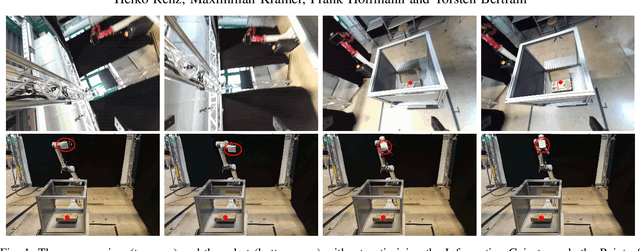
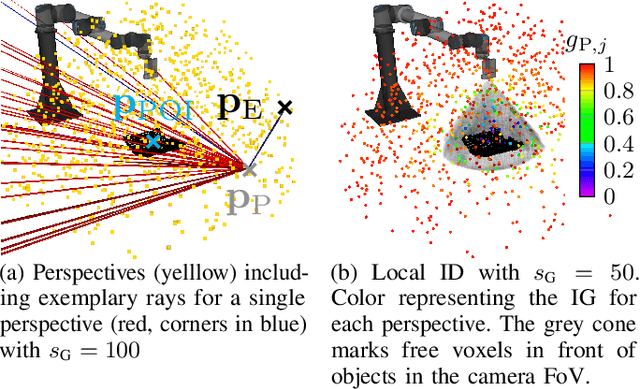
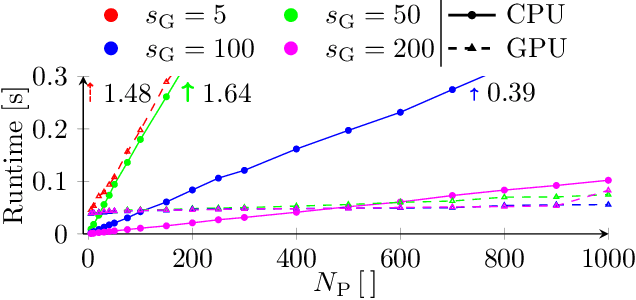
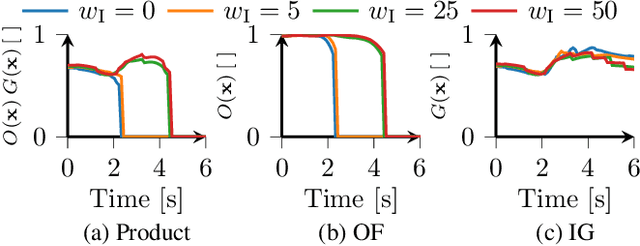
Visual observation of objects is essential for many robotic applications, such as object reconstruction and manipulation, navigation, and scene understanding. Machine learning algorithms constitute the state-of-the-art in many fields but require vast data sets, which are costly and time-intensive to collect. Automated strategies for observation and exploration are crucial to enhance the efficiency of data gathering. Therefore, a novel strategy utilizing the Next-Best-Trajectory principle is developed for a robot manipulator operating in dynamic environments. Local trajectories are generated to maximize the information gained from observations along the path while avoiding collisions. We employ a voxel map for environment modeling and utilize raycasting from perspectives around a point of interest to estimate the information gain. A global ergodic trajectory planner provides an optional reference trajectory to the local planner, improving exploration and helping to avoid local minima. To enhance computational efficiency, raycasting for estimating the information gain in the environment is executed in parallel on the graphics processing unit. Benchmark results confirm the efficiency of the parallelization, while real-world experiments demonstrate the strategy's effectiveness.
LoRD: Adapting Differentiable Driving Policies to Distribution Shifts
Oct 15, 2024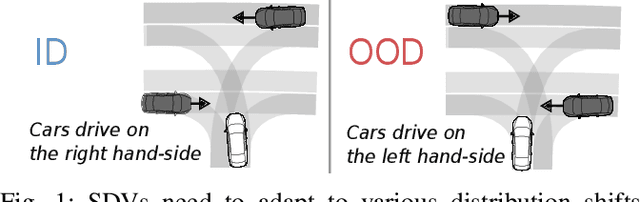
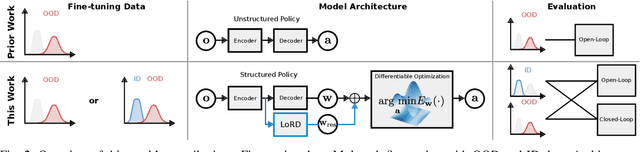

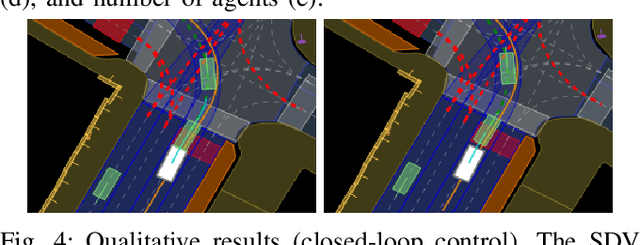
Distribution shifts between operational domains can severely affect the performance of learned models in self-driving vehicles (SDVs). While this is a well-established problem, prior work has mostly explored naive solutions such as fine-tuning, focusing on the motion prediction task. In this work, we explore novel adaptation strategies for differentiable autonomy stacks consisting of prediction, planning, and control, perform evaluation in closed-loop, and investigate the often-overlooked issue of catastrophic forgetting. Specifically, we introduce two simple yet effective techniques: a low-rank residual decoder (LoRD) and multi-task fine-tuning. Through experiments across three models conducted on two real-world autonomous driving datasets (nuPlan, exiD), we demonstrate the effectiveness of our methods and highlight a significant performance gap between open-loop and closed-loop evaluation in prior approaches. Our approach improves forgetting by up to 23.33% and the closed-loop OOD driving score by 8.83% in comparison to standard fine-tuning.
LEROjD: Lidar Extended Radar-Only Object Detection
Sep 09, 2024
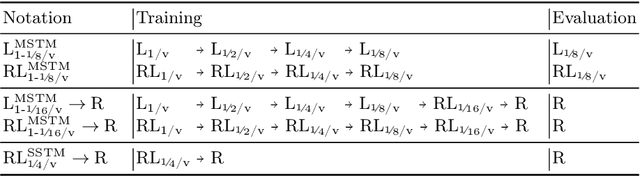

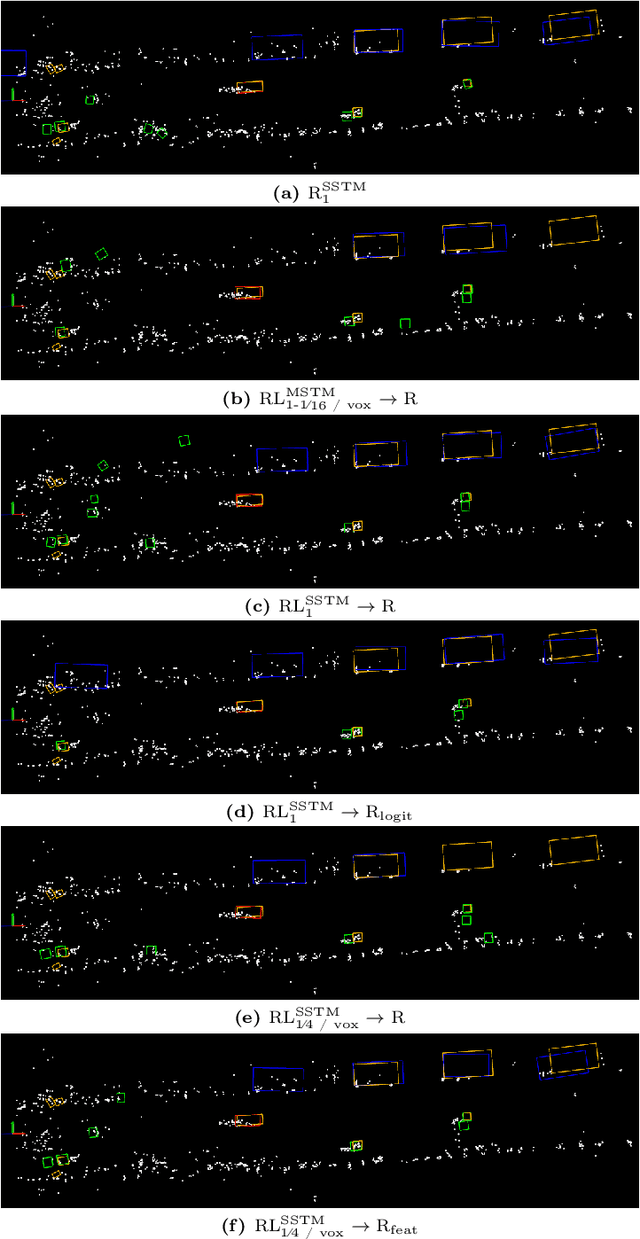
Accurate 3D object detection is vital for automated driving. While lidar sensors are well suited for this task, they are expensive and have limitations in adverse weather conditions. 3+1D imaging radar sensors offer a cost-effective, robust alternative but face challenges due to their low resolution and high measurement noise. Existing 3+1D imaging radar datasets include radar and lidar data, enabling cross-modal model improvements. Although lidar should not be used during inference, it can aid the training of radar-only object detectors. We explore two strategies to transfer knowledge from the lidar to the radar domain and radar-only object detectors: 1. multi-stage training with sequential lidar point cloud thin-out, and 2. cross-modal knowledge distillation. In the multi-stage process, three thin-out methods are examined. Our results show significant performance gains of up to 4.2 percentage points in mean Average Precision with multi-stage training and up to 3.9 percentage points with knowledge distillation by initializing the student with the teacher's weights. The main benefit of these approaches is their applicability to other 3D object detection networks without altering their architecture, as we show by analyzing it on two different object detectors. Our code is available at https://github.com/rst-tu-dortmund/lerojd
Multi-Object Tracking based on Imaging Radar 3D Object Detection
Jun 03, 2024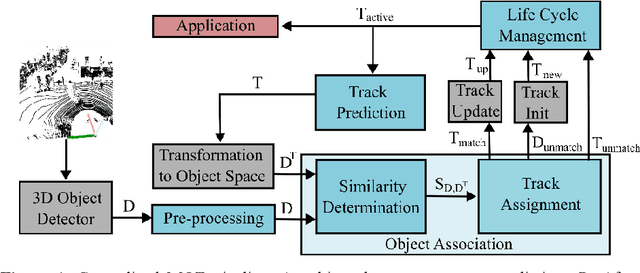
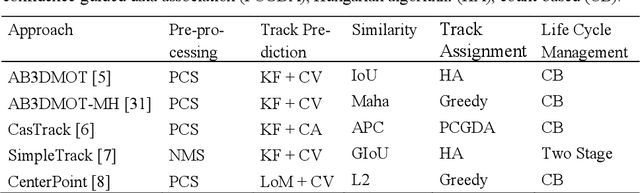

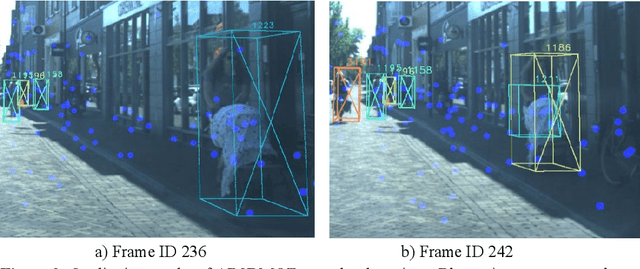
Effective tracking of surrounding traffic participants allows for an accurate state estimation as a necessary ingredient for prediction of future behavior and therefore adequate planning of the ego vehicle trajectory. One approach for detecting and tracking surrounding traffic participants is the combination of a learning based object detector with a classical tracking algorithm. Learning based object detectors have been shown to work adequately on lidar and camera data, while learning based object detectors using standard radar data input have proven to be inferior. Recently, with the improvements to radar sensor technology in the form of imaging radars, the object detection performance on radar was greatly improved but is still limited compared to lidar sensors due to the sparsity of the radar point cloud. This presents a unique challenge for the task of multi-object tracking. The tracking algorithm must overcome the limited detection quality while generating consistent tracks. To this end, a comparison between different multi-object tracking methods on imaging radar data is required to investigate its potential for downstream tasks. The work at hand compares multiple approaches and analyzes their limitations when applied to imaging radar data. Furthermore, enhancements to the presented approaches in the form of probabilistic association algorithms are considered for this task.
Energy-based Potential Games for Joint Motion Forecasting and Control
Dec 04, 2023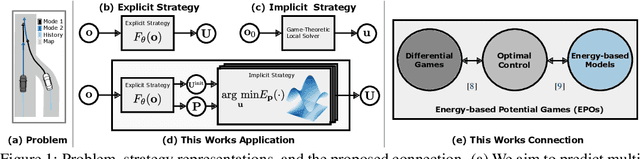
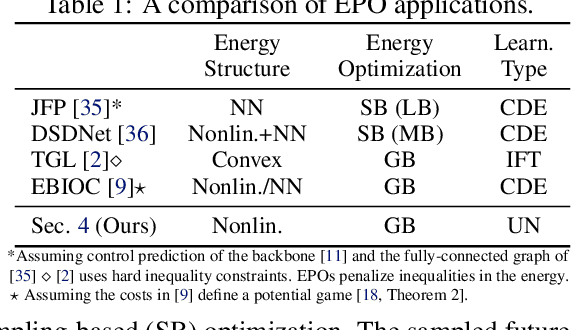
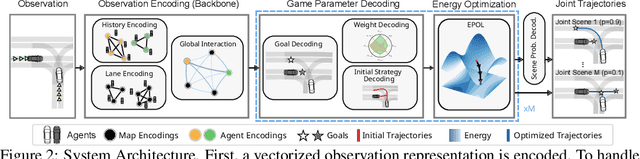
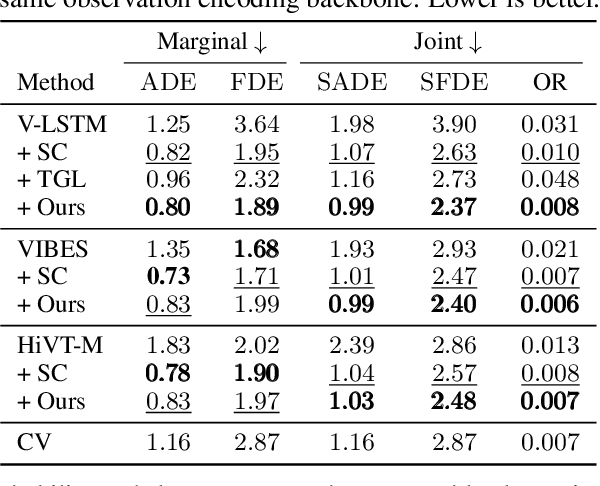
This work uses game theory as a mathematical framework to address interaction modeling in multi-agent motion forecasting and control. Despite its interpretability, applying game theory to real-world robotics, like automated driving, faces challenges such as unknown game parameters. To tackle these, we establish a connection between differential games, optimal control, and energy-based models, demonstrating how existing approaches can be unified under our proposed Energy-based Potential Game formulation. Building upon this, we introduce a new end-to-end learning application that combines neural networks for game-parameter inference with a differentiable game-theoretic optimization layer, acting as an inductive bias. The analysis provides empirical evidence that the game-theoretic layer adds interpretability and improves the predictive performance of various neural network backbones using two simulations and two real-world driving datasets.
Time-Optimal Trajectory Planning in Highway Scenarios using Basis-Spline Parameterization
Oct 05, 2023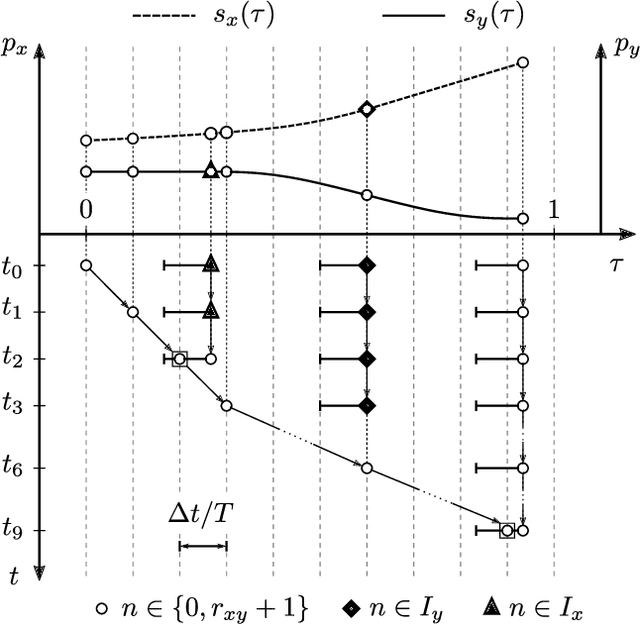
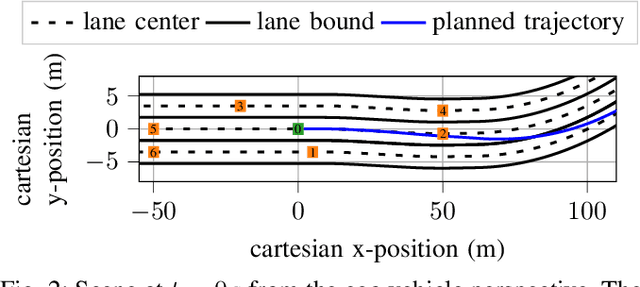
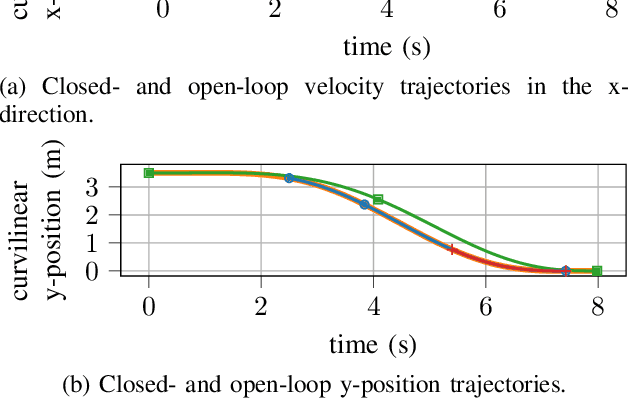
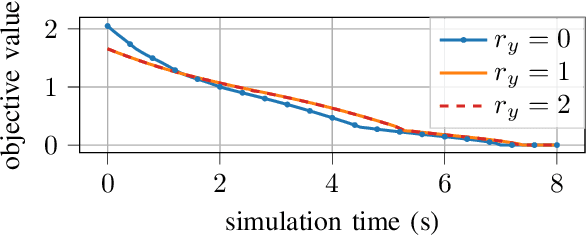
Basis splines enable a time-continuous feasibility check with a finite number of constraints. Constraints apply to the whole trajectory for motion planning applications that require a collision-free and dynamically feasible trajectory. Existing motion planners that rely on gradient-based optimization apply time scaling to implement a shrinking planning horizon. They neither guarantee a recursively feasible trajectory nor enable reaching two terminal manifold parts at different time scales. This paper proposes a nonlinear optimization problem that addresses the drawbacks of existing approaches. Therefore, the spline breakpoints are included in the optimization variables. Transformations between spline bases are implemented so a sparse problem formulation is achieved. A strategy for breakpoint removal enables the convergence into a terminal manifold. The evaluation in an overtaking scenario shows the influence of the breakpoint number on the solution quality and the time required for optimization.
On a Connection between Differential Games, Optimal Control, and Energy-based Models for Multi-Agent Interactions
Aug 31, 2023Game theory offers an interpretable mathematical framework for modeling multi-agent interactions. However, its applicability in real-world robotics applications is hindered by several challenges, such as unknown agents' preferences and goals. To address these challenges, we show a connection between differential games, optimal control, and energy-based models and demonstrate how existing approaches can be unified under our proposed Energy-based Potential Game formulation. Building upon this formulation, this work introduces a new end-to-end learning application that combines neural networks for game-parameter inference with a differentiable game-theoretic optimization layer, acting as an inductive bias. The experiments using simulated mobile robot pedestrian interactions and real-world automated driving data provide empirical evidence that the game-theoretic layer improves the predictive performance of various neural network backbones.
Ego-Motion Estimation and Dynamic Motion Separation from 3D Point Clouds for Accumulating Data and Improving 3D Object Detection
Aug 29, 2023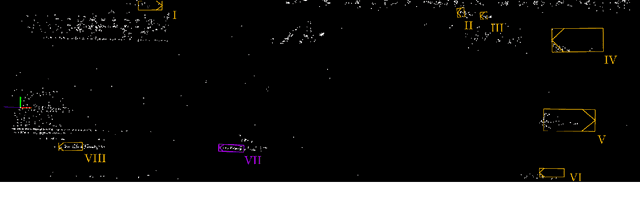
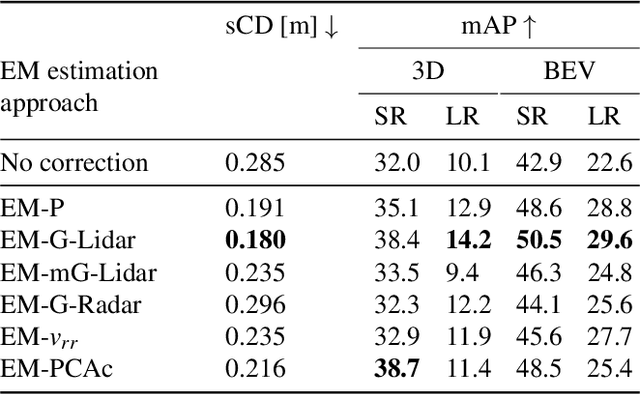
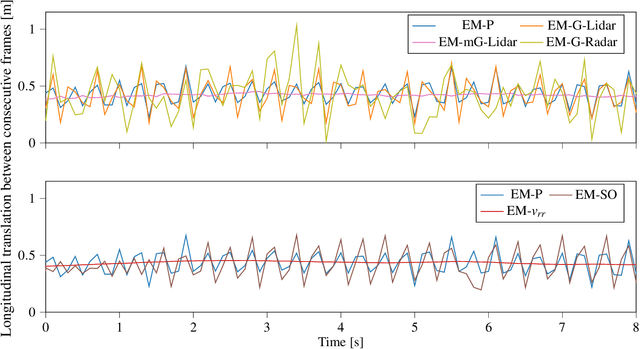
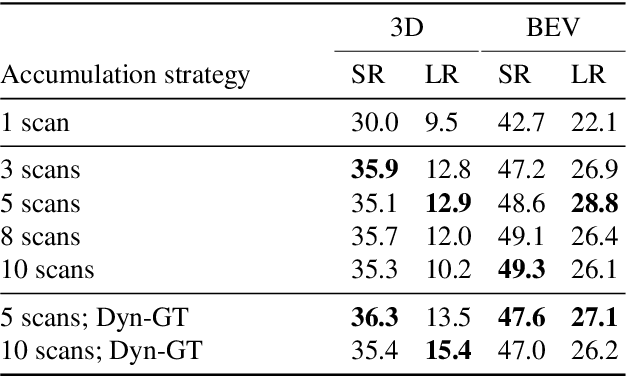
New 3+1D high-resolution radar sensors are gaining importance for 3D object detection in the automotive domain due to their relative affordability and improved detection compared to classic low-resolution radar sensors. One limitation of high-resolution radar sensors, compared to lidar sensors, is the sparsity of the generated point cloud. This sparsity could be partially overcome by accumulating radar point clouds of subsequent time steps. This contribution analyzes limitations of accumulating radar point clouds on the View-of-Delft dataset. By employing different ego-motion estimation approaches, the dataset's inherent constraints, and possible solutions are analyzed. Additionally, a learning-based instance motion estimation approach is deployed to investigate the influence of dynamic motion on the accumulated point cloud for object detection. Experiments document an improved object detection performance by applying an ego-motion estimation and dynamic motion correction approach.