 Add to Chrome
 Add to Firefox
 Add to Edge
CANMOT: Class-Aware Noise Modeling for Multi-Object Tracking in Autonomous Driving
Jun 02, 2026
Kalman filter (KF)-based multi-object tracking (MOT) remains a strong baseline for autonomous driving due to its strong performance, computational efficiency and interpretability. In most practical systems, the process noise and measurement noise covariances are defined globally and shared across object classes, presuming identical uncertainty characteristics across heterogeneous traffic participants. This work revisits this assumption and proposes CANMOT, a class-aware and object-aligned noise modeling framework for KF-based 3D MOT. Class-specific diagonal process and measurement covariance matrices are introduced and optionally expressed in the object coordinate frame to preserve longitudinal-lateral anisotropy. Systematic experiments on the nuScenes benchmark show that class-aware and object-aligned noise modeling improves tracking performance and substantially reduces identity switches compared to state-of-the-art (SotA). In addition, the consistency of the estimated uncertainty is analyzed using the Average Normalized Estimation Error Squared (ANEES) and $χ^2$-based violation tests. The results reveal severe overconfidence in standard KF-based MOT baselines. While the proposed formulation improves calibration without modifying the underlying filtering framework, it still exhibits substantial inconsistency, highlighting the need for further research in this area. Code is available at https://github.com/rst-tu-dortmund/learned-3d-nms.

Learned Non-Maximum Suppression for 3D Object Detection
Jun 02, 2026Post-processing is a critical stage in LiDAR-based 3D object detection, where dense and overlapping proposals must be filtered for compact and reliable perception. This work introduces two learned filtering modules that replace heuristic non-maximum suppression (NMS) by leveraging relations among detections. D2D-Rescore employs transformer-based detection-to-detection (D2D) attention, while GossipNet3D adapts the 2D GossipNet concept to 3D through localized message passing in bird's-eye view. A metric-aware matching strategy aligned with the nuScenes evaluation protocol ensures consistent training and validation behavior, improving overall detection performance. Both approaches improve mean average precision (mAP), nuScenes detection score (NDS), and true positive quality compared to CircleNMS, particularly for small and infrequent classes, while adding minimal computational overhead. These results demonstrate that learned, detection-level filtering can enhance 3D detector reliability without modifying the base network, offering a principled alternative to heuristic suppression. Code is available at https://github.com/rst-tu-dortmund/learned-3d-nms .
Energy-based Potential Games for Joint Motion Forecasting and Control
Dec 04, 2023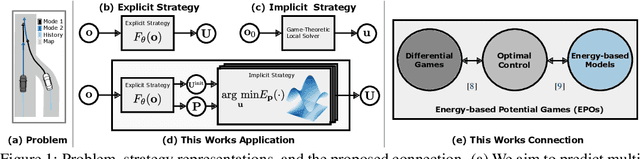
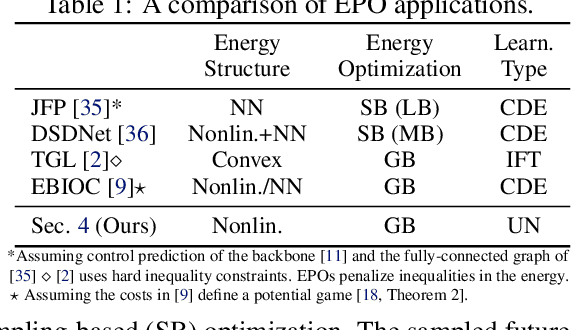
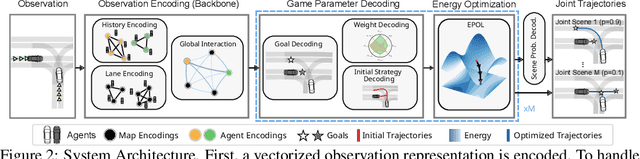
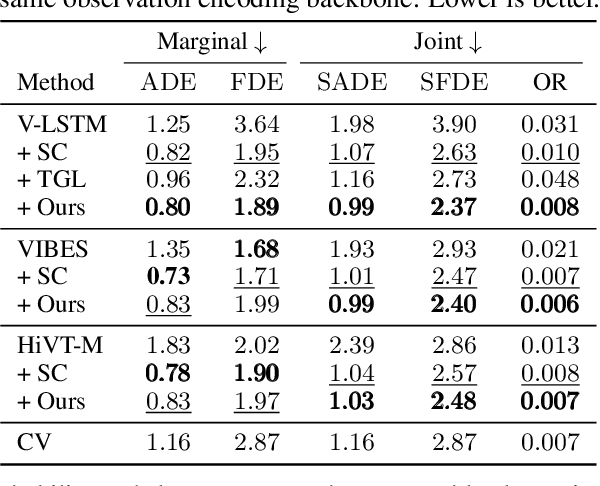
This work uses game theory as a mathematical framework to address interaction modeling in multi-agent motion forecasting and control. Despite its interpretability, applying game theory to real-world robotics, like automated driving, faces challenges such as unknown game parameters. To tackle these, we establish a connection between differential games, optimal control, and energy-based models, demonstrating how existing approaches can be unified under our proposed Energy-based Potential Game formulation. Building upon this, we introduce a new end-to-end learning application that combines neural networks for game-parameter inference with a differentiable game-theoretic optimization layer, acting as an inductive bias. The analysis provides empirical evidence that the game-theoretic layer adds interpretability and improves the predictive performance of various neural network backbones using two simulations and two real-world driving datasets.