 Add to Chrome
 Add to Firefox
 Add to Edge
UrbanHuRo: A Two-Layer Human-Robot Collaboration Framework for the Joint Optimization of Heterogeneous Urban Services
Mar 04, 2026
In the vision of smart cities, technologies are being developed to enhance the efficiency of urban services and improve residents' quality of life. However, most existing research focuses on optimizing individual services in isolation, without adequately considering reciprocal interactions among heterogeneous urban services that could yield higher efficiency and improved resource utilization. For example, human couriers could collect traffic and air quality data along their delivery routes, while sensing robots could assist with on-demand delivery during peak hours, enhancing both sensing coverage and delivery efficiency. However, the joint optimization of different urban services is challenging due to potentially conflicting objectives and the need for real-time coordination in dynamic environments. In this paper, we propose UrbanHuRo, a two-layer human-robot collaboration framework for joint optimization of heterogeneous urban services, demonstrated through crowdsourced delivery and urban sensing. UrbanHuRo includes two key designs: (i) a scalable distributed MapReduce-based K-submodular maximization module for efficient order dispatch, and (ii) a deep submodular reward reinforcement learning algorithm for sensing route planning. Experimental evaluations on real-world datasets from a food delivery platform demonstrate that UrbanHuRo improves sensing coverage by 29.7% and courier income by 39.2% on average in most settings, while also significantly reducing the number of overdue orders.

RELS-DQN: A Robust and Efficient Local Search Framework for Combinatorial Optimization
Apr 11, 2023Combinatorial optimization (CO) aims to efficiently find the best solution to NP-hard problems ranging from statistical physics to social media marketing. A wide range of CO applications can benefit from local search methods because they allow reversible action over greedy policies. Deep Q-learning (DQN) using message-passing neural networks (MPNN) has shown promise in replicating the local search behavior and obtaining comparable results to the local search algorithms. However, the over-smoothing and the information loss during the iterations of message passing limit its robustness across applications, and the large message vectors result in memory inefficiency. Our paper introduces RELS-DQN, a lightweight DQN framework that exhibits the local search behavior while providing practical scalability. Using the RELS-DQN model trained on one application, it can generalize to various applications by providing solution values higher than or equal to both the local search algorithms and the existing DQN models while remaining efficient in runtime and memory.
DASH: Distributed Adaptive Sequencing Heuristic for Submodular Maximization
Jun 20, 2022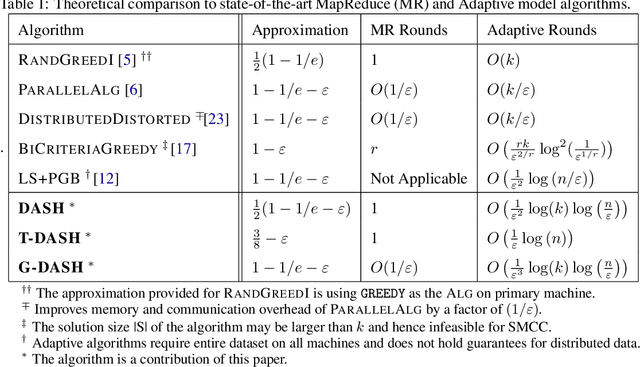
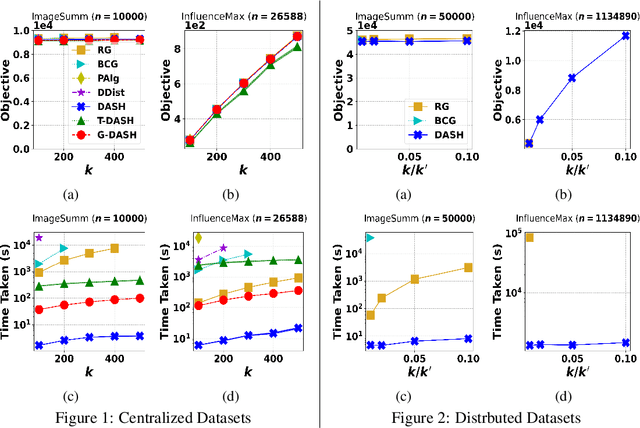
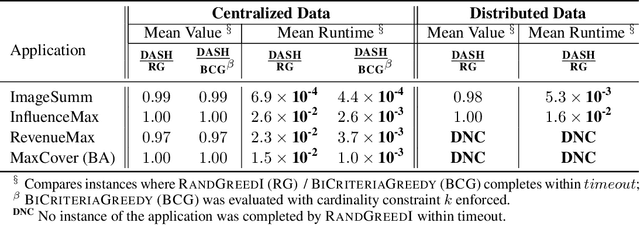
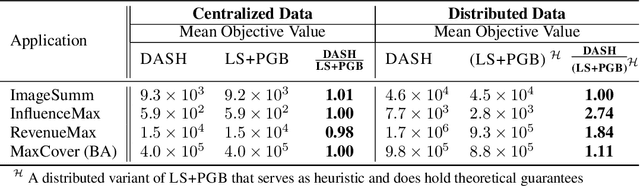
The development of parallelizable algorithms for monotone, submodular maximization subject to cardinality constraint (SMCC) has resulted in two separate research directions: centralized algorithms with low adaptive complexity, which require random access to the entire dataset; and distributed MapReduce (MR) model algorithms, that use a small number of MR rounds of computation. Currently, no MR model algorithm is known to use sublinear number of adaptive rounds which limits their practical performance. We study the SMCC problem in a distributed setting and present three separate MR model algorithms that introduce sublinear adaptivity in a distributed setup. Our primary algorithm, DASH achieves an approximation of $\frac{1}{2}(1-1/e-\varepsilon)$ using one MR round, while its multi-round variant METADASH enables MR model algorithms to be run on large cardinality constraints that were previously not possible. The two additional algorithms, T-DASH and G-DASH provide an improved ratio of ($\frac{3}{8}-\varepsilon$) and ($1-1/e-\varepsilon$) respectively using one and $(1/\varepsilon)$ MR rounds . All our proposed algorithms have sublinear adaptive complexity and we provide extensive empirical evidence to establish: DASH is orders of magnitude faster than the state-of-the-art distributed algorithms while producing nearly identical solution values; and validate the versatility of DASH in obtaining feasible solutions on both centralized and distributed data.
Best of Both Worlds: Practical and Theoretically Optimal Submodular Maximization in Parallel
Nov 15, 2021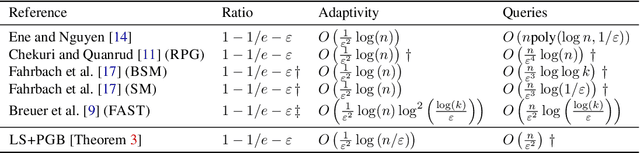
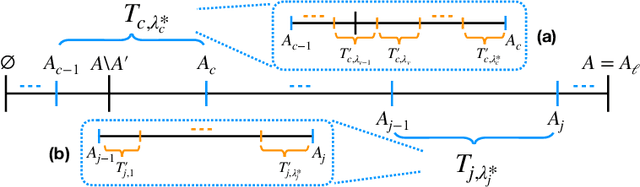
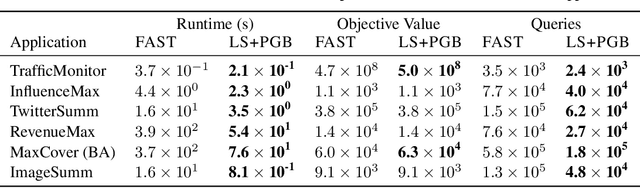
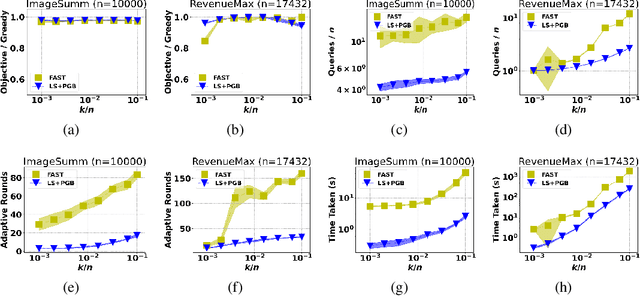
For the problem of maximizing a monotone, submodular function with respect to a cardinality constraint $k$ on a ground set of size $n$, we provide an algorithm that achieves the state-of-the-art in both its empirical performance and its theoretical properties, in terms of adaptive complexity, query complexity, and approximation ratio; that is, it obtains, with high probability, query complexity of $O(n)$ in expectation, adaptivity of $O(\log(n))$, and approximation ratio of nearly $1-1/e$. The main algorithm is assembled from two components which may be of independent interest. The first component of our algorithm, LINEARSEQ, is useful as a preprocessing algorithm to improve the query complexity of many algorithms. Moreover, a variant of LINEARSEQ is shown to have adaptive complexity of $O( \log (n / k) )$ which is smaller than that of any previous algorithm in the literature. The second component is a parallelizable thresholding procedure THRESHOLDSEQ for adding elements with gain above a constant threshold. Finally, we demonstrate that our main algorithm empirically outperforms, in terms of runtime, adaptive rounds, total queries, and objective values, the previous state-of-the-art algorithm FAST in a comprehensive evaluation with six submodular objective functions.