 Add to Chrome
 Add to Firefox
 Add to Edge
Memory-Augmented Vision-Language Agents for Persistent and Semantically Consistent Object Captioning
Mar 25, 2026
Vision-Language Models (VLMs) often yield inconsistent descriptions of the same object across viewpoints, hindering the ability of embodied agents to construct consistent semantic representations over time. Previous methods resolved inconsistencies using offline multi-view aggregation or multi-stage pipelines that decouple exploration, data association, and caption learning, with limited capacity to reason over previously observed objects. In this paper, we introduce a unified, memory-augmented Vision-Language agent that simultaneously handles data association, object captioning, and exploration policy within a single autoregressive framework. The model processes the current RGB observation, a top-down explored map, and an object-level episodic memory serialized into object-level tokens, ensuring persistent object identity and semantic consistency across extended sequences. To train the model in a self-supervised manner, we collect a dataset in photorealistic 3D environments using a disagreement-based policy and a pseudo-captioning model that enforces consistency across multi-view caption histories. Extensive evaluation on a manually annotated object-level test set, demonstrate improvements of up to +11.86% in standard captioning scores and +7.39% in caption self-similarity over baseline models, while enabling scalable performance through a compact scene representation. Code, model weights, and data are available at https://github.com/hsp-iit/epos-vlm

Embodied Image Captioning: Self-supervised Learning Agents for Spatially Coherent Image Descriptions
Apr 11, 2025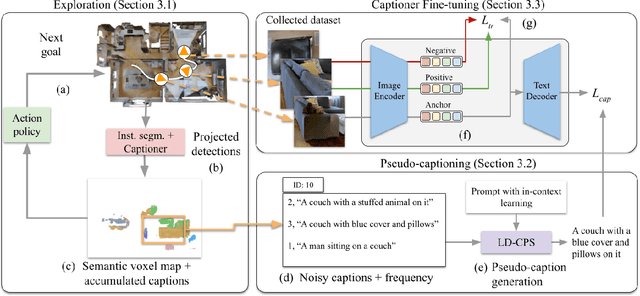
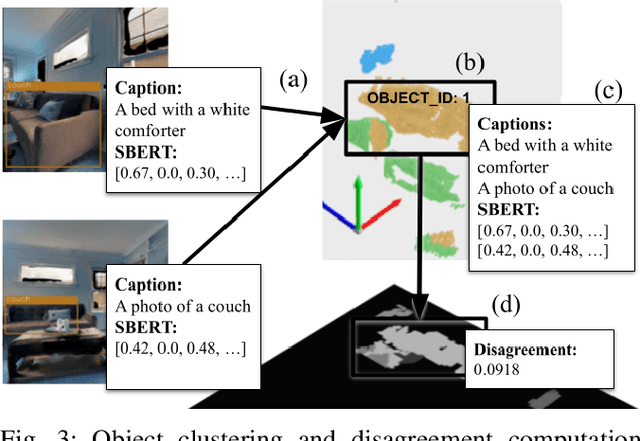
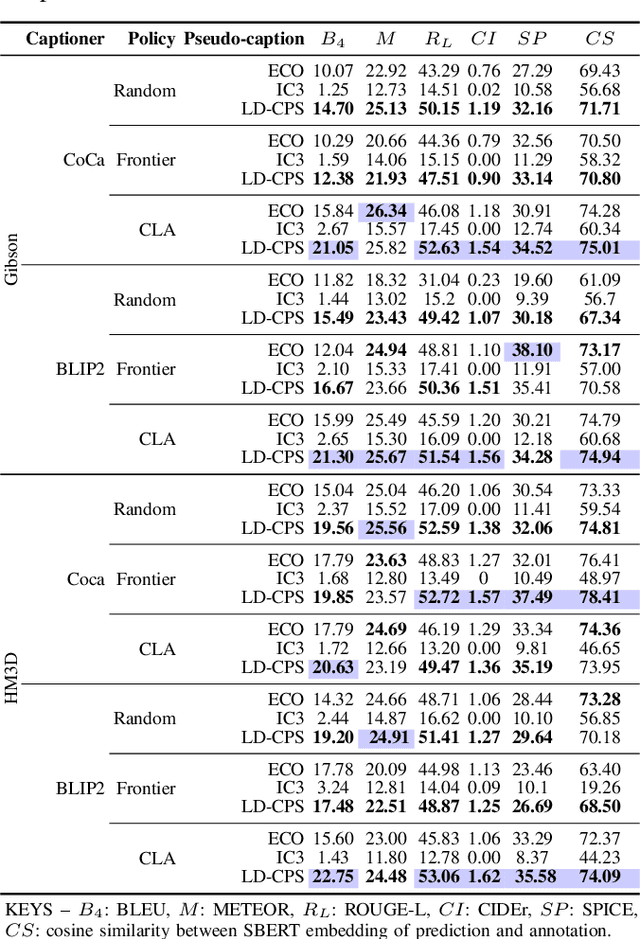
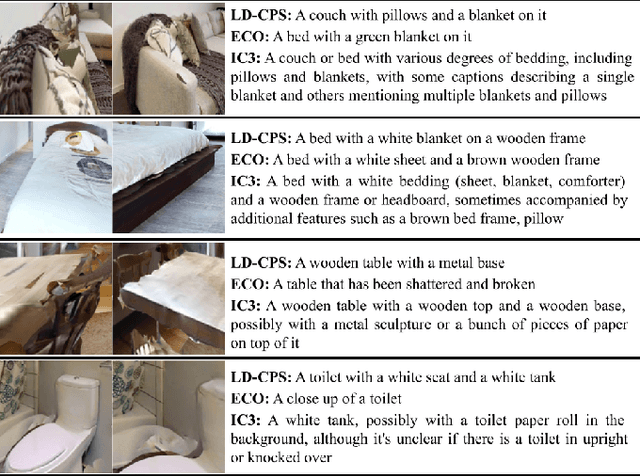
We present a self-supervised method to improve an agent's abilities in describing arbitrary objects while actively exploring a generic environment. This is a challenging problem, as current models struggle to obtain coherent image captions due to different camera viewpoints and clutter. We propose a three-phase framework to fine-tune existing captioning models that enhances caption accuracy and consistency across views via a consensus mechanism. First, an agent explores the environment, collecting noisy image-caption pairs. Then, a consistent pseudo-caption for each object instance is distilled via consensus using a large language model. Finally, these pseudo-captions are used to fine-tune an off-the-shelf captioning model, with the addition of contrastive learning. We analyse the performance of the combination of captioning models, exploration policies, pseudo-labeling methods, and fine-tuning strategies, on our manually labeled test set. Results show that a policy can be trained to mine samples with higher disagreement compared to classical baselines. Our pseudo-captioning method, in combination with all policies, has a higher semantic similarity compared to other existing methods, and fine-tuning improves caption accuracy and consistency by a significant margin. Code and test set annotations available at https://hsp-iit.github.io/embodied-captioning/