 Add to Chrome
 Add to Firefox
 Add to Edge
RadarGen: Automotive Radar Point Cloud Generation from Cameras
Dec 19, 2025
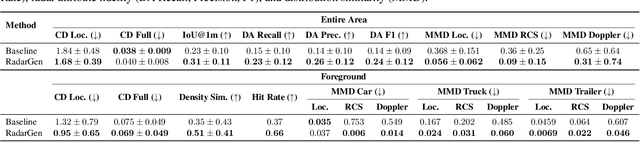
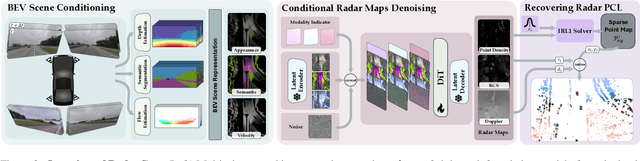
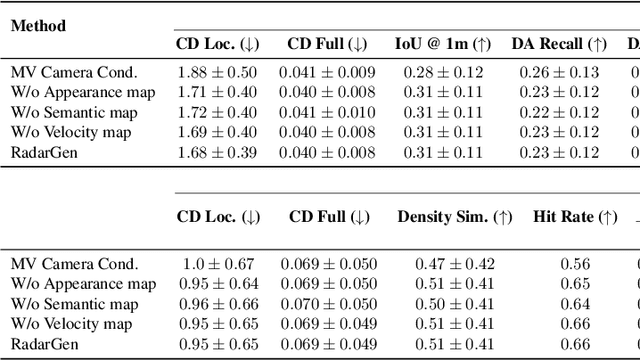
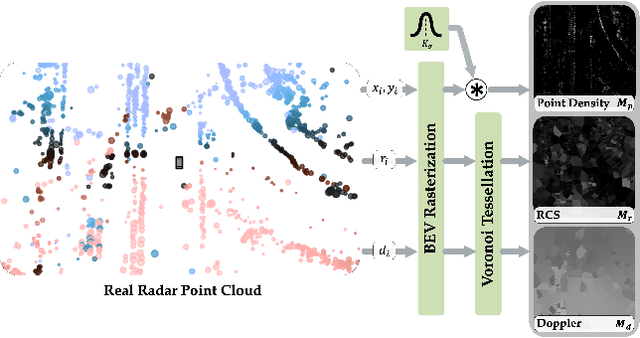
We present RadarGen, a diffusion model for synthesizing realistic automotive radar point clouds from multi-view camera imagery. RadarGen adapts efficient image-latent diffusion to the radar domain by representing radar measurements in bird's-eye-view form that encodes spatial structure together with radar cross section (RCS) and Doppler attributes. A lightweight recovery step reconstructs point clouds from the generated maps. To better align generation with the visual scene, RadarGen incorporates BEV-aligned depth, semantic, and motion cues extracted from pretrained foundation models, which guide the stochastic generation process toward physically plausible radar patterns. Conditioning on images makes the approach broadly compatible, in principle, with existing visual datasets and simulation frameworks, offering a scalable direction for multimodal generative simulation. Evaluations on large-scale driving data show that RadarGen captures characteristic radar measurement distributions and reduces the gap to perception models trained on real data, marking a step toward unified generative simulation across sensing modalities.

ReHub: Linear Complexity Graph Transformers with Adaptive Hub-Spoke Reassignment
Dec 02, 2024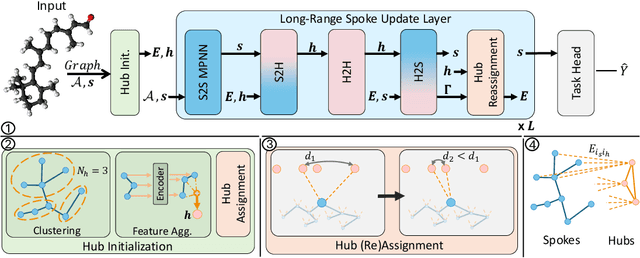
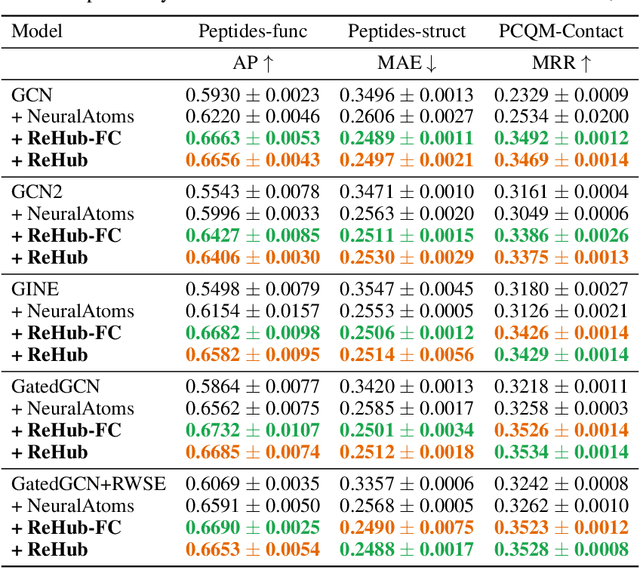
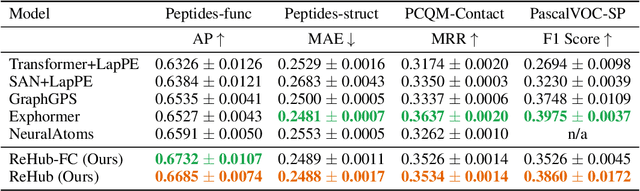
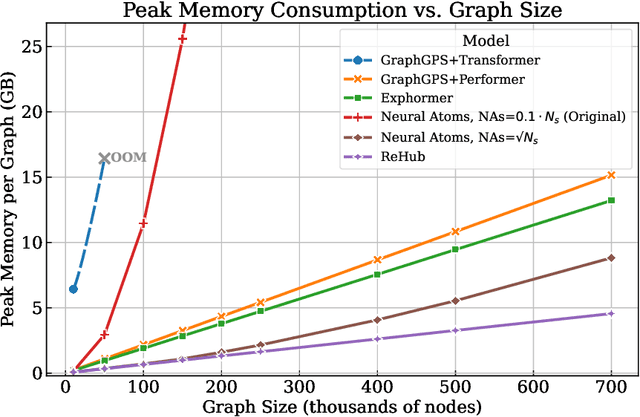
We present ReHub, a novel graph transformer architecture that achieves linear complexity through an efficient reassignment technique between nodes and virtual nodes. Graph transformers have become increasingly important in graph learning for their ability to utilize long-range node communication explicitly, addressing limitations such as oversmoothing and oversquashing found in message-passing graph networks. However, their dense attention mechanism scales quadratically with the number of nodes, limiting their applicability to large-scale graphs. ReHub draws inspiration from the airline industry's hub-and-spoke model, where flights are assigned to optimize operational efficiency. In our approach, graph nodes (spokes) are dynamically reassigned to a fixed number of virtual nodes (hubs) at each model layer. Recent work, Neural Atoms (Li et al., 2024), has demonstrated impressive and consistent improvements over GNN baselines by utilizing such virtual nodes; their findings suggest that the number of hubs strongly influences performance. However, increasing the number of hubs typically raises complexity, requiring a trade-off to maintain linear complexity. Our key insight is that each node only needs to interact with a small subset of hubs to achieve linear complexity, even when the total number of hubs is large. To leverage all hubs without incurring additional computational costs, we propose a simple yet effective adaptive reassignment technique based on hub-hub similarity scores, eliminating the need for expensive node-hub computations. Our experiments on LRGB indicate a consistent improvement in results over the base method, Neural Atoms, while maintaining a linear complexity. Remarkably, our sparse model achieves performance on par with its non-sparse counterpart. Furthermore, ReHub outperforms competitive baselines and consistently ranks among top performers across various benchmarks.