 Add to Chrome
 Add to Firefox
 Add to Edge
PaReGTA: An LLM-based EHR Data Encoding Approach to Capture Temporal Information
Feb 23, 2026
Temporal information in structured electronic health records (EHRs) is often lost in sparse one-hot or count-based representations, while sequence models can be costly and data-hungry. We propose PaReGTA, an LLM-based encoding framework that (i) converts longitudinal EHR events into visit-level templated text with explicit temporal cues, (ii) learns domain-adapted visit embeddings via lightweight contrastive fine-tuning of a sentence-embedding model, and (iii) aggregates visit embeddings into a fixed-dimensional patient representation using hybrid temporal pooling that captures both recency and globally informative visits. Because PaReGTA does not require training from scratch but instead utilizes a pre-trained LLM, it can perform well even in data-limited cohorts. Furthermore, PaReGTA is model-agnostic and can benefit from future EHR-specialized sentence-embedding models. For interpretability, we introduce PaReGTA-RSS (Representation Shift Score), which quantifies clinically defined factor importance by recomputing representations after targeted factor removal and projecting representation shifts through a machine learning model. On 39,088 migraine patients from the All of Us Research Program, PaReGTA outperforms sparse baselines for migraine type classification while deep sequential models were unstable in our cohort.

DinoAtten3D: Slice-Level Attention Aggregation of DinoV2 for 3D Brain MRI Anomaly Classification
Sep 15, 2025Anomaly detection and classification in medical imaging are critical for early diagnosis but remain challenging due to limited annotated data, class imbalance, and the high cost of expert labeling. Emerging vision foundation models such as DINOv2, pretrained on extensive, unlabeled datasets, offer generalized representations that can potentially alleviate these limitations. In this study, we propose an attention-based global aggregation framework tailored specifically for 3D medical image anomaly classification. Leveraging the self-supervised DINOv2 model as a pretrained feature extractor, our method processes individual 2D axial slices of brain MRIs, assigning adaptive slice-level importance weights through a soft attention mechanism. To further address data scarcity, we employ a composite loss function combining supervised contrastive learning with class-variance regularization, enhancing inter-class separability and intra-class consistency. We validate our framework on the ADNI dataset and an institutional multi-class headache cohort, demonstrating strong anomaly classification performance despite limited data availability and significant class imbalance. Our results highlight the efficacy of utilizing pretrained 2D foundation models combined with attention-based slice aggregation for robust volumetric anomaly detection in medical imaging. Our implementation is publicly available at https://github.com/Rafsani/DinoAtten3D.git.
Brainomaly: Unsupervised Neurologic Disease Detection Utilizing Unannotated T1-weighted Brain MR Images
Feb 18, 2023Deep neural networks have revolutionized the field of supervised learning by enabling accurate predictions through learning from large annotated datasets. However, acquiring large annotated medical imaging datasets is a challenging task, especially for rare diseases, due to the high cost, time, and effort required for annotation. In these scenarios, unsupervised disease detection methods, such as anomaly detection, can save significant human effort. A typically used approach for anomaly detection is to learn the images from healthy subjects only, assuming the model will detect the images from diseased subjects as outliers. However, in many real-world scenarios, unannotated datasets with a mix of healthy and diseased individuals are available. Recent studies have shown improvement in unsupervised disease/anomaly detection using such datasets of unannotated images from healthy and diseased individuals compared to datasets that only include images from healthy individuals. A major issue remains unaddressed in these studies, which is selecting the best model for inference from a set of trained models without annotated samples. To address this issue, we propose Brainomaly, a GAN-based image-to-image translation method for neurologic disease detection using unannotated T1-weighted brain MRIs of individuals with neurologic diseases and healthy subjects. Brainomaly is trained to remove the diseased regions from the input brain MRIs and generate MRIs of corresponding healthy brains. Instead of generating the healthy images directly, Brainomaly generates an additive map where each voxel indicates the amount of changes required to make the input image look healthy. In addition, Brainomaly uses a pseudo-AUC metric for inference model selection, which further improves the detection performance. Our Brainomaly outperforms existing state-of-the-art methods by large margins.
Generalizable Natural Language Processing Framework for Migraine Reporting from Social Media
Dec 23, 2022
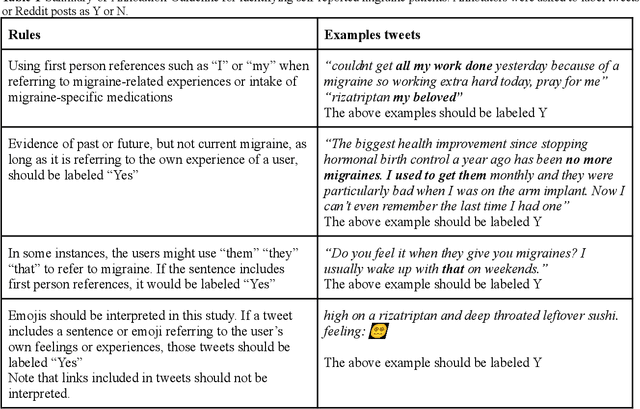
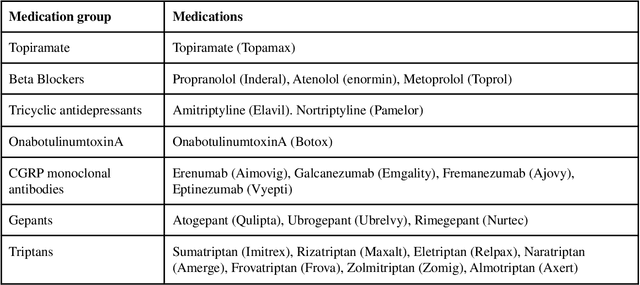

Migraine is a high-prevalence and disabling neurological disorder. However, information migraine management in real-world settings could be limited to traditional health information sources. In this paper, we (i) verify that there is substantial migraine-related chatter available on social media (Twitter and Reddit), self-reported by migraine sufferers; (ii) develop a platform-independent text classification system for automatically detecting self-reported migraine-related posts, and (iii) conduct analyses of the self-reported posts to assess the utility of social media for studying this problem. We manually annotated 5750 Twitter posts and 302 Reddit posts. Our system achieved an F1 score of 0.90 on Twitter and 0.93 on Reddit. Analysis of information posted by our 'migraine cohort' revealed the presence of a plethora of relevant information about migraine therapies and patient sentiments associated with them. Our study forms the foundation for conducting an in-depth analysis of migraine-related information using social media data.