 Add to Chrome
 Add to Firefox
 Add to Edge
Bridging Natural Language and Microgrid Dynamics: A Context-Aware Simulator and Dataset
Apr 07, 2026
Addressing the critical need for intelligent, context-aware energy management in renewable systems, we introduce the \textbf{OpenCEM Simulator and Dataset}: the first open-source digital twin explicitly designed to integrate rich, unstructured contextual information with quantitative renewable energy dynamics. Traditional energy management relies heavily on numerical time series, thereby neglecting the significant predictive power embedded in human-generated context (e.g., event schedules, system logs, user intentions). OpenCEM bridges this gap by offering a unique platform comprising both a meticulously aligned, language-rich dataset from a real-world PV-and-battery microgrid installation and a modular simulator capable of natively processing this multi-modal context. The OpenCEM Simulator provides a high-fidelity environment for developing and validating novel control algorithms and prediction models, particularly those leveraging Large Language Models. We detail its component-based architecture, hybrid data-driven and physics-based modelling capabilities, and demonstrate its utility through practical examples, including context-aware load forecasting and the implementation of online optimal battery charging control strategies. By making this platform publicly available, OpenCEM aims to accelerate research into the next generation of intelligent, sustainable, and truly context-aware energy systems.

Rethinking the Unsolvable: When In-Context Search Meets Test-Time Scaling
May 28, 2025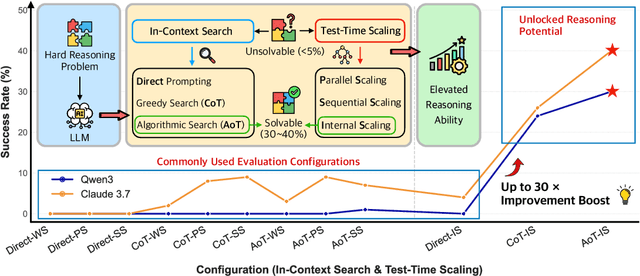
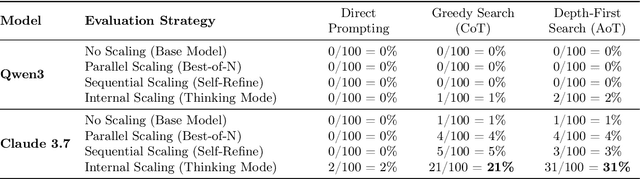
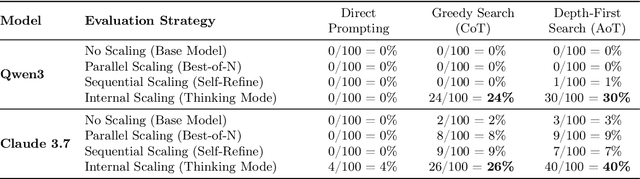
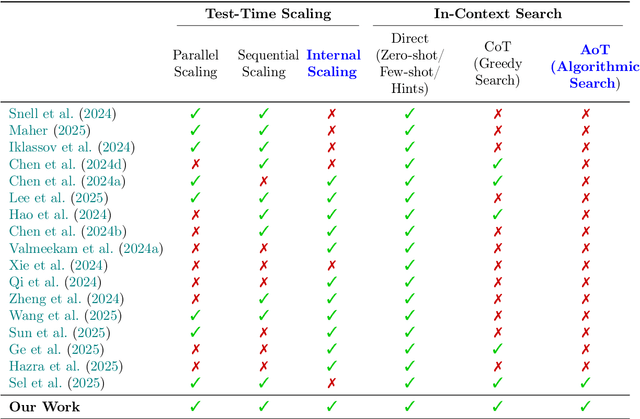
Recent research has highlighted that Large Language Models (LLMs), even when trained to generate extended long reasoning steps, still face significant challenges on hard reasoning problems. However, much of the existing literature relies on direct prompting with simple in-context learning examples for evaluation, which largely overlooks advanced techniques to elicit LLMs' deliberate reasoning before drawing conclusions that LLMs hit a performance ceiling. In this paper, we systematically explore the combined potential of in-context search and test-time scaling on super hard reasoning tasks. We find that by employing advanced in-context search prompting to LLMs augmented with internal scaling, one can achieve transformative performance breakthroughs on tasks previously deemed "unsolvable" (e.g., reported success rates below 5%). We provide both empirical results and theoretical analysis of how this combination can unleash LLM reasoning capabilities: i) Empirically, on controlled NP-hard tasks and complex real-world planning benchmarks, our approach achieves up to a 30x improvement in success rates compared to previously reported results without any external mechanisms; ii) Theoretically, we show that in-context search prompting, when combined with internal scaling, significantly extends the complexity class of solvable reasoning problems. These findings challenge prevailing assumptions about the limitations of LLMs on complex tasks, indicating that current evaluation paradigms systematically underestimate their true potential. Our work calls for a critical reassessment of how LLM reasoning is benchmarked and a more robust evaluation strategy that fully captures the true capabilities of contemporary LLMs, which can lead to a better understanding of their operational reasoning boundaries in real-world deployments.