 Add to Chrome
 Add to Firefox
 Add to Edge
RAM: Reachability Across Morphologies
Jun 08, 2026
Many stages of the robotic lifecycle, from morphology synthesis to operation, rely fundamentally on the reachable workspace. However, current methods for approximating workspaces are slow, imprecise, or tied to a single morphology. We introduce Reachability Across Morphologies (RAM): a morphology-conditioned, implicit neural representation that acts as a fast, differentiable surrogate for pose reachability, generalising to unseen morphologies while inherently accounting for self-collisions. To train RAM, we publish a large-scale dataset of $3\cdot10^{10}$ samples generated solely from forward kinematics. Experiments show that our model achieves an $ F_1$-score of $86\%$ at nanosecond inference, outperforming the baseline by $14\%$ while reducing inference time by three orders of magnitude. We further demonstrate speed-ups of one and two orders of magnitude for gradient-based morphology and trajectory optimisation, respectively. Website: https://timwalter.github.io/ram.

NeRSemble: Multi-view Radiance Field Reconstruction of Human Heads
May 04, 2023
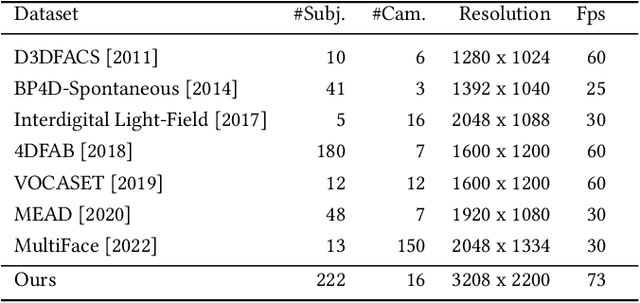


We focus on reconstructing high-fidelity radiance fields of human heads, capturing their animations over time, and synthesizing re-renderings from novel viewpoints at arbitrary time steps. To this end, we propose a new multi-view capture setup composed of 16 calibrated machine vision cameras that record time-synchronized images at 7.1 MP resolution and 73 frames per second. With our setup, we collect a new dataset of over 4700 high-resolution, high-framerate sequences of more than 220 human heads, from which we introduce a new human head reconstruction benchmark. The recorded sequences cover a wide range of facial dynamics, including head motions, natural expressions, emotions, and spoken language. In order to reconstruct high-fidelity human heads, we propose Dynamic Neural Radiance Fields using Hash Ensembles (NeRSemble). We represent scene dynamics by combining a deformation field and an ensemble of 3D multi-resolution hash encodings. The deformation field allows for precise modeling of simple scene movements, while the ensemble of hash encodings helps to represent complex dynamics. As a result, we obtain radiance field representations of human heads that capture motion over time and facilitate re-rendering of arbitrary novel viewpoints. In a series of experiments, we explore the design choices of our method and demonstrate that our approach outperforms state-of-the-art dynamic radiance field approaches by a significant margin.