 Add to Chrome
 Add to Firefox
 Add to Edge
Entropy Minimization without Model Collapse: Mitigating Prediction Bias in Medical Imaging
Jun 01, 2026
Entropy minimization (EM) is the dominant objective for test-time adaptation, yet its failure mode, model collapse, remains poorly understood. In this work, we show that distribution shifts can cause feature clusters corresponding to distinct classes in the model's representation space to merge, while the decision boundary remains fixed. This induces a systematic skew in the predicted class distribution, referred to as prediction bias. Prediction bias refers to a shift in the predicted class distribution, with some classes overrepresented and others suppressed. We show that entropy minimization amplifies this prediction bias by tightening the existing clusters, reinforcing the incorrect groupings until all predictions collapse to a trivial solution. Next, to demonstrate the significance of prediction bias and mitigate it, we further propose Distribution Shift Bias Reduction (DSBR), a bias-correcting objective that specifically targets this failure mode by equalizing the contribution of each predicted class to the unsupervised entropy minimization loss. To study this failure mode, we design suitable adaptation settings using four medical-imaging datasets and additionally evaluate on ImageNet-C. We find that DSBR consistently stabilizes test-time adaptation, prevents model collapse, and matches or outperforms state-of-the-art methods. Moreover, DSBR operates solely at test-time.

Antithetic Sampling for Top-k Shapley Identification
Apr 02, 2025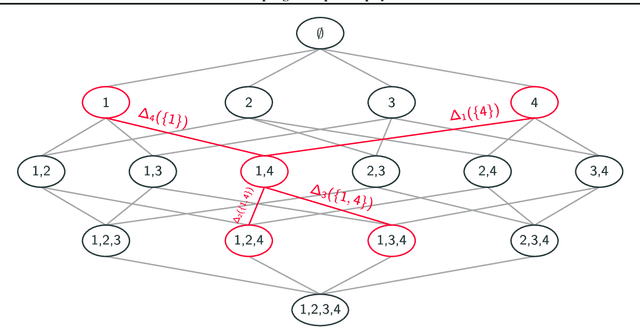
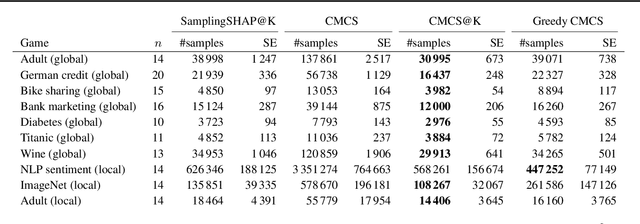
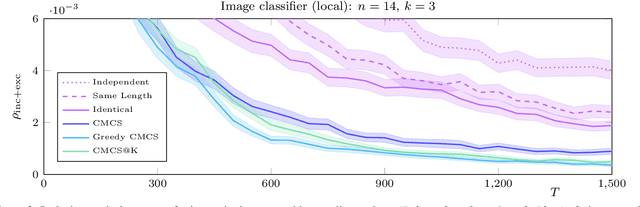
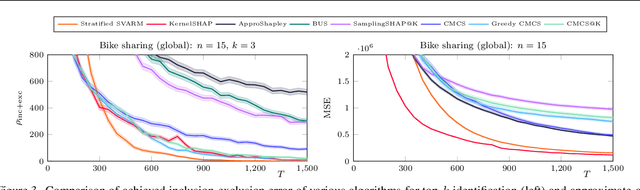
Additive feature explanations rely primarily on game-theoretic notions such as the Shapley value by viewing features as cooperating players. The Shapley value's popularity in and outside of explainable AI stems from its axiomatic uniqueness. However, its computational complexity severely limits practicability. Most works investigate the uniform approximation of all features' Shapley values, needlessly consuming samples for insignificant features. In contrast, identifying the $k$ most important features can already be sufficiently insightful and yields the potential to leverage algorithmic opportunities connected to the field of multi-armed bandits. We propose Comparable Marginal Contributions Sampling (CMCS), a method for the top-$k$ identification problem utilizing a new sampling scheme taking advantage of correlated observations. We conduct experiments to showcase the efficacy of our method in compared to competitive baselines. Our empirical findings reveal that estimation quality for the approximate-all problem does not necessarily transfer to top-$k$ identification and vice versa.