 Add to Chrome
 Add to Firefox
 Add to Edge
Self-evolving network verifiers
Aug 11, 2026
Symbolic network verifiers can reason about correctness across vast spaces of routing inputs and failures, but only for the protocols and features an expert has encoded by hand. Creating and maintaining a faithful model of the control plane is both difficult and never-ending, since no written source specifies perfectly what a network does: vendor implementations deviate from the RFCs, and behaviour shifts with releases. The burden of constant upkeep ultimately keeps verification out of many networks that need it. We argue that the model should instead evolve automatically to faithfully capture the actual network behaviour. To achieve that, we leverage the only source that specifies it unambiguously: the router software itself. In a counterexample-guided loop, a coding agent proposes extensions to the verifier's symbolic encoding, while a trusted oracle (e.g., emulated routers) supplies the ground-truth routing state. The agent iteratively refines the network model using each disagreement with the oracle. As early evidence, a prototype of this system taught a 3,000-line SMT-based verifier three features it did not support: OSPF areas, BGP route reflection, and L3VPN over EVPN, converging autonomously on models that match the oracle, even noticing vendor-specific behaviour. Automating model growth shifts the hard problem from writing verification systems to systematically testing them; we propose a research agenda for trusting and harnessing automatically evolved verifiers.

Sub-100uW Multispectral Riemannian Classification for EEG-based Brain--Machine Interfaces
Dec 18, 2021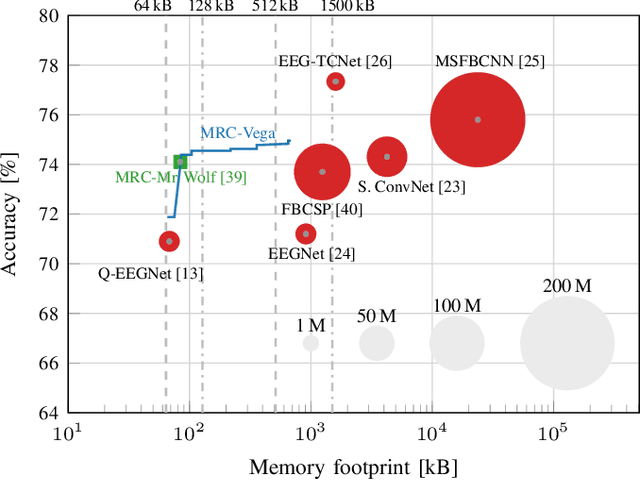
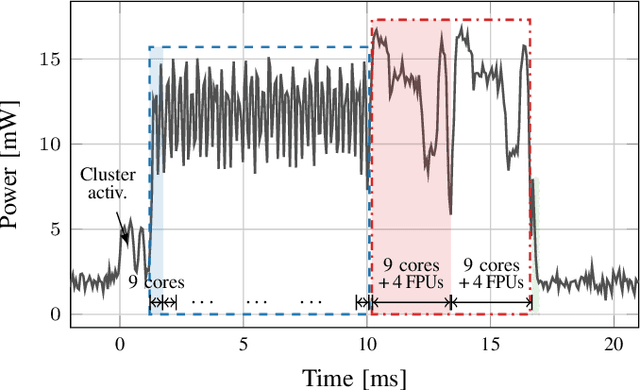
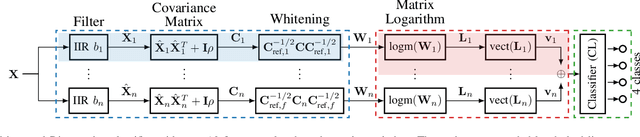
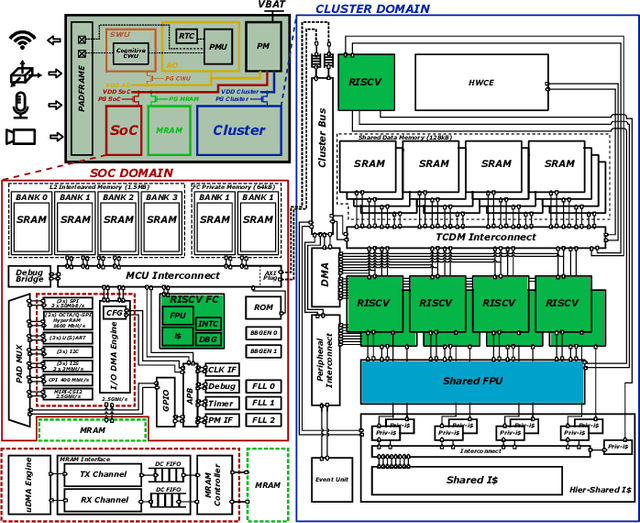
Motor imagery brain--machine interfaces enable us to control machines by merely thinking of performing a motor action. Practical use cases require a wearable solution where the classification of the brain signals is done locally near the sensor using machine learning models embedded on energy-efficient microcontroller units, for assured privacy, user comfort, and long-term usage. In this work, we provide practical insights on the accuracy-cost trade-off for embedded BMI solutions. Our multispectral Riemannian classifier reaches 75.1% accuracy on a 4-class MI task. The accuracy is further improved by tuning different types of classifiers to each subject, achieving 76.4%. We further scale down the model by quantizing it to mixed-precision representations with a minimal accuracy loss of 1% and 1.4%, respectively, which is still up to 4.1% more accurate than the state-of-the-art embedded convolutional neural network. We implement the model on a low-power MCU within an energy budget of merely 198uJ and taking only 16.9ms per classification. Classifying samples continuously, overlapping the 3.5s samples by 50% to avoid missing user inputs allows for operation at just 85uW. Compared to related works in embedded MI-BMIs, our solution sets the new state-of-the-art in terms of accuracy-energy trade-off for near-sensor classification.
Mixed-Precision Quantization and Parallel Implementation of Multispectral Riemannian Classification for Brain--Machine Interfaces
Feb 22, 2021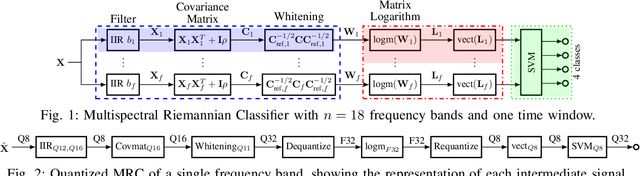
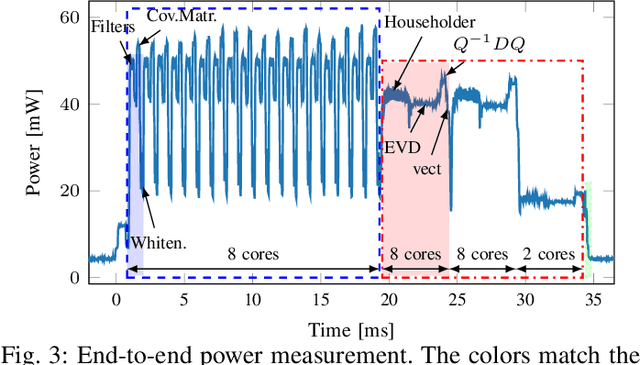
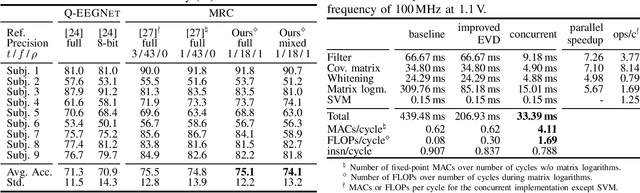
With Motor-Imagery (MI) Brain--Machine Interfaces (BMIs) we may control machines by merely thinking of performing a motor action. Practical use cases require a wearable solution where the classification of the brain signals is done locally near the sensor using machine learning models embedded on energy-efficient microcontroller units (MCUs), for assured privacy, user comfort, and long-term usage. In this work, we provide practical insights on the accuracy-cost tradeoff for embedded BMI solutions. Our proposed Multispectral Riemannian Classifier reaches 75.1% accuracy on 4-class MI task. We further scale down the model by quantizing it to mixed-precision representations with a minimal accuracy loss of 1%, which is still 3.2% more accurate than the state-of-the-art embedded convolutional neural network. We implement the model on a low-power MCU with parallel processing units taking only 33.39ms and consuming 1.304mJ per classification.
Q-EEGNet: an Energy-Efficient 8-bit Quantized Parallel EEGNet Implementation for Edge Motor-Imagery Brain--Machine Interfaces
Apr 24, 2020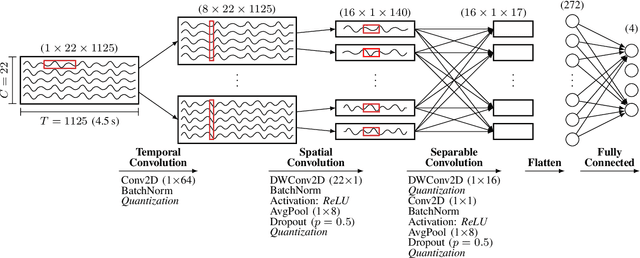
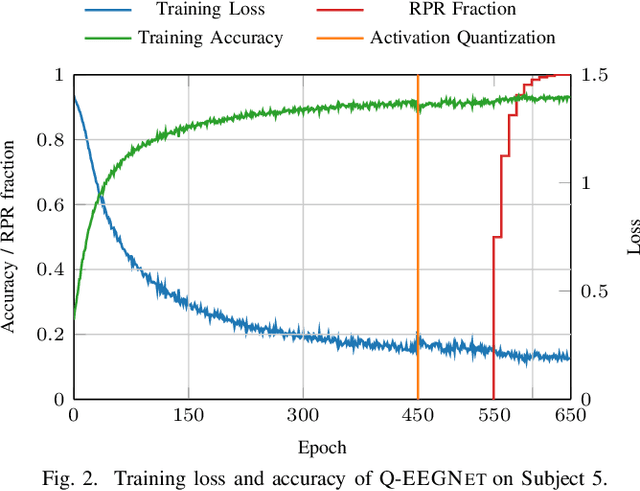
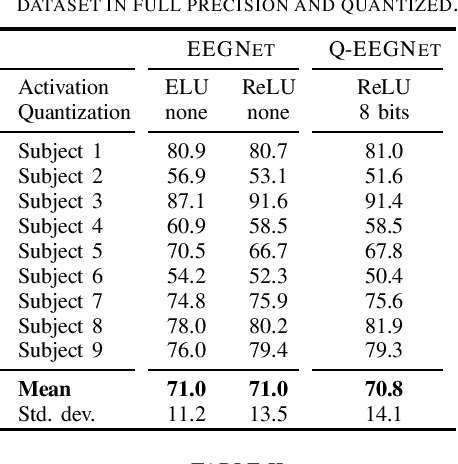
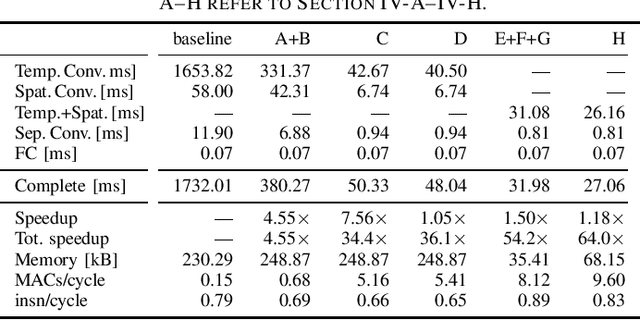
Motor-Imagery Brain-Machine Interfaces (MI-BMIs) promise direct and accessible communication between human brains and machines by analyzing brain activities recorded with Electroencephalography (EEG). Latency, reliability, and privacy constraints make it unsuitable to offload the computation to the cloud. Practical use cases demand a wearable, battery-operated device with a low average power consumption for long-term use. Recently, sophisticated algorithms, in particular deep learning models, have emerged for classifying EEG signals. While reaching outstanding accuracy, these models often exceed the limitations of edge devices due to their memory and computational requirements. In this paper, we demonstrate algorithmic and implementation optimizations for EEGNET, a compact Convolutional Neural Network (CNN) suitable for many BMI paradigms. We quantize weights and activations to 8-bit fixed-point with a negligible accuracy loss of 0.2% on 4-class MI, and present an energy-efficient hardware-aware implementation on the Mr.Wolf parallel ultra-low power (PULP) System-on-Chip (SoC) by utilizing its custom RISC-V ISA extensions and 8-core compute cluster. With our proposed optimization steps, we can obtain an overall speedup of 64x and a reduction of up to 85% in memory footprint with respect to a single-core layer-wise baseline implementation. Our implementation takes only 5.82 ms and consumes 0.627 mJ per inference. With 20.692GMAC/s/W, it is 252x more energy-efficient than an EEGNET implementation on an ARM Cortex-M7 (0.082GMAC/s/W).