 Add to Chrome
 Add to Firefox
 Add to Edge
Self-evolving network verifiers
Aug 11, 2026
Symbolic network verifiers can reason about correctness across vast spaces of routing inputs and failures, but only for the protocols and features an expert has encoded by hand. Creating and maintaining a faithful model of the control plane is both difficult and never-ending, since no written source specifies perfectly what a network does: vendor implementations deviate from the RFCs, and behaviour shifts with releases. The burden of constant upkeep ultimately keeps verification out of many networks that need it. We argue that the model should instead evolve automatically to faithfully capture the actual network behaviour. To achieve that, we leverage the only source that specifies it unambiguously: the router software itself. In a counterexample-guided loop, a coding agent proposes extensions to the verifier's symbolic encoding, while a trusted oracle (e.g., emulated routers) supplies the ground-truth routing state. The agent iteratively refines the network model using each disagreement with the oracle. As early evidence, a prototype of this system taught a 3,000-line SMT-based verifier three features it did not support: OSPF areas, BGP route reflection, and L3VPN over EVPN, converging autonomously on models that match the oracle, even noticing vendor-specific behaviour. Automating model growth shifts the hard problem from writing verification systems to systematically testing them; we propose a research agenda for trusting and harnessing automatically evolved verifiers.

Evaluating Agentic Configuration Repair for Computer Networks
Jun 04, 2026Misconfigurations in computer networks remain a major source of critical Internet outages. Research is turning to Large Language Models (LLMs) to automate the complex, error-prone task of network configuration. However, even state-of-the-art models fail to resolve misconfigurations in large-scale, complex scenarios and often introduce new errors. In this work, we benchmark open- and closed-source LLMs augmented with formal network verification and context retrieval tools. We demonstrate that agentic architectures outperform base LLMs in repair efficacy (by 12% on average) and safety (by 17% on average), enabled by the ability to dynamically manage context and iteratively validate configuration repairs.
Learning to Configure Computer Networks with Neural Algorithmic Reasoning
Oct 26, 2022We present a new method for scaling automatic configuration of computer networks. The key idea is to relax the computationally hard search problem of finding a configuration that satisfies a given specification into an approximate objective amenable to learning-based techniques. Based on this idea, we train a neural algorithmic model which learns to generate configurations likely to (fully or partially) satisfy a given specification under existing routing protocols. By relaxing the rigid satisfaction guarantees, our approach (i) enables greater flexibility: it is protocol-agnostic, enables cross-protocol reasoning, and does not depend on hardcoded rules; and (ii) finds configurations for much larger computer networks than previously possible. Our learned synthesizer is up to 490x faster than state-of-the-art SMT-based methods, while producing configurations which on average satisfy more than 93% of the provided requirements.
A new hope for network model generalization
Jul 12, 2022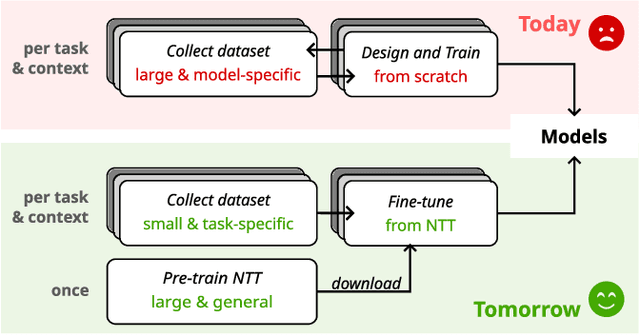
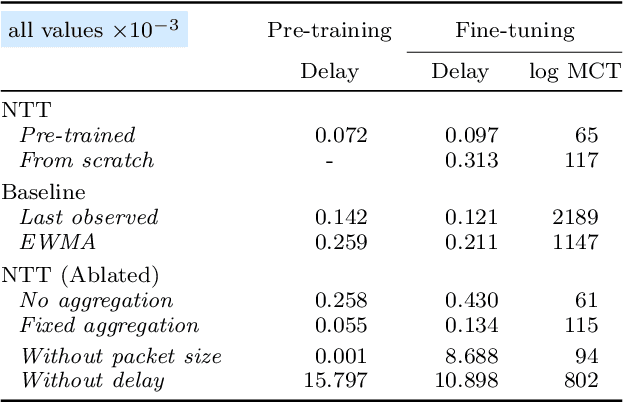
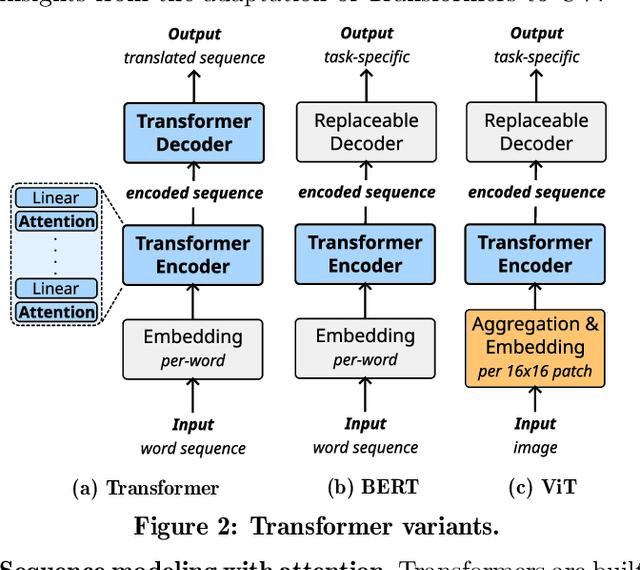
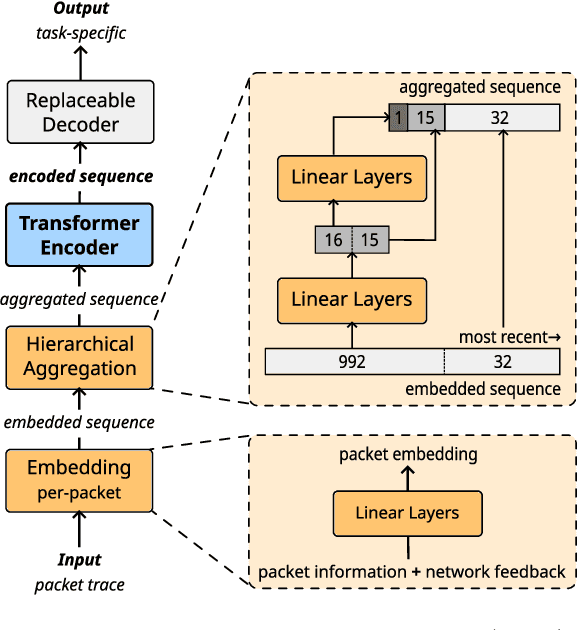
Generalizing machine learning (ML) models for network traffic dynamics tends to be considered a lost cause. Hence, for every new task, we often resolve to design new models and train them on model-specific datasets collected, whenever possible, in an environment mimicking the model's deployment. This approach essentially gives up on generalization. Yet, an ML architecture called_Transformer_ has enabled previously unimaginable generalization in other domains. Nowadays, one can download a model pre-trained on massive datasets and only fine-tune it for a specific task and context with comparatively little time and data. These fine-tuned models are now state-of-the-art for many benchmarks. We believe this progress could translate to networking and propose a Network Traffic Transformer (NTT), a transformer adapted to learn network dynamics from packet traces. Our initial results are promising: NTT seems able to generalize to new prediction tasks and contexts. This study suggests there is still hope for generalization, though it calls for a lot of future research.